

Hello, Monday morning.1 Good to see you! Welcome!
If it’s a Monday morning, it must be time to deliver another of the weekly newsletters for Special Education Today. Ding! Ding! Here ‘tis! This is the 28th newsletter of the fifth volume, and it covers the week that began 5 January 2026. Consistent with previous issues of the SET newsletter, this issue will include a photo, some notes about the status of the community, a catalog of the week’s posts, and some comments.
Let’s get cracking!
Photo
At Pat’s urging, I looked out a window of the SET office and caught sight of this visitor to the back yard.
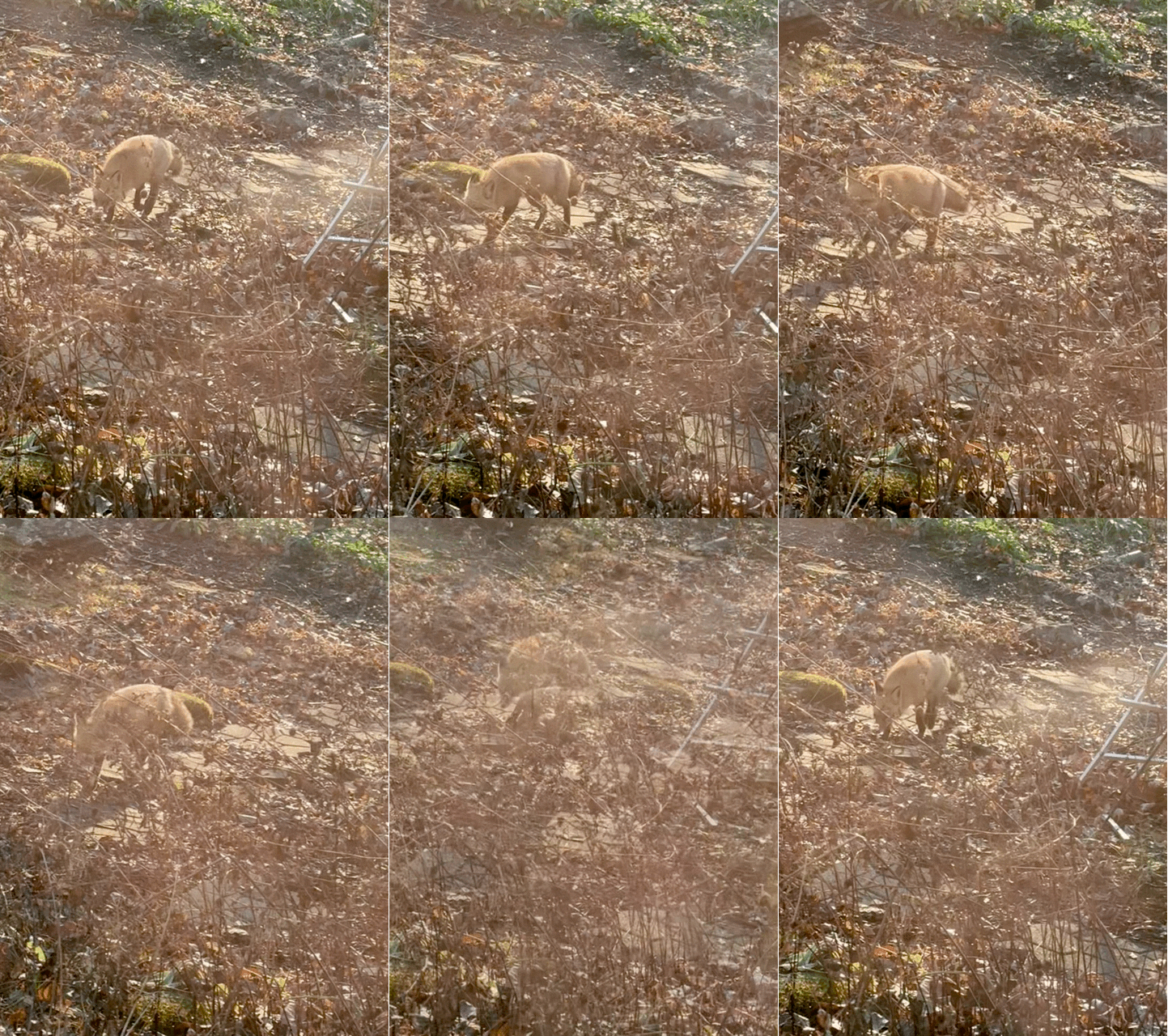
There have been a pair of foxes coming to eat bird seed that has fallen from the feeders hanging from our porch. Pat has a lovely earlier photo of one (same? different?) curled into a ball and napping about 10 meters north of the spot where this one was trotting past my window.
The creek on the east boundary of our yard functions a bit like a highway for wildlife. There are lots of birds, of course. We have also had black bears as well as the more common dear, raccoon, opossum, skunk, terrapin, (ubiquitous) squirrels, and others (see 30 October 2023 for a couple of views of the area).
Sometimes our cats (they only venture out of the house onto enclosed porches) will watch the wildlife out the windows. They get pretty alert when they spot the foxes.
Status report
In this week’s Department of Thanks, there are quite a few because there because there was a goodly bit of activity. Here’s are some notes:
Welcomes to Rob O’N. and Nour A., who became paid supporters this past week. 2They join other subscribers including (but not limited to) Angelique W., Amanda H., Ann R., Anna O., Bev J., Bob P., Callie O., Candace S., Christy A., Clay K., Dan H., Debbie R., Ed M., Ed P., Eileen F., Isabel G., Jane N., Jen W., Jean S., Jenni R., [the late] Jim K., Jim P., Jim S., Joel M., Kimberly B., Kimmy L., Kristen McM., Kristin S., Larry M., Linda L., Luann D., Lucinda S., Marilyn F., Mary R., Maryann L., Michael K., Mike N., Nancy C.-W., Paige P., Pam S., Pei Jung H., Riley M., Roberta B., Susan S., Susan O., Tina C., and Vicki W.
Comments & replies by Doug C., Joel M.,Laura McK., Tim H., Jane B. (twice), and Jean S.. These are the Dear Readers who make my day; I greatly appreciate your interactions with the content. And, for those who wonder if you’re recognizing the names: Yes, these Dear Readers represent some of the widely known people who read SET and it’s flattering to have them in our community.
Welcome, also, to the 20 or 25 new subscribers at the free level. It’s great to have y’all on the decks. Enjoy poking around and please let me know how you learned about SET.
Also, please note that SET is, indeed, an international community. To be sure, over 80% of subscribers come from the USA. However, there are at least one and up to 35 subscribers from the following countries:3 Australia, the UK, Canada, Morocco, Taiwan, Portugal, Italy, France, Germany, Nigeria, Mexico, Costa Rica, Chile, Argentina, Brazil, Chana, Tunisia, Netherlands, Luxembourg, Norway, Poland, Ukraine, Romania, Lebanon, Cyprus, Turkey, Saudi Arabia, Pakistan, India, Vietnam, Myanmar…and I may have missed a few.
There were > 6300 reads of posts on SET last week. As I’ve noted before, because one person might read multiple posts, I don’t know how many visitors made those reads.
Things seem to be picking back up after the slow period over the end of the year. For all y’all who visited and read something, thanks. And please tell folks to join in the fun and frivolity. Share SET!
Spedlettes
In this section (once known as “table of contents” before Joel M. savvily renamed it), I have a list of the posts from last week. Initials for the authors are in brackets after each item. It was not a slow week for SET. Alert readers probably saw all 11 posts during the week. In case you missed any, here is a list with links.
Special Education Today newsletter 5(27): Here are the updates for the first week of 2025 ) [JWL]
Happy b’day to TeachEffectively.com: Here’s a post about a predecessor to SET [JWL]
Brain scan study helps clarify effects of stimulants: Do some of the findings challenge popular concepts about how stimulants work? [JWL]
ASAT Newsletter yet again!: Want can one learn regarding evidence-based practices for autism from this first of the year instance of the venerable newsletter? [JWL]
Tribute to Joanna Ross: What should we know about a UK teacher? [JWL]
Sped law resources: Are you interested in perusing materials about legal developments? [JWL]
Remembering the times of PARC: Could anyone use a refresher on the world of children with disabilities when advocates chased their civil rights? [JWL, DB]
Readers can keep up with the latest posts by going to the home page for SET. Even if we don’t send a post to subscribers by e-mail, I post them all on the Web site. Oh! And I encourage readers to get the Substack app for their portable devices so that all their Substack subscriptions can be readily available.
Free subscribers have access to the newest notes for a limited time. Paying subscribers have access to all the current and all the previous ~1500 notes in the archives. These weekly newsletters are available for free in the archives.
Comments
Seeing the fox out my office window reminded me of an article I read in Science this past week. Shany Dror, Ádám Miklósi, Boglárka Morvai, Andreea-Silvia Năstase, and Claudia Fugazza published a paper entitled “Dogs with a large vocabulary of object labels learn new labels by overhearing like 1.5-year-old infants 8 January 2025, The title pretty much tells the story.
Children as young as 18 months can acquire novel words by overhearing third-party interactions. Demonstrating similar learning processes in nonhuman species would indicate that the social-cognitive skills supporting this process are not exclusively human but may have evolved, or can develop, in other species, offering valuable insights into the origins of language-related cognition. In this study, we demonstrated that a small group of Gifted Word Learner dogs, which possess an extensive vocabulary of object labels, can learn new labels by overhearing their owners’ interactions. Moreover, we show that these dogs can acquire novel object-label mappings even when the labels and objects are not presented simultaneously. Taken together, these results suggest that Gifted Word Learner dogs possess sociocognitive skills functionally parallel to those of 18-month-old children.
That’s right, the dogs essentially learned labels for some toys indirectly (i.e., without some of the trappings of explicit instruction). It’s a pretty cool demonstration of the effects of incidental instruction. Indeed, although the study by Dror et al. was with “gifted dogs” (their term, not mine!), we special educators have known about the observational learning process for some time from studies with students with disabilities (see, e.g., Farmer et al., 1991; Ledford & Wolery, 2015).
Oh, and by the way, it’s not really necessary to rely on cognitive psychology to understand what’s happening. All one has to do is follow the teaching processes. That is to say, the learning by the dogs is a product of behavioral processes. There are demonstrations, practice, and rewards.
And, yes, I could go on and on about these and other matters. But, I shan’t in this issue. Check back in the coming weeks, though…I might just go into a full-fledged rant! In the mean time, please remember to take care of each other, stay safe, and teach your children well (both during explicit and indirect instruction).
References
Dror, S., Miklósi, Á., Morvai, B., Năstase, A. S., & Fugazza, C. (2026). Dogs with a large vocabulary of object labels learn new labels by overhearing like 1.5-year-old infants. Science, 391(6781), 160-163. https://doi.org/10.1126/science.adq5474
Farmer, J. A., Gast, D. L., Wolery, M., & Winterling, V. (1991). Small group instruction for students with severe handicaps: A study of observational learning. Education and Training in Mental Retardation, 190-201. https://www.jstor.org/stable/23878588
Ledford, J. R., & Wolery, M. (2015). Observational learning of academic and social behaviors during small-group direct instruction. Exceptional Children, 81(3), 272-291. https://doi.org/10.1177/0014402914563698
JohnL
John Wills Lloyd, Ph.D., UVA Professor Emeritus,
Founder & Editor of SET

SET should not be confused with a product that uses essentially the same name and is published by the Council for Exceptional Children. SET predated CEC’s publication by decades (I wonder if CEC put “today” in all capitals to distinguish its product from SET). Despite my appreciation for CEC, this product is not designed to promote that organization nor should the views expressed here be considered to represent the views or policies of that organization. A membership in CEC does not get one a subscription to SET and vice versa!
Footnote
That’s a reference to the date-time here in the eastern region of North America where I’m writing this newsletter! I understand that it may not be morning or even Monday when- and where-ever you’re reading it.
Once you’ve subscribed to SET, please do not let that deter you from supporting worthy causes. Consider donating some time (or even $$!) to other efforts to promote effective special education as well as peace, equity, justice. There are plenty of worthy non-profits; I’m sure you can find them.
Order of the countries does not imply the number of subscribers nor the importance of them!
Oh my goodness! I envy you the view that you have of all the wildlife passing through! We finally started getting rabbits and squirrels passing through our yard in the last 18 months or so - they would just not be seen in our neighborhood at all. The cats are all quite pleased to have a "new show" on "cat TV" (also known as the back window). I would love to see foxes and bears though too! My entire family has seen bears in the wild either going to or from Virginia or in Pennsylvania or Tennessee. I have missed every single encounter and not had any of my own.