

Welcome to this week’s issue of the Special Education Today newsletter. It’s the 1540th newsletter for the life of SET, the 26th for the 5th volume, and the one for week that began in 2025 and ended in 2026. Knowledgeable readers can anticipate that it includes a photo, some status notes, a list of recent posts, and a bit of an editorial.
Photo
As I was searching for some old photos to share with new subscriber Rick L., I came across this little gem from 2008. Ken Kavale was newly elected as vice president of the Division for Learning Disabilities and we were attending the group’s meeting in the spring of that year, just a 8 months before his sudden passing. In 2022 I published “Friday Photos: Our late leader, Ken Kavale” here on SET; that post included this photo and a link to an obituary that I’d posted near the time of his death.
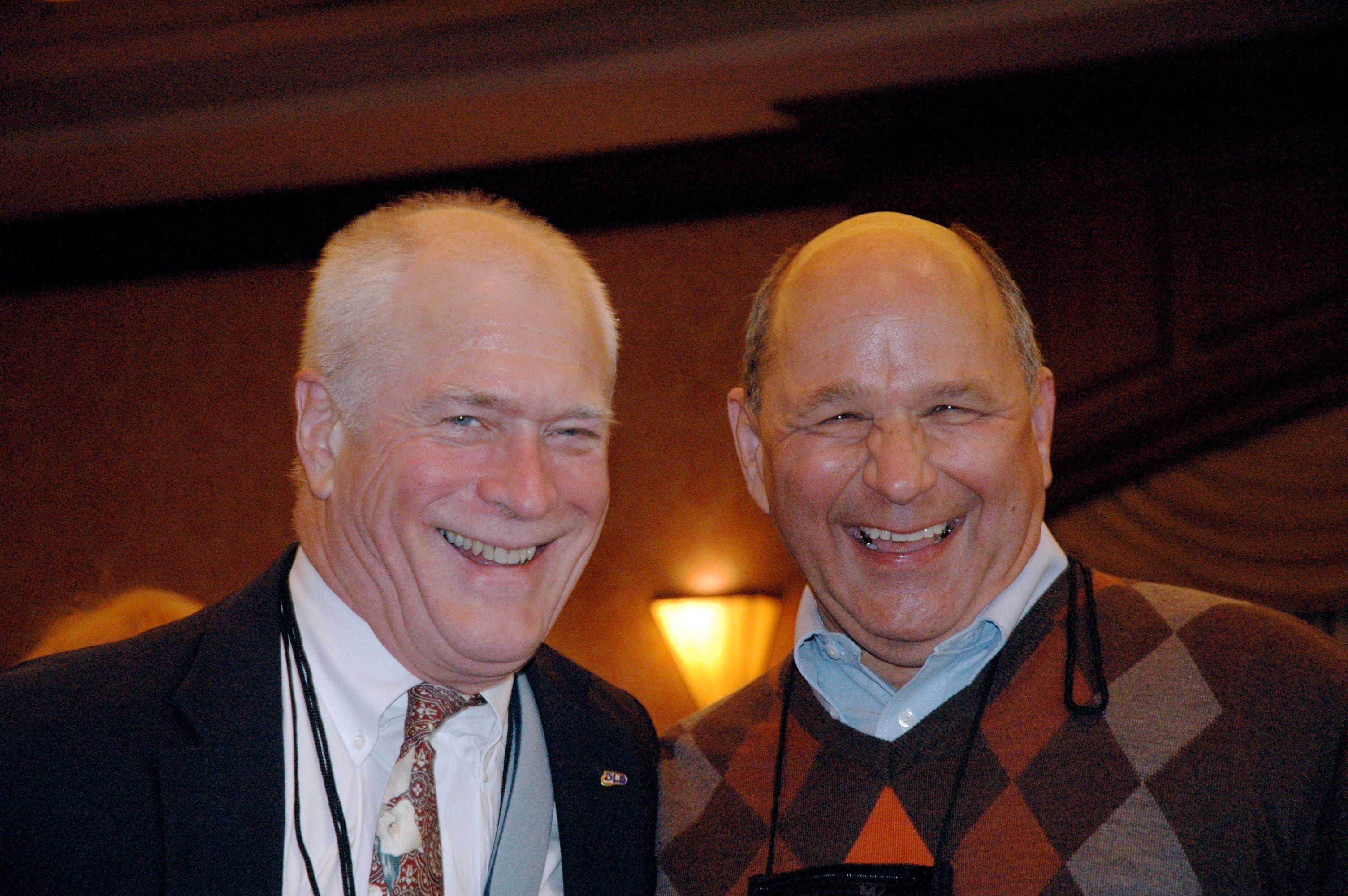
I wanted to repost this photo because I have been thinking about Ken’s academic work frequently recently. As I explain in this week’s commentary, I think Ken’s work is instructive even though he passed nearly 20 years before I’m writing this post. In addition, there are probably many Dear Readers of SET these days who didn’t have the opportunity to see this old photo in 2022.
Updates
Thanks to Joel M. (2x), Dan H. (2x), Jane B., Michael G., and Larry M. for dropping comments this past week. It’s wonderful to have such Dear Readers’ feedback and observations.
Here is a special thanks for Doug C., who commented on my note about his post about taking a broad view of educational reform efforts; Doug wrote,
Thanks, John. We’ve been together on this path for many decades because we know that it’s not about statistics but about every single youth in our school systems.
Speaking of restacks, thanks for Sandra D. for her restack of the SET post about he US court’s discussion of IQ. Also, thanks to Zach G., Kata S., and Laura S. for noting the SET note about Laura’s discussion of Direct Instruction.
Thanks to Annmarie U. and Rick L. for joining the ranks of supporters. 🎶 🎉 🍾
Welcome to Sanely, Henry, Laura S., Kelly C., Pasquale F., Joyce M., Luke H., Babbage, Erin P., True C., Andrea W., Steven M., Bev J., The L. V. P., Carol A., Irvington., and Elizabeth L. That’s a lot of readers for whom this will be the first weekly newsletter. You represent part of the 7.5% growth in subscribers over the last 90 days. I hope y’all find it rewarding to read the drivel and (a) covert to paid subscribers and (b) tell lots of folks about SET and what a wonderful resource you’ve found it to be.
Spedlettes
As those who sacrificed part of their holidays to read the SET posts for the previous week know, we didn’t publish many articles recently. Sigh. I promise that there will be more coming on both the free and the paid sides. In the meantime, please content yourselves with the opportunity to review the posts for the previous week (all of which are by JWL unless otherwise noted):
Special Education Today newsletter 5(26): In this last week of the year, who is ready to escape 2025 and slip into 2026?
US Supreme Court weighs use of IQ: What is the importance of IQ in determining whether a man with intellectual disability should be executed? [DB & JWL]
HNY (western): Shall we pursue better prospects for individuals with disabilities and their families in the coming years? I hope the answer is a resounding “yes!”
Tom Lovitt’s SET work: Shouldn’t Tom Lovitt play first cornet in the orchestra of Special Education Today?
D. Carnine provided a coherent explanation to guide educational reform: What will it take to move education toward improved outcomes for students, families, and educators?
An old blog took its first breath on this day in 2007: A look back to the first posts on EBD Blog
There you see the corpus of posts for the week that began in 2025 and ended in 2026. They represent the 1534th-1539th posts in SET’s history. (Subscribers with a paying sub can read any and all of those.) There's a little of this and a dash of that. Some posts will be of greater interest to some readers than to others, but I hope none will be uninteresting to everyone.
Notes & comment
Unless someone who has an interest in instruction has been living under a rock far from paved passages on the Intetubes, she probably is aware that there has been a lot of chatter about ideas from cognitive psychology out there in the last few years. The discourse often includes suggestions about teaching (some better than others), although those suggestions often are extrapolations from research that does not expressly address teaching or that seems to be ignorant of what teachers and educators have long known.
Fancy-but-uninformative research
I fear that too much of the evidence used in the discussions about applications of cognitive psychology is not really about teaching. Think about the studies of blood flow in different parts of the brains of good readers versus poor readers. It’s fascinating to know that when poor readers (simplifying here) perform reading tasks, the blood carries nutrients to many diverse areas of their brains, but that when good readers perform the same reading tasks the blood carries nutrients to fewer areas of their brains, especially some areas believed to be involved in language. Note that such studies do not tell us one dang thing about how to get the blood to flow to those areas. You have to extrapolate a lot to get from the differences between groups’ blood flow to how to teach kids those to perform those reading actions.
Now, I know that there actually are studies that have described changes in blood flow, both studies of reading development and remediation. Researchers have studied changes in the blood flow of kids who start with scattered patterns of blood flow and later become better readers…and, voilà, the blood flow got more organized!
“See,” someone might explain, “It’s all about having activity in these certain parts of the brain.” “OK,” I’ll reply, “I get it. I understand that the blood flow changes so that it looks more like the blood flow of good readers. Now please tell me how to make that change in blood flow happen. Might it be that you have to teach the kids how to read?”
Ignorance
Sometimes in making a valuable recommendation, folks touting the benefits of cognitive psychology portray the recommendation as founded in relatively recent psychological research, overlooking the fact that the recommendation was provided in the educational literature decades earlier. Take, for example, recommendations to avoid predicating instruction on learning styles. Those of us who have been around special education know that there were suggestions to diagnose visual and auditory modality learning styles in the 1960s and 1970s, and we know that such recommendations were pretty quickly examined experimentally and found to be mistaken. Indeed, there were enough studies (39 of them) that had examined the benefits of learning-style-based teaching that Ken Kavale and Steve Forness were able to conduct a meta-analysis and report it in 1987 in Exceptional Children. They concluded that
With respect to instruction, no benefits accrued to subjects taught by methods matched to their modality preferences. When compared to control subjects receiving no special instruction, the subjects in the modality preference groups receiving differential instruction exhibited only modest gains. In sum, no empirical support was rendered for the modality model.
That is to say, we special educators have known for the better part of 40 years that modality learning styles is bunkum. Please don’t misunderstand: It’s good that the psychologists are recommending against following the learning styles model. But we should be a little skeptical of anyone touting as new something that we’ve already known for years (and years). And, if they’re not pushing the recommendation as something new, it would be the scholarly thing to point to previous research (e.g., Kavale & Forness, 1987).
The point
I appreciate people hoping to contribute to improving education for our kids. It’s nice to learn about useful—i.e., evidence-based—methods, materials, practices, and procedures. But when the recommendations are about something that we already have learned about from our own research, it feels a little…well…insulting to tell us that it’s the great, new slicer for bread. And when the recommendations require multiple leaps over chasms of parsimony (or even just one leap), it is probably time to ask something like, “…and the instructional research undergirding that psychological principle is…?”
That is, when people come telling me how to teach based on the “science of this” or the “science of that,” I’d appreciate it if they’d predicate their recommendations on research about instruction and not pass off practices as their own when they really are things teachers have known for a long time.
Okay, so I’ve run out of strength. Sigh. Please let me courage you to take care of yourselves and each other. Please remind people to buckle their seatbelts, drive carefully, eat healthily, exercise (I’m hoping to be moving again regularly in a year), and teach your students well.
And thanks to each and every reader for all that she or he does for kids with disabilities.
JohnL
John Wills Lloyd, Ph.D.
Founder and Editor, Special Education Today
Reference
Kavale, K. A., & Forness, S. R. (1987). Substance over style: Assessing the efficacy of modality testing and teaching. Exceptional Children, 54(3), 228-239. https://doi.org/10.1177/001440298705400305
SET should not be confused with a product that uses the same name and is published by the Council for Exceptional Children. SET predated CEC’s publication by decades. Despite my appreciation for CEC, this product is not designed to promote that organization nor should the views expressed here be considered to represent the views or policies of that organization.
I agree with you completely. I panicked when Ohio made the decision to require "Science of Reading". I thought I was going to have to relearn a lot of content. But when I read the textbook that I was given, the citations were people I knew and the practices were exactly what I had been trained on. I was actually a little annoyed that I read a textbook on something I already knew how to do; if I read a whole textbook in a week I want to learn something new!!!