

You are reading the 25th issue of the 5th year of Special Education Today. This issue covers the week that began 15 December 2025. In it you will find notes about a photo, notes about the current status of SET, a list of the last week’s posts, and some topical notes and comments.
Read on! I hope that you find the experience informative and (maybe?) even pleasurable.
Photo
I plan to launch a series of posts about historical figures in special education. During some searches for possible content for the series, I came up the accompanying photo.
The image was published in 1949 in Look magazine and the US Library of Congress lists the photographer as Stanley Kubrick. As some readers surely know, the late Mr. Kubrick went on to write, direct, produce, and contribute to well-known movies, as shown on the pages about him from the IMDB and Wikipedia (and, no doubt, many other sources).1
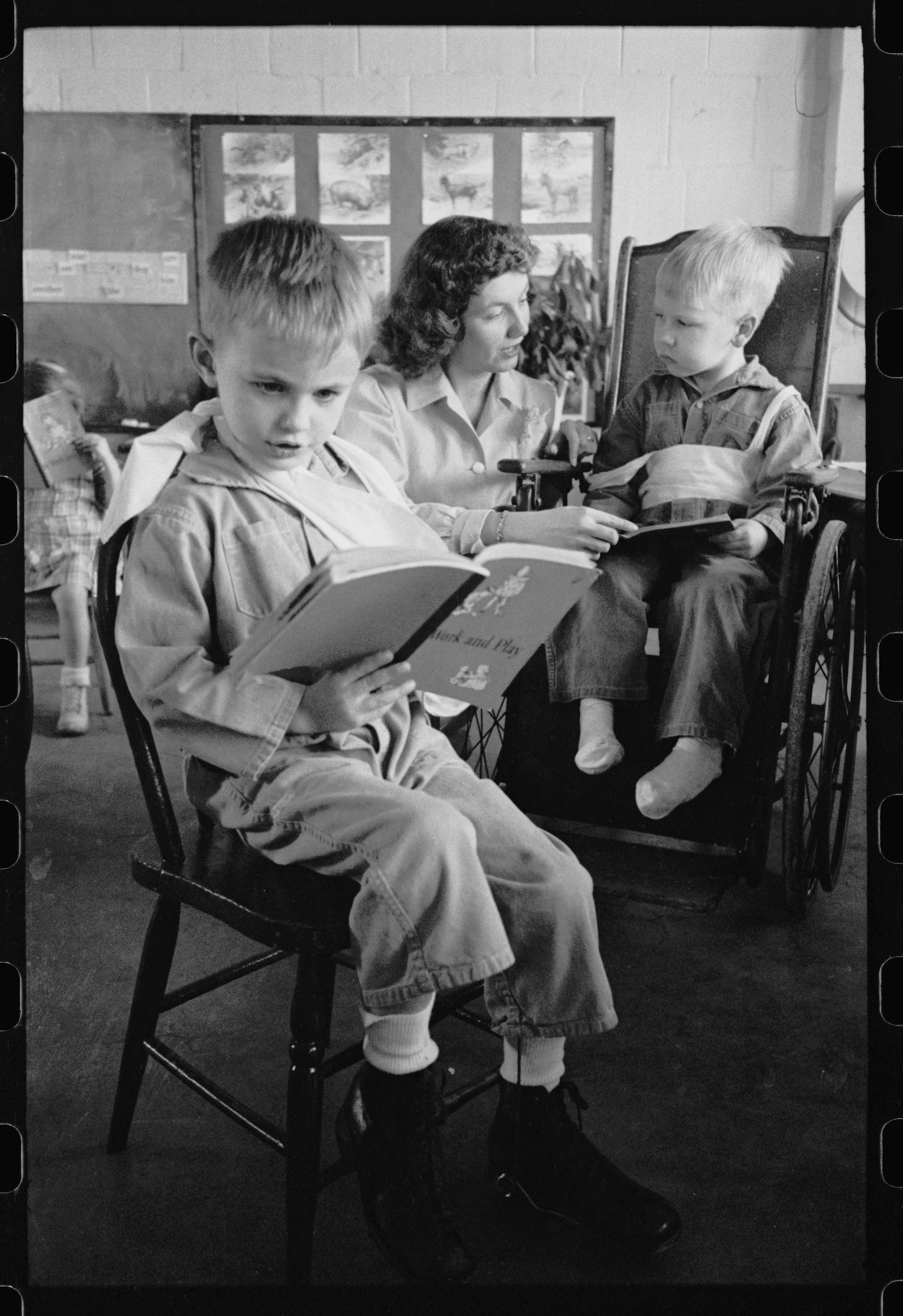
I was intrigued by this photo not only because of its connection to Mr. Kubrick, but also by some interpretations that I put on it. Of course the lead spin was that it shows kids who appear to have disabilities getting instruction in 1949, a time that some readers might consider dang near the dark ages.2
It shows a teacher and two children in school; the boy in the foreground is reading what looks like “We Work and Play,” one of the texts in the famous look-say reading program popularly referred to as “Dick” and “Jane.” The Dick-and-Jane series was published by Scott Foresman and was authored (at least in party) by the immensely influential William S. Gray.
Here were children with disabilities learning to read (we hope). They were in school…they were getting access to the general curriculum, even though that curriculum may have been flawed. And, it would only over the next 10 to 20 years that (a) “the reading wars” began in earnest and (b) parents and educators began to clamor for services for children who were not learning successfully in the general curriculum and would be said to have “learning disabilities.”
Status update
Substack told me that there are greater than 1050 direct subscribers and 100s more “followers” (which includes people who follow SET authors like David Bateman and Mandy Rispoli). Welcome to the seven new subscribers from the week of this issue of the newsletter.
Special welcome to Janie J. who became a paying subscriber this week. Woohoo, and thanks, Jamie, for helping keep the ship afloat.
Thanks to those who dropped “likes” on posts. Sometimes, I know, when some unhappy event is the core content of a post, it is difficult to respond with a “like.” One may wish to express appreciation for learning about the post’s content, but actually dislike the subject in the content. It’s as if one needed a different button. I don’t have control over the creation of the like button, but I welcome suggestions about how it might be renamed, improved, or replaced.
And here’s an extra helping of thanks to readers who posted comments this past week: Nancy S. (thrice!), Dan H., and Jane B.
Spedlets list
Over the week there were six new posts. Here’s a list of them.
Special Education Today newsletter 5(24): Is it the next iteration of SET newsletter? Is it for 15 December 2025?
Cancelled program cuts services for deafblind child and family: How many readers of SET saw the consequences of US policy changes coming?
Report documented increased use of r-word: Would anyone be surprised that the word has been used more frequently since POTUS did?
Remediation can happen: What about students who get out of elementary school without knowing how to decode fluently?
C. Ulmer’s continued advocacy: Can anyone keep up with the Special Books for Special Kids features about individuals with disabilities?
The return of the—ugh—time-out box: What’s the story about this latest apparent outbreak of malediction?
Because I wrote all of the week’s posts, I didn’t add author’s initials to the entries in the list. Keep the faith though! Some of your favorite writers will be publishing posts in the coming days and weeks.
If you are among the free subscribers, remember to read this week’s posts soon. They will be going behind the pay wall in the next 5-10 days. Of course, you can ensure that you will always have access to them by becoming a supporter of SET, starting a paid subscription.
Commentary
There is what we might call a “kicker” to the photo story in this issue. In fact, I’ll refer to two kickers in this section. First, we are just about to experience what Jennifer Jenkins and James Boyle called “Public Domain Day,” and Dick and Jane will be part of that experience. Here is an explanation about Public Domain Day:
On January 1, 2026, thousands of copyrighted works from 1930 enter the US public domain, along with sound recordings from 1925. They will be free for all to copy, share, and build upon.[3] The literary highlights range from William Faulkner’s As I Lay Dying to Agatha Christie’s The Murder at the Vicarageand the first four Nancy Drew novels. From cartoons and comic strips, the characters Betty Boop, Pluto (originally named Rover), and Blondie and Dagwood made their first appearances. Films from the year featured Marlene Dietrich, Greta Garbo, the Marx Brothers, and John Wayne in his first leading role. Among the public domain compositions are I Got Rhythm, Georgia on My Mind, and Dream a Little Dream of Me. We are also celebrating paintings from Piet Mondrian and Paul Klee.
The original appearance of Dick and Jane was in William Elson’s Elson Basic Readers from the 1930s (see the Wikipedia entry cited earlier on Dick and Jane). Once they are out in the public domain, I imagine we’ll see additional discussions about the series. Although I imagine that there have been unauthorized uses of them, I suspect the illustrations—which I recall as very attractive— will appear widely. Just imagine advertising agencies being able to use them to evoke ideas about long-ago childhood, innocence, and light-airy all-American experiences.3
Second, regardless of the socio-cultural influences, thinking about the Dick and Jane readers provides a basis for revisiting our current approaches to teaching reading. Some of that discussion should examine the role of the basal reading series, which were contrasted with the “phonics” curricula of the time and later decried by advocates of “whole language.” But I want to suggest that an important aspect of the discussion should be the role of research in reading instruction that led to the development and revision of curricula such as Scott Foresman’s Dick and Jane series.
William Gray, the influential author of subsequent editions of the Dick and Jane series that followed on the original by William Elson, conducted many studies about reading. Readers might be familiar with the Gray Oral Reading Test that he developed originally and might have encountered measures of readability influenced by his studies.4 He brought those strands of research and the research of his contemporaries to bear on revising the Dick and Jane series. So, it would be inaccurate to say that the series was not research-based.
What matters here, in my view, is the nature and focus of the research that is considered the research basis for reading instruction. For example, descriptive studies of normal child development may be conducted using pristine methods, but they rarely have express implications for the teaching of reading. Instead, we need to base our teaching on frank experiments about the effects of providing different instruction to learners; what do those different instructional practices do to the course of children’s development?
That problem with seeking guidance from the wrong evidence base is still with we educators. Currently, many educators are seemingly infatuated with findings from neuroscience and psychology, seeking guidance for teaching from descriptive studies and examinations of relationships between hypothetical constructs. The good news is that the guidance they derive sometimes aligns with actual educational studies about the effects of instructional practices and procedures. The bad news is that we may be deceiving ourselves into thinking those studies from related areas are critical components of the research basis for teaching.
So I recommend to Dear Readers of SET that they seek guidance about how to teach their students well from express tests of instructional methods. Avoid the mistakes of the past in designing instruction. Focus on a research base that is drawn from the most highly relevant studies. To be sure, seek research that employed excellent methods and that used those methods to study operationally distinct practices.
I think my recommendation there will save readers from lots of angst and misery. And I think we need all of us to maintain our health and well being so that we can focus on teaching our students effectively.
JohnL
John Wills Lloyd, Ph.D.
UVA Professor Emeritus
Founder & Editor, https://www.SpecialEducationToday.com/
Footnote
There is a Web site named “kubrickfilms.com” that apparently is devoted to Mr. Kubrick’s work, but it was unavailable when I visited the URL.
I advise caution about classifying 1949 as medieval. I was one year of age in 1949; I’m pretty sure I was living in a civilized society at that time.
Don’t forget Sally, Dick and Jane’s little sister, and Spot and Puff, the prototypical pets of the family.
For examples, see William S. Gray and Bernice E. Leary, 1935, What Makes a Book Readable, from the University of Chicago Press and Gray and Ruth Munroe, 1929, The Reading Interests and Habits of Adults, from Macmillan.
I always enjoy your explorations of pedagogy, especially how research has influenced it. I read Dick and Jane in elementary school, and used the Gray Oral Reading Test as a sped teacher and psychologist.