

Good morning | afternoon | evening, Dear Readers. Here we have the thirteenth issue of the newsletter for Special Education Today for its sixth year. No AI was abused or annihilated in producing this newsletter.
Here we go!1
Photo
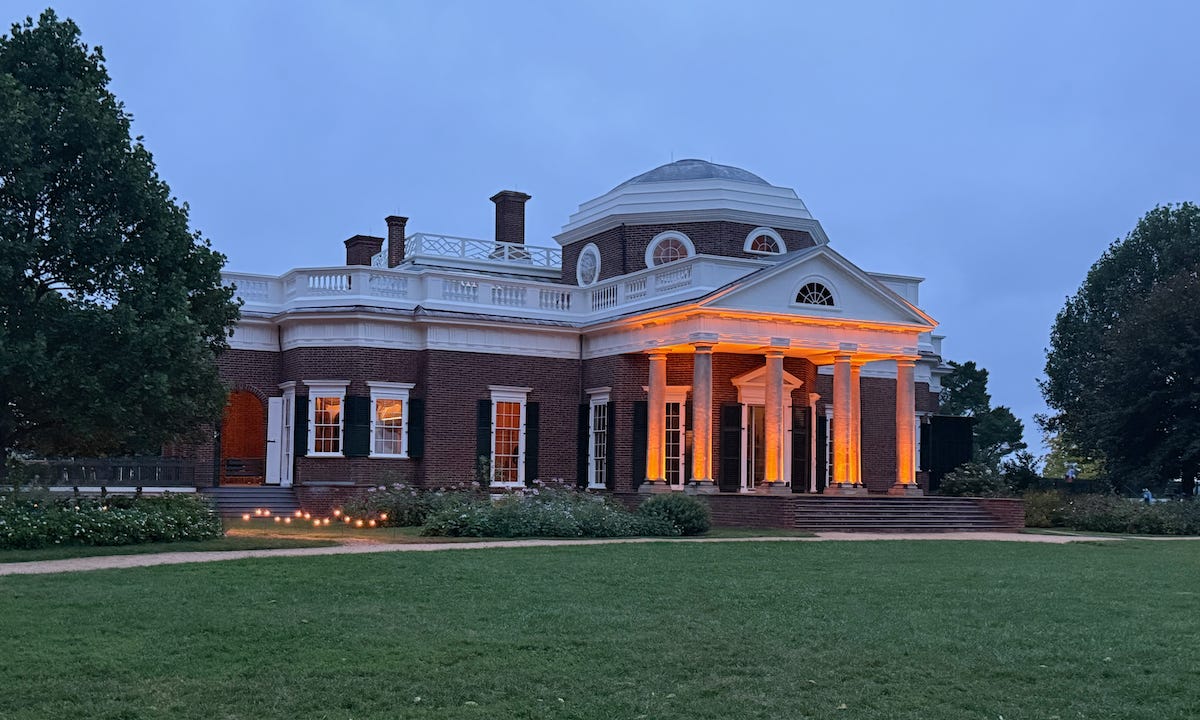
We had the opportunity to visit Monticello this week. The iconic home of Thomas Jefferson was the site of a conversation between PBS journalist Judy Woodruff and New York Times columnist Jamelle Bouie who is also Monticello’s current Fritz and Claudine Kundrun Fellow about freedom of the press. It was the first in a series of talks billed as “Pursuits of Knowledge,” and one of many events held at Monticello.
After the talk, as the crowd thinned, I was able to get this image of the house from the west lawn. It’s not quite the “nickel view,” but the lighting made it different from the many other times I have seen the mansion from that general location.
Status update
SET welcomed a contributing author to the team this week. Although she had been working on it for a lot longer, this week Maha Al-Hendawi published her first piece for SET on 24 September. Maha is on the faculty of Qatar University. She is an accomplished scholar who is especially alert to special education and disabilities in the Arab speaking world, so she can help all of us know more about what is happening in the western part of Asia.
In addition to publishing posts this past week (the list, including Maha’s, is in the next section), there were some other goings on with SET, too.
Of importance, one of the events was that I got notice of a new supporting subscriber. So, everyone, please tip a hat, raise a glass, or say something nice in welcoming Chen S. to the little gang of folks who help make SET run on something more than the fumes of raw circulation. Chen joins other supporting subscribers, including Bob P., Alix H., Angelique W., Ann R., Callie O., Carol W., Christine T., Cindi S., Clay K., Dan H., Ed M., Ed P., Jane N., Janet J., Jeremy J., Jim F., Jose B., Joel M., Judy V., Kata S., Keith L., Kristin S., KT L., Larry M., Linda L., LuAnn J., Mary-Anne L., Meg D., Michele M., Micki D., Mike N., Mike N., Nancy M., Nancy S., Nicole V., Pam S., Paula C., Roberta B. , Sam B., Stephanie A.O., Sunil, Tim H., Trent T., and Vince C. (to mention just some of these folks).2 I hope I got these names right. Some subscribers have not created Substack profiles, so I must guess at the names from email addresses or from my own records. Also, I read through the records of paid subscribers and select those to show in these weekly lists of recognition on a quasi-random basis; if your name did not appear this week, please watch the future lists (and thanks to you, too).
As usual, here’s a special doff of the chapeau to SET’s patron-level subscribers: Mike G., Kathy M., and Anita A.
I am pleased to note, too, that there were seven new subscribers at the free level this past week. I do not have a count for how many folks unsubscribed, but the addition of these seven brings the total number of subscribers close to 1300.
That level of subscriptions is nice, but it is not as large as the subscription levels for some of the other folks who also read SET. Some Dear Readers have ‘stacks that are much more widely read than SET. Take a look at these four examples (and see some of what I read regularly):
Emily K.’s Learn with Dr. Emily
Holly K.’s The Bell Ringer
Carl H.’s The Learning Dispatch
Callie O.’s Special Education Action
I dearly wish that I could talk about discussions that we are having over on the Chat section of SET, but there is little happening over there. I think it presents a means for us to have brief discussions of current events and such. Thanks to Jannie KT and Betsy T. for contributing there in the past year or so, though.
SETlets (or “T’ o’ Contents”)
SET is a source for learning about the education of children with disabilities and their lives with their families. This past week reflects SET’s eclectic nature. There were posts about people, policy, research, and more. We hope that these articles provided valuable information to you, Dear Readers, but perhaps we should be covering other stories, instead. Write to us (well, to me, JWL) if you would like to see SET cover different “beats” than those one regularly sees…or skip some beats? Just reply to the email version of this newsletter or drop a comment on this post.
Here is the list with the one post for the paying peeps in the first clump and the public posts in the second. Note the authors’ initials are in parentheses after each item.
For the faithful
Providing students choices affects their behavior: In what ways and for whom is having students choose their activities beneficial? (JWL)
Out in the wild
Special Education Today Newsletter 6(12): Here’s the news and info for the week that began 14 September 2026 (JWL)
Please define “to teach”: What is a no-nonsense and succinct definition for “teaching?” (JWL)
Dan Hallahan to receive award from Salman Center for Disability Research: The center announced the recipients of awards in five areas of disability research (JWL & MA-H)
Remembering Ann Philomena Kaiser, 1948-2026: Professor Kaiser of Vanderbilt University passed away 13 September 2026 (JWL)
Friday catch-up notes—25 September 2026: How about these stories from this past week? (JWL)
Forthcoming resources on writing for primary grades: What has Sally Bergquist got up her sleeve?
Understood reported continuing confusion about ED changes: What do people know and believe about how the Trump administration is changing special education?
So, Dear Readers, that is what you got this week. If anyone is interested in finding these and other posts, please point a browser at https://www.SpecialEducationToday.com and review the archive of posts. The home page will show relatively recent posts, but there should be a button at the bottom that permits one to see “more” (or something like that). In addition, to perusing the archives, it is possible to search for posts using the magnifying glass at the top.
Of course, please be advised that not all of the posts are available to the general public. Some are reserved for readers with paid subscriptions. Join us1
Comments
So, here’s the part of the newsletter, and of SET where I get to freelance a bit. I have few constraints on what I write in this little corner of our world. I probably offend some readers some of the time. I do not feel compelled to perform lots of research before typing the words for this section. I just get to spout!
And this week I am spouting about a concern that…well…concerns me. This week I am spouting about how much of contemporary conversations about education I see on the Intertubes are pretty much spin that is only tenuously connected to educational realities.
Before someone notes the wrong, I understand that these very comments are, in fact, a genuine illustration of the problem about which I am about to complain.
Here, however, is “the thing.” So much of what I see in “the press” about education is lightly sanded and varnished opinion. It reminds me of conversations I have heard—even participated in—among sports fans on Monday mornings. A group of people (often mostly males) working in a shared physical space stand around the [water cooler | coffee-machine | mail boxes] and quip about events (athletic contests?) they observed (usually on television) over the weekend. There conversation is certain amount of simple observation, incredulity, and one-ups-manship. The facts are usually only a jumping off place for people to express their own unique perspective or “take.”
Speaker 1: “That overtime win by the Elephants was fantastic! They stole the victory in the last few seconds!”
Speaker 2: “Oh that was great, but did you see that pass by Gonzalez to Aparicio in in the last minute of the? Aparicio’s path—the cuts and fakes? It was amazing!
Speaker 3: “Right, but like Jane Blow said when it happened—and she’s been around for a long time, so she should know—like she said, there’s no team that’s ever come back from that far down in the history of the Great Hero’s League.
“Haha,” one might say. But if you want to see similar yakking and spin, just search for posts about the latest PISA results, the rankings by country, the changes in the scores over time.
Writer 1: “Look at how horrible the PISA scores are! They just keep going down. It just shows how horrible our education systems are.
Writer 2: “Well, right, but look at how Country A is bucking the trend! The scores for A are going up for the second year in a row! That shows that A’s policies are the right policies.”
Writer 3: “Ha! Baloney! Country A has already adopted these horrible policies and we are going to see their scores sink next time PISA comes out. And I’m confident that Country R is going to rise because they are adopting new training that will make their scores grow immediately.
I marvel at spin such as I have illustrated here. The speakers or writers seem to have great confidence in their views, but I am a little less sure about those views. Why?
There’s the basic evidence matter: The PISA scores on which they rely, for example, are aggregations at such a high level that they change only terrifically slowly. If one thinks of them as dots on a graph plotted over time, they go up and down, up and down. Stating that one dot is higher or lower is more easily said than shown statistically.
And there’s the inference matter: Do we really know the cause of higher or lower scores? Did anyone experimentally manipulate changes in policy so that we can attribute changes in scores to those independent variables? Did Countries A, M, and T implement a phonics- and knowledge centric curriculum in Year -5, Countries F, L, and O implement a comparable curriculum in Year -3, and Countries D and S implement a comparable curriculum in Year -1? And, did each of those countries’ PISA Reading scores show clear, salutary rises in the years following the policy change?
I would like to see those commentators who are crowing about current evidence about education take a step back and perform a simple, logical analysis of their arguments. I am reluctant to accept the arguments of those who recommend reforming education based on analyses such as I have described here.
As Engelmann, Bateman, and I explained, too many arguments about educational reform take indirect and, frankly, illogical paths. They do not look at the problem in simple and plain terms. If one does take a clear-eyed look at the performance of students (i.e., their test scores), it is pretty clear that changes in instruction (i.e., teaching) provides the most direct path to improving outcomes. And that brings me to a third bullet to follow the two previous bullets:
Teaching is hard and changing teaching at scale is really hard.
I hope that my spin on these matters helps some of us to step away from the abyss that is our interpretation of the meaning of educational crises (“Oh my, the PISA scores are falling, just like the sky, Chicken Little!”) and focus instead on changing things that are within reach and that might benefit kids. Instead of PISA reading scores, let us improve students’ words read correctly per minute, percentage of close items in a passage completed correctly, number of facts written in three minutes after reading a chapter, vocabulary items correctly matched with simple definitions, etc.
Okay, end rant.
Lest you think I might have forgotten, here are the usual recommendations: (a) Wear your seatbelts (and make sure your children’s seats are affixed properly). (b) Get vaccinations as appropriate. (c) Eat healthy foods. (d) Exercise. (e) Wash your hands (“you filthy animals”). (f) Watch out for your family, friends, and neighbors, and fellow denizens of Earth. And…and please, teach your children well.
JohnL
SET Editor guy
Charlottesville

Footnote
Typo and grammaro counts unknown.
And even more thanks to those of you who keep renewing your subscriptions. SET has, according to Substack, a high renewal rate. Yay!