

Having seen many uses of the word “teaching” come across my feed, I asked myself just what that word implied. What in the world do people mean when they say “teach?” How should we understand it?
I poked about on the Intertubes, and it seemed to me that often the word is used without much clear definition. In fact—warning: scatology ahead—many of the references to “teaching” I found were pony poop. People just don’t get what it takes to teach.
I decided we ought to take a look at the meaning of “teaching,” so I wrote this post. I wanted to work toward an objective definition of teaching that could provide structure to future posts about research, effectiveness, and practice.
I amassed notes as I went along searching those ‘tubes. I have some softer and some harder notes, and I’ll present them pretty straightly. Please don’t mistake this for a literature review. It is not, by any reasonable stretch. It’s just a morass of observations.
The notes fall into categories that I shall use to organize this content: popular uses, quotes, definitions, and data-driven methods, and then a proposal followed by some summary observations.
Popular uses
Part of the difficulty in understanding “teaching” is that the word is used in so many different ways. In common parlance, “to teach” (and its cognates) is—well—common. “Teach” just seems to get tossed around.
Some Dear Readers may have heard observations, comments, and statements such as these:
“Yes, I’m a teacher.”
“That’ll teach him!”
“Oh, I teach English. I don’t teach reading.”
“Ordinary experience is a powerful teacher.”
“Teaching is only part of the job of being a teacher.”
“I’m teaching a unit on the water cycle.”
“That’s just teaching to the test.”
Though such popular uses may communicate an idea about teaching in the context in which they are used, these everyday uses are rarely based on a careful analysis of the meaning of the word “teach.” They are usually a kind of short hand for an idea about something sort of vague.
I want to talk about teaching as an action, something that happens in space and time, I want to talk about teaching in schools, where it is supposed to happen regularly. I am not aiming for something from the romantic tradition…more the scientific perspective.


Quotes
One can find lots of quotes about teaching. I suspect there is an entire book somewhere that aggregated quotes. Many of us, Dear Readers, have seen quotes such as the following. They talk about the meaning of teaching.
As a warm-up for this post, here are a few quotes (with links pointing to biographies of the speakers).
Just think of the tragedy of teaching children not to doubt.—Clarence Darrow
I never teach my pupils. I only attempt to provide the conditions in which they can learn.—Albert Einstein
Good teaching is one-fourth preparation and three-fourths theater.--Gail Godwin
The best teacher is the one who suggests rather than dogmatizes, and inspires his listener with the wish to teach himself.—Edward Bulwer-Lytton []
The teacher must derive not only the capacity, but the desire, to observe natural phenomena. The teacher must understand and feel her position of observer: the activity must lie in the phenomenon.—Maria Montessori
Some of these quotations, and many others with which we may be familiar are just quotes, of course. They are only what people said. That is, they are talk. They are subjective observations. So, we have to be cautious about reading deeply into them. Still, they can help sharpen our thinking.
These quotes are, I think, good hearted or well-intentioned. They communicate often-ephemeral ideas. They emphasize inspiration as a critical feature of teaching. Indeed, some of these quotations seem to have the purpose of inspiring us to appreciate teaching.
None of these quotations, however, provide objective and operational descriptions of teaching. They do not tell what the teacher does in observable terms.
Definitions
To help move us ahead, let us consider the definitions of teaching offered by some experts.
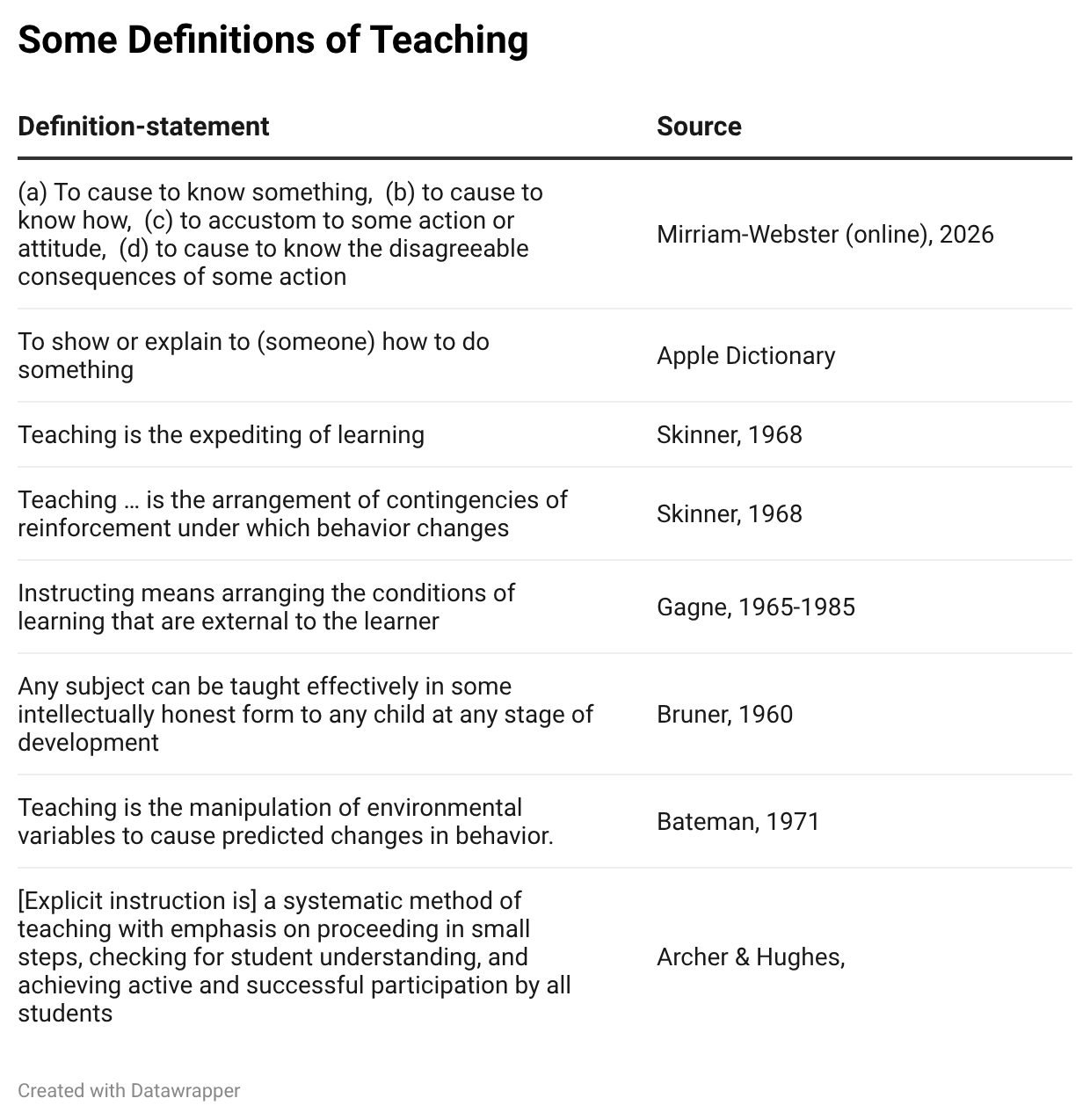
These statements are valuable, because they describe observable actions that someone would take to teach concepts and operations, to inform a learner about ideas and procedures for accomplishing things.
Descriptions
Some readers might suggest that a more objective description of teaching could be had by considering evidence-based teaching practices. They might say that those practices that have been shown to improve students’ learning offer an appropriate way to define teaching. For example, they might recommend the principles of instruction described by Barak Rosenshine (2012; Rosenshine & Stevens, 1986).
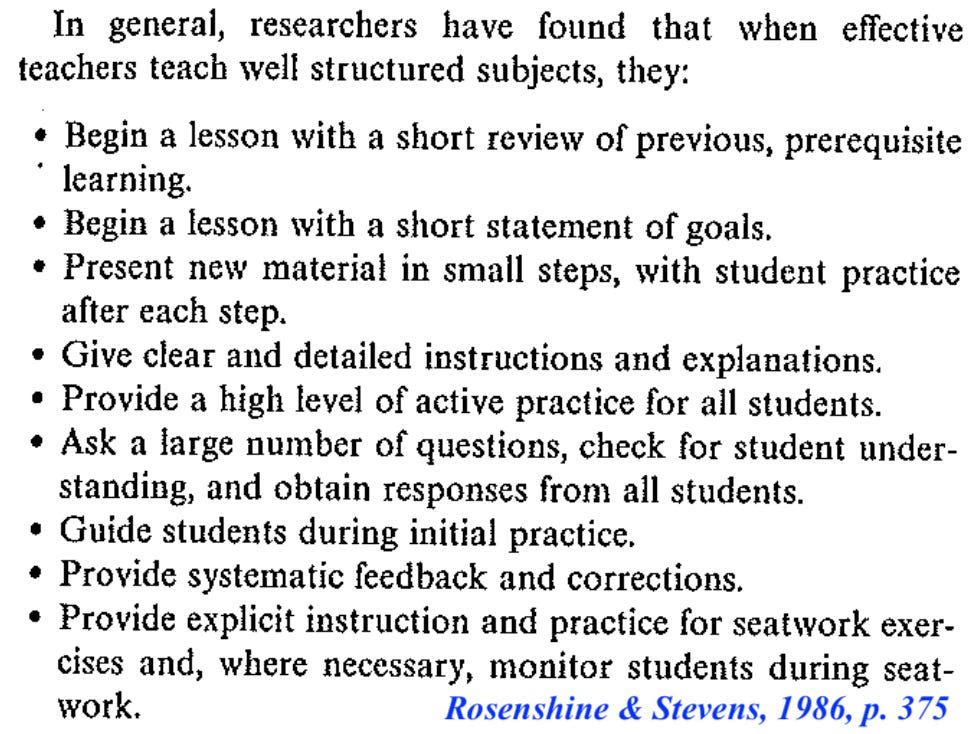
Others might refer to the list of “high-leverage practices” (McLesky et al., 2019)1 The Web site for HLPs describes them thusly: “A deceptively simple concept, HLPs are a relatively small set of key practices all educators should know and have in their toolbelt.” The 22 HLPs folks organized in four “domains”: (1) collaboration, (2) data-driven planning, (3) instruction in behavior and academics, and (4) intensify and intervene as needed. As can be inferred from reading the names of the domains, although some HLPs describe specific actions (e.g., HLP 8 is “Provide Positive and Constructive Feedback to Guide Students’ Learning Gand Behavior”), most of the HLPs refer to broad collections of teaching actions (e.g., HLP 11: “Identify and Prioritize Long- and Short-Term Learning Goals”)
The Rosenshine principles, the HLPs, and other descriptions of particular parts of teaching are helpful because they move us more toward talking about actions that can be coded, counted, But they are a bit too molecular to serve as a definition of teaching.
What is the generic of these actions? That’s where I want us to go.
A proposal
Some observant readers may have noted that I slipped a ringer into the earlier table listing authorities’ definitions. I used a definition from Bateman (1971) that I think actually comes pretty close to what we need. Here it is again:
“Teaching is the manipulation of environmental variables to cause predicted changes in behavior.”
That’s nice. It’s succinct. It focuses on objective matters. It’s dang straight-forward.
Let’s take a closer look at Bateman’s definition. Let’s consider the words and phrases that compose it.
Some readers might object to the use of the word “manipulation,” considering it heartless or too mechanical. Okay, I hear that. To me this objection sounds like the ‘plaint of a romantic who thinks of education as a horticultural endeavor where one hopes to nurture young minds as they develop naturally. The extent to which we see the word “:manipulate” as unsympathetic, however, is pretty much on the shoulders of the person who is hearing it that way. But, teachers actually do operate, change, demonstrate, or modify things when they teach. That is, they manipulate. Shoot, even a reading a poem to a class is manipulating words. So, “manipulate” is OK…you have to do something to teach.
Some readers might object to the words “environmental variables” as being used in teaching. But, wait? What the heck else do teachers modify or change in front of their students? One might say, “ideas” or “concepts,” “illustrations” or “examples,” etc. And, I might agree and then ask, what do teachers do to manipulate the ideas or examples? Well, I guess they would change the words, or the displays, or something else in the learning environment, something rather observable. A lesson, in this sense, is at base a set of directions for making changes in the environment surrounding the learners. Those environmental variables might by pictures, sounds, words…even smells. I am happy with “manipulating environmental variables.”
“Wait!” some folks might say, “You’re ignoring the word that’s the biggest problem: ‘behavior!’” I hope you might agree that it is actually behavior that we hope to change when we teach something. What else might we hope to change? Some folks might say that learning isn’t really about behavior, but they will ultimately have to admit that the only way to ascertain whether someone has learned something is to assess behavior. Does the learner say or write accurate answers?2 Does the learner perform the steps of an algorithm in the proper order? How do we know she remembers? How do we know they examined something? How does the learner demonstrate mastery other than by some action, some behavior? So, the word “behavior” belongs here.
Well, what about the word “cause?” That word is exactly the right one. Teaching must produce outcomes. There should be a direct and dang near linear connection between teaching and learning. It is nearly laughable to say, as many of us have probably heard people say, “I taught it. They just didn’t get it.” “To teach” is an active verb; one teaches something. We want to cause the learners to know something (concepts or declarative knowledge) or to know how to do something (operations or procedural knowledge).
“Predicted?” Yes, that is correct. It is sorely tempting to do a lot of “teaching” and then simply take credit for anything that the students could say or do at a later time. Error! If a teacher is simply going to manipulate the environment (do stuff; present a lesson, demonstrate an experiment, have students solve a problem or set of problems, etc.), for what purpose is the teacher doing all that stuff? I think we would agree that the purpose was (or ought to be) for the students (also known as learners) to learn something. So, what will they learn? Please predict how their behavior will be different because of the teaching. One should not hope to get credit simply for throwing the dart; one wants the dart to hit the target—and preferably the center ring on the target. Think about Robert Mager’s clarity about objectives: State the behavioral objective of the teaching.
So, rereading her definition, I think Bateman nailed it. She provided a crisp, sharp statement the explained what the action of teaching is and its purposes.
Conclusion
I hope that this ramble through the morass of the language we use has sparked lots ideas for you, Dear Readers. I have little hope, however, that it is taught you anything. It’s just been a lot of my yammering into the megaphone.
Still, I hope that it helps us stop, take a step back, and reflect on the myriad of recommendations one e can find on the Web these days about improving teaching. Just think about, for example, all the recommendations that one can find for improving instruction (especially in reading) these days. How many of those recommendations consider teaching at the level that we have here?
I see too many recommendations about teaching that address unobservable processes and subjective outcomes. We special educators know that teaching occurs in more having students master learning letter-sound correspondences and sounding-out strategies. Yes, we may need to teach them chemistry. But we also need to understand “teaching” of self-care procedures, discriminations about when to start crossing streets, even how to say “yes” and “no.”
Educators know better. Special educators know how important it is to think of teaching in fundamental, objective terms. We need to take no-nonsense looks at what people recommend about teaching.

Oh, and, sorry. There’s no AI here…well, very little…I used ChatGPT to generate the images in the figure showing different views of teaching. As for the words, I composed this myself.
References
Archer, A. L., & Hughes, C. A. (2010). Explicit instruction: Effective and efficient teaching. Guilford.
Bateman, B. (1971). The essentials of teaching. Otter Ink.
Bruner, J. (1960). The process of education. Harvard University Press.
Gagné, R. M. (1985). The conditions of learning and theory of instruction (4th ed.). Holt, Rinehart, Winston.
Mager, R. F. (1962). Preparing instructional objectives. Feron.
McLeskey, J., Billingsley, B., Brownell, M. T., Maheady, L., & Lewis, T. J. (2019). What are high-leverage practices for special education teachers and why are they Important? Remedial & Special Education, 40(6), 331-337. https://doi.org/10.1177/0741932518773477
Rosenshine, B. (2012). Principles of instruction: Research-based strategies that all teachers should know. American Educator, spring, 12-19; 39.
Rosenshine, B., & Stevens, R. (1986). Teaching functions. In M. C. Wittrock (Ed.), Handbook of research on teaching (3rd ed., pp. 376-391). Macmillan.
Skinner, B. F. (1968). The technology of teaching. Appleton-Century-Crofts. [BF Skinner Foundation, 2016, https://www.bfskinner.org/product/the-technology-of-teaching-pdf/]
Footnotes
Alert readers who read the list of authors for this citation will recognize that the membership of our little island is well represented there. How many subscribers to Special Education Today do you recognize among the authors?
I am pretty sure that we can reduce the relevant behaviors to very few: Say. Write. Act [in a narrow sense, not a theatric sense). This topic must be set aside for right now, though. It requires a post of its own.