

Hello, and welcome to another issue of the newsletter for Special Education Today. This issue, which covers the week that ended 20 September 2026, includes the usual content: (a) a photo, (b) an update about the community, (c) a list of the week’s SETlettes, and (d) some commentary (warning: long and ramble).
It was a wonderful week, right?
Yes, it was! So, let’s get right to it!
Photo
On the good news front, I went out again this week. Bryan C., Michael K., and I lunched at a local pizza place (where else would one go with Michael?). It was the Christians on the downtown mall.
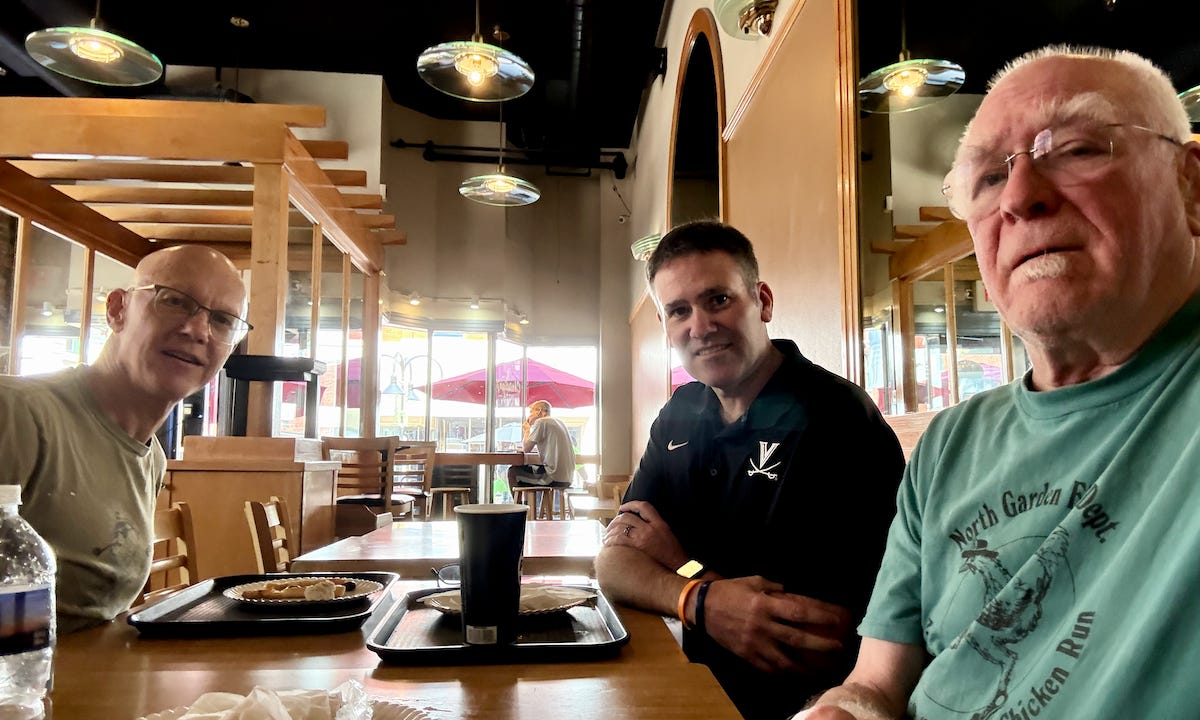
There are at least two problems with this photo (and neither problem is one the subjects, other than the photographer). First, I should not have used the bright window as the background. Second, I should have shown a slice of pie hanging out of my mouth.
It was actually a splendid time. I greatly appreciate my colleagues taking time from their real lives to humor the old man, to get me out on the town. I hope we can do it again and attract a few of the other local SET community members to join us.
Status update
Substack reported 1280 subscribers for SET and greater than 1700 total followers. SET is a niche publication. It’s not like some on Substack that have mass market appeal. The audience will never be in the 100s of 1000s, but we can hope that we can get 1000s to share with us.
About 40% of visitors to SET come to posts directly. (You, Dear Subscribers would be in that group.) About 20% come from search engines such as Gaagle. Another 15% come from email (probably messages you, Dear Readers, share). About 9% each come from people who found SET via Substack or Faceplant. The remaining ~5% come from other social media (e.g., “twitter,'“ LinkedIn), search engines (e.g., Bing), and similar sources.1
I’m pleased to see continued growth in the size of the community. I hope you can continue to promote SET to your friends, colleagues, family members, and others. They are welcome to subscribe!
There were one new paying subscriber, Maha Al-H., this week. It’s great to have Maha joining Angelique W., Anita A., Bob P., Christine T., Clay K., Dan H., Ed M., Janet J., Joel M., Kathy M., Kristin S., Larry M., Linda L., Mary-Anne L., Michele M., Mike G., Mike N., Pam S., Pam S., Mary Anne L., Kristin S., Hill W., Larry M., Christine T., Joel M. (did I already mention him?), and Ed P…among others.
Meanwhile, welcome to those folks who are new subscribers on the free side. It’s great to have you here and I hope you find SET valuable. I also hope you’ll share and, perhaps join the paying folks in helping make SET available even more widely.
Special recognition for SET’s patrons:
Anita A., Mike G., and Kathy M.
SETlets (AKA “table of contents”)
Look! Look!2
I have changed the heading here. I happened to be looking at a message from 2025 in which long-time subscriber Joel M. suggested alternative names for this section. As a result of consulting my faulty memory, I had been using “spedlettes” (and probably other spellings, too). But, Joel had actually suggested “SETLETS.” It is better, and I should have been using it. So I’m going to use it…now let us see, Dear Readers, for now long I remember this correction. Check next week.
Special Education Today newsletter 6(11): What went down in SET-land the week that began 7 September 2026?
Increasing writing output for German students: Does a package of reinforcement improve students’ written production?
Curtis Pride models success despite deafness: What has Mr. Pride done?
US state governors oppose US Justice Department’s reinterpretation of Olmstead: What are the governors saying about people with disabilities seeking community-based services?
Sold a Story in video: What is Emily Hanford doing?
Diabetes screening in early childhood: What are the implications for children with developmental disabilities?
Friday catch-up notes—18 September 2026: What about stories that didn’t show up as a full post this week?
A young person explains autism and borderline personality disorder from the her own perspective: Shouldn’t a first-person account of having a disability promote understanding and support?
CEC Division for Research awards nominations are open: For what awards is DR seeking nominations?
I get the prize for “author of the week.” I wrote all of these!
The articles for this week were all on the free side of SET, but they will go behind the paywall in a a couple of weeks. Please read them now, if you are a free subscriber. (Better yet, become a supporter so that you can read them again anytime.)
Be sure to check the SET Web site to keep current. On the site, one can find an HTML-formated version of this newsletter as well as any newer posts (and a link to archived posts, with some available to free subscribers and all available to supporting subscribers) and a sorta-kinda subject index to the archives called “clumps.” The a tour the next time you are stuck on hold, in a faculty meeting, waiting for an appointment, or similarly vacant time.
Commentary
In the fall 2026 elections for the Commonwealth of Virginia, there is a ballot item that I think merits broad consideration, because it bears on disability. Virginia voters are asked to vote on an amendment to the Virginia Constitution about who is qualified to vote in elections.
Voting by whom?
The top line issue in the proposed amendment on which Virginia voters will have their say is about whether people who have been disqualified from voting because they were convicted of a felony may regain their right to vote after having served the sentence for the felony of which they were convicted. Once someone has done her time, should she be able to vote in subsequent elections?
As one might guess, this is a matter of intense political interest. It is also a test about one’s view of psychology; are personalities inherently good or bad? Once a felon, always a felon?
However, interesting those topics may be, there is a second part of the purposed amendment that brings disability into sharper focus. Here is the text of the statement that will appear on the ballot for Virginia voters:
Question: Should the Constitution of Virginia be amended (i) to provide for the fundamental right to vote in the Commonwealth, (ii) to revise the qualifications of voters so that a person convicted of a felony is not entitled to vote during his period of incarceration but is automatically invested with the right to vote upon release from incarceration, and (iii) to update the existing prohibition on voting by persons found to be mentally incompetent to instead apply to persons who have been found to lack the capacity to understand the act of voting?
Please go back and reread phrase iii. So, uhm. people who are found to be “mentally incompetent” are prohibited from voting, and this amendment would update that prohibition so that applies to people who “lack the capacity to understand the act of voting.”
I have not read the legislative record on this proposed amendment, but I have to wonder what is proposed to be the standard for whether someone has “the capacity to understand the act of voting.”
Start with whether someone can “understand the act of voting.” How do we determine that someone has that understanding?
Now, back out a step and consider the “capacity” to understanding something. What is the test for “the capacity to understand the act of voting?”
But, wait…by whom?
Now, please let me add to my confusion. I posted a note about an article from the NY Times column called “The Ethicist.” It’s entitled, “My Developmentally Disabled Sister Can’t Vote Herself. Can Our Mother Cast a Ballot For Her? Kwame Anthony Appiah, the author of “The Ethicist,” That is not ethical for a mother to exercise her child’s right to vote on her behalf.
I think Mr. Appiah made the right call. However, I want to defend the right for individuals with disabilities to exercise their franchise. People with disabilities should, in my view, get to vote. They are citizens who, if not felons, should have a say in the government that affects their lives and freedoms.
But, here's the rub: Should any and all exercise their right to vote? Individuals with schizophrenia? Autism? Dyslexia? Is there a qualification? And, here we are back to the proposed amendment to the Virginia Constitution. How should we determine whether someone has the capacity to understand the act of voting?
But…wait, who’s voting?
How about one more complication? Suppose that the individual who is voting is doing so via, let’s just say, facilitated communication? Rapid prompting?
Surely, the matter of who is doing the voting comes back to Mr. Appiah’s observations. And, perhaps it should come back to the currently-hot topic in the US about voter fraud.
Let me circle back (if I may use the popular phrase). I think that our fellow humans who have disabilities should be able to cast their ballots. I would want us—the other voters—to honor their votes just as we would honor our family members’, neighbors’, and friends’ (and enemies’).
But I get stuck on the questions about whether their votes are their own. The difficulty is in determining that “capacity to understand.” It is not in the matter of whether someone else is voting for the individual.
What is that capacity? Surely, I hope no one) will suggest a cut point on a measure of IQ or a maturity scale. How do we know that someone with a disability should be able to vote independently and privately?
Literature?
Most readers of SET will not be surprised that there is a substantial literature on this topic. It is broad (dare I say, “diverse”) and extensive.
I searched preliminarily and found a lot of articles. Do your own searches. As you might suspect, those I found were mostly philosophy and spin. To be sure there were some data-based studies, but they were only descriptive.
We are not likely to get experimental research about the such topics. After all, what is the criterion variable? Is it casting a vote? Is it casting a vote for the “correct” candidate? Okay,
In the absence of evidence, and in the situation where we are not likely to have strong empirical evidence, what should we advocates and educators say?
Probably we should have gotten to our legislators before they put before us the question about whether voters should
update the existing prohibition on voting by persons found to be mentally incompetent to instead apply to persons who have been found to lack the capacity to understand the act of voting?
I am saddened by the fact that I took three strikes when I could have been at bat with the Virginia legislature in crafting the language of this amendment. In the context of the famous observation by US political figure that “all politics is local” [sic], I should have been more alert. My bad.
Dear Readers, please do not replicate my mistake. Please put your fingers up into the air and see which way the winds are blowing. And when issues about individuals with disabilities blow by, please take note and volunteer your expertise.
Doing so is just a part of our efforts to take care of kids, ourselves, our friends and family member's, and even our pets. And I hope that you remember our familiar entreaties: Wear your seatbelts (and implore passengers in your vehicle wear them, too). Wash your hands frequently, like Jimmy Kauffman did. Prefer gathering in safe spaces. Eat healthily and help others to do so (maybe cut down on pizza?). Exercise regularly. And, of course, teach our children well.
JohnL
SET Editor guy
Charlottesville
SET should not be confused with a product with nearly the same name that is published by the Council for Exceptional Children. SET predated CEC’s publication by decades. Despite my appreciation for CEC, this product is not affiliated with that organization.
Footnotes
Of course, these percentages vary over time. Please don’t take them as absolute truths!
I am not certain that the readers I had in first grade in 1954 at Baldwin elementary where the teacher was Ms. Lightner, began with “Look! Look!” I do recall that Ms. Lightner wrote on the chalk board the word “Look” and put a chalky spot in each of the letters “o,” pointed to the word, and told us that to read we needed to look. We were ordered into three groups (by what criteria I do not know), but the whole class instruction consisted of her pointing (with a long stick) to words on a big book and reading each word. Most of the time, we were supposed to sit in the circles of our smaller groups and read silently.