

Dear Dear Readers,
Greetings. Welcome to another issue of the newsletter for Special Education Today. In this week’s edition—which (for those of you who have understandably lost track) is the 1836th post in SET’s history—you will find the usual sections: a photo; an update on SET’s status; a list of the SETlettes, and a few comments (beware: The comments).
Let us go then, you and I…1
Photo
After an early morning appointment this week, Pat and I found ourselves over on the hill-area to the east of Hookville2 going out for breakfast. The area is known as “Pantops,”3 because it offers splendid views to the west across most of the city and all the way to the Blue Ridge Mountains.
Outside the breakfast place where we ate, we spotted something that one rarely sees these days: A phone booth!
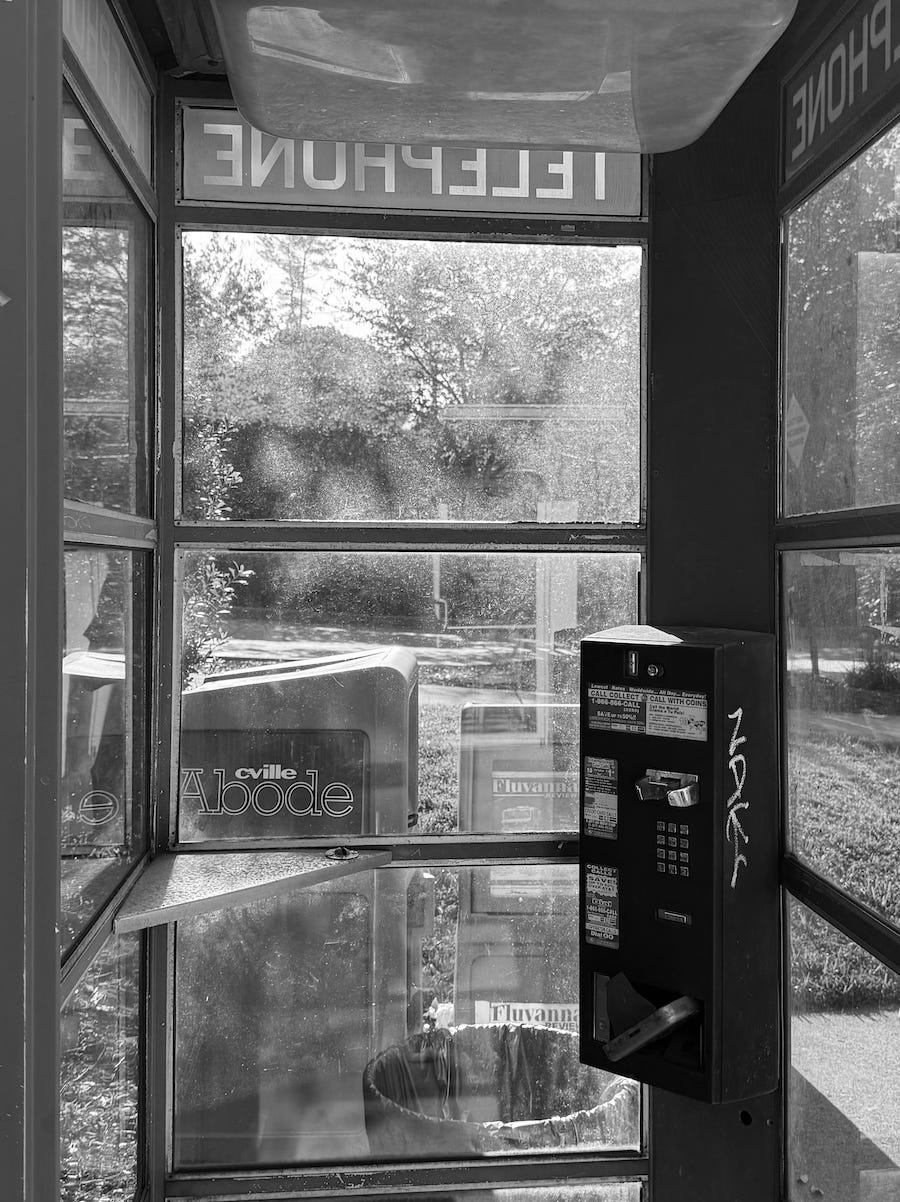
It was missing its door,4 had no handset, and was a bit dinghy, but it had boxes for local free newspapers in its neighborhood. And it evoked some memories of those phone booths I have known in my life.
Updates
I am happy to welcome Amanda H. to the ranks of the supporting subscribers. Amanda joins these wonderful Dear Readers: Angelique W., Bob P., Christine T., Clay K., Dan H., Ed M., Ed P., Janet J., Joel M., Karmelyn L., Kathy M., Kristin S., Larry M., Linda L., Mary-Anne L., Michele M., Mike C. Mike N., Jackie R., Pam S., Stephanie A.-O., Emerson D., Gerry W., Alix H., Annmarie O., Bear A., Keith L., Jean S., Bryan W., Jean C. (who ought to show up for lunch one week soon), Pam S., Pam S., Jane B., Jim P., Jim S., Michael K., Bev J., Tina C., and Vicki W. (among others). Thank you each and all for sticking with SET.
Thanks to Sunil G., Amanda H., Tom Z. (2), Rhonda B., Dan H. for dropping comments this past week. Thanks, too, to Built D. and Shasta M., both of whom have sites of their own—SamPetersLPLC (yep, “Built” is a pseudonym) and Medical Motherhood, respectively—that I hope Dear Readers are reading. Watch the comments spaces for links to other colleagues’ ‘stacks and expand your reading horizons (teehee).
SETlettes
Those readers who follow along closely will have seen these articles over the past week.
Special Education Today Newsletter 6(13): If anyone might be interested in knowing what happened for SET for the week that began 21 September 2026, fret not because this post provides a list
Teaching: The OTTER approach #0: What is this?
Understood launches Zero Reject podcast series: What does this resource offer parents and educators of students with disabilities?
SET years ago #003: 1 October 2026: What was happening on SET years ago?
Sold a Story 2 is starting: What could Emily Hanford and colleagues do to follow the influential podcast on reading instruction?
Friday catch-up notes—2 October 2026: What are some stories that did not appear as full posts this past week?
Deaf dancing in Burkina Faso: Can you stay still while watching these dancers?
Please use these links to go back to and read any posts that you might have missed (or reread them, if you did not miss them but just want to review one or more). And, please remember that you can always go to the SET home page to review recent and much earlier posts. And (another and), avoid forgetting that you can find a link to “clumps” on the home page, where there is a semi-sorta subject index to the > 1800 posts on SET.
Comments
For the editorial this week, I considered riffing on dancing, using it as a base for talking about teaching. Then I switched to crowing about…uhm…the possibility that teaching will be putting on a dance show.
Dancing
As I researched dancing by Deaf folks (and another story about a dance program for individuals with disabilities in Indiana5), I remembered how Bonnie G., a dear friend and great teacher educator, used to respond to prospective teachers who objected to having to learn scripted instructional programs because those programs thwarted their creativity. Bonnie told them (I am paraphrasing), “Look, if you’re going to learn to dance the Macarena, first you have to learn the steps, arm movements, and all. Then, once you’re good with that, you can add your special, creative wiggles and eye movements.”
I think Bonnie’s advice is really good for those of us who prepare prospective teachers, coach colleagues, and administer programs. First, be sure you are teaching effectively. That is more important than following your personal style or feel. Once you are damn sure that your kids are learning optimally, then you can start to roll your own wiggles and show your “personality.”
But, I abandoned that essay for this week’s commentary. Instead, I want to talk about teaching.
Oh, wait! Am I going to devote the remainder of this editorial to the importance of teaching for our students? So, maybe the remainder of this commentary is about the same thing as learning to dance?
Might teaching get a moment?
This week I posted about Emily Hanford’s new podcast series, Sold a Story 2. I am very eager to review this series. Given the clarity and depth of Ms. Hanford’s previous work (Sold a Story on reading) and the hints in the trailer for this new series, I am optimistic that those who follow Sold a Story 2 are going to learn a lot about teaching. What is more, I know that she has spoken with knowledgable folks like Kurt Engelmann and Doug Carnine, so I think that she will tell us will be largely consistent with the drivel that you, Dear Readers, are familiar with from reading this ‘stack.
As Dear Readers know, I argue that instruction—teaching—is terrifically important for students with disabilities. Whether we are teaching our kids to wipe their behinds, prepare lunch foods, read-write-compute, understand physics, or damn near anything, the qualities (features) of that teaching are critically important for their success. We special educators have been laboring over here (in classrooms, homes, employment places, and research sites6) to refine those teaching practices, procedures, programs, and materials for decades. We get teaching.
From watching the trailer for Sold a Story 2, with its nod to Zig Engelmann, I get a good feeling. From the acknowledgement of influential psychologists (e.g., Carl Hendrick’s The Learning Dispatch: Exploring the Science of Learning), my optimism grows. From the observations of journalists like Holly Korbey (The Bell Ringer), my confidence gets a boost. From the work of the Goyen Literacy Fellows I find encouragement.
Shoot! Maybe folks are coming around to the understanding that all that talk about improving educational outcomes devoted to laws and policies, buildings’ architecture, who’s in those buildings, the importance of leadership, the need for and the horrors of testing, the benefits and problems of licensure, the gender and race of students (and teachers), spending, big theories, and all that are less important than the freaking day-to-day teaching.
So, I am hoping that the public’s spotlight is going to follow teaching around on the stage for at least a moment (longer! longer!). I hope that concern about education is about to focus on instruction—its design and delivery—and that the matters we have been discussing here on our little island-community (practices guided by evidence and reason) will be legitimately considered on that stage where the dance occurs.
In preparation for what I hope is our moment in the sun, I hope that we all will remember to take care of ourselves and our colleagues. And, as you might anticipate, I hope that we all make dang sure that we are teaching our students well.
Hugs & Love,
JohnL
John Wills Lloyd, Ph.D.
UVA Professor Emeritus
Founder & Editor, https://www.SpecialEducationToday.com/

SET should not be confused with a product that uses essentially the same name and is published by the Council for Exceptional Children. SET predated CEC’s publication by decades; I wonder if CEC put “today” in all capitals to distinguish its product from SET. Despite my appreciation for CEC, this product is not designed to promote that organization nor should the views expressed here be considered to represent the views or policies of that organization. A membership in CEC does not get one a subscription to SET nor vice versa!
Footnote
I am, as a few of you may know, fond of the poem “The Love Song of J. Alfred Prufrock” by T S. Eliot. I am using the first words of that poem here.
“Hookville” is a play on “C’ville.” C’ville is a long standing nickname for Charlottesville. (I remember my maternal grandmother using it in the 1950s.) In the vernacular of the students at the University of Virginia (before it became a coeducational institution), there were nicknames for the grades one earned on exams or papers of for courses: A = ace; B = boy; C = hook; D = “dog”; and F = “flag.” So, of course, “C’ville” became “Hookville.”
The pronunciation is “pant-ops” as I’ve heard. That might befuddle some readers who apply usual syllabication rules. That pronunciation is supposed to be the result of naming by T. Jefferson’s use of two words translating “all” (pan) and “seeing” (ops). Those who have studied phonetics will understand how the “t” sound got into the word.
Perhaps the missing door would dissuade Clark Kent from changing clothes there and coming out of it as Superman?
I hope I can stick with it enough to drop a link to this program in another post (or at least the forthcoming Friday Catch Up).
For many researchers in special education, “sites” is euphemism for “schools.”