

In a 1971 book entitled The Essentials of Teaching, Barbara Bateman presented the OTTER approach to teaching. Over five forth-coming posts here on Special Education Today I plan to recapitulate the components of this approach.
In the book, Bateman began with an introductory chapter and ended with a summary chapter. In each of the four chapters between the introduction and the summary, she presented four elements she considered to be the main elements of teaching. In each of following posts on SET I shall give a summary of one of those four chapters and then a conclusive commentary on how Bateman’s characterization fits with contemporary educational thought and practice.
Overview
Here is an overview of what the next posts will present:
Objectives: Clearly and dispassionately specifying what learners will do as a result of instruction is the critical first step in teaching. Explicit and objective goals for teaching not only make clear where instruction is headed, but also identify the tasks that educators must analyze to design instruction and the ways of measuring whether learners have learned whatever it is that educators are teaching. In the post on objectives, we shall examine topics such as the characteristics of useful objectives, the selection of them, and the guidance for instruction that they offer. We shall seek to answer the question, “What are we teaching?”
Task analysis: Following from objectives, every learning outcome specifies some action that learners can do. That is, there are explicit tasks. They may be quite simple or complex, but they are actions that can be performed publicly. And those tasks can be analyzed to determine what educators must teach learners so that they can perform them. For example, to make a peanut-butter-and-jelly sandwich, the students must be able to perform a set of actions in sequence. To read printed words aloud, students must perform a set of actions in sequence (i.e., sound out the words). What do these tasks requite? That is, what are the component skills the students need to master? Often in education, this aspect of teaching is not treated in a systematic way. We just design activities that approximate the entire task or we provide sloppy approximations of the component skills. Task-analyses specify what lessons must include. In this post, I shall provide examples of analyzing tasks from self-care to social sciences.
Teaching and managing: When educators have clearly specified objectives and carefully designed teaching plans, they still must implement those lessons in ways that ensure that learners can acquire the component skills or knowledge and thereby fulfill the objectives. This is about the transactions that occur between teachers and students. It is about the teaching practices. It is about building environments in which learners succeed. There has been a lot of talk about different teaching methods, some of it quite broad (e.g., direct versus indirect teaching) and some of it at a level of precision that is sharpened to the point of a pin (e.g., types of feedback). The summary in this article will assume that there is not a lot to be gained from engaging the broad debates or even from drilling into the research on types of prompts. But it will emphasize that there are some instructional practices that are particularly useful in leading students to mastery of component skills, and that teaching should employ those methods.
Evaluation: In this post, rather than bemoaning how horrible tests are, I shall simply remind readers that objectives specify how we can assess whether students have reached mastery of the objective. We do not need evaluations that provide grade equivalents or normative scores. We need to assess whether learners can do what the objective specified. Can the learner read connected prose fluently? Can he compute the product of binomial expressions? Can she extract DNA from common fruits? Can the students identify common features of planetary orbits? Such competencies are readily testable. What is more, the tiny teaching actions (e.g., questions) that lead up to mastery are each an evaluation in and of themselves. So, how do we evaluate learners’ learning. Well, we do not need fancy tests. We really just need a good dose of common sense.
OTTER?
As one can readily see, the initial letters of these four components—Objectives, Task analysis, Teaching, and Evaluation—point toward a mnemonic for teaching: OTTE. All we need to make that mnemonic work is an “r” on the end and we have OTTER. So, Dear Readers can expect that there will be a post that discusses the R component. For a hint about the content of that post, look closely at the accompanying image.
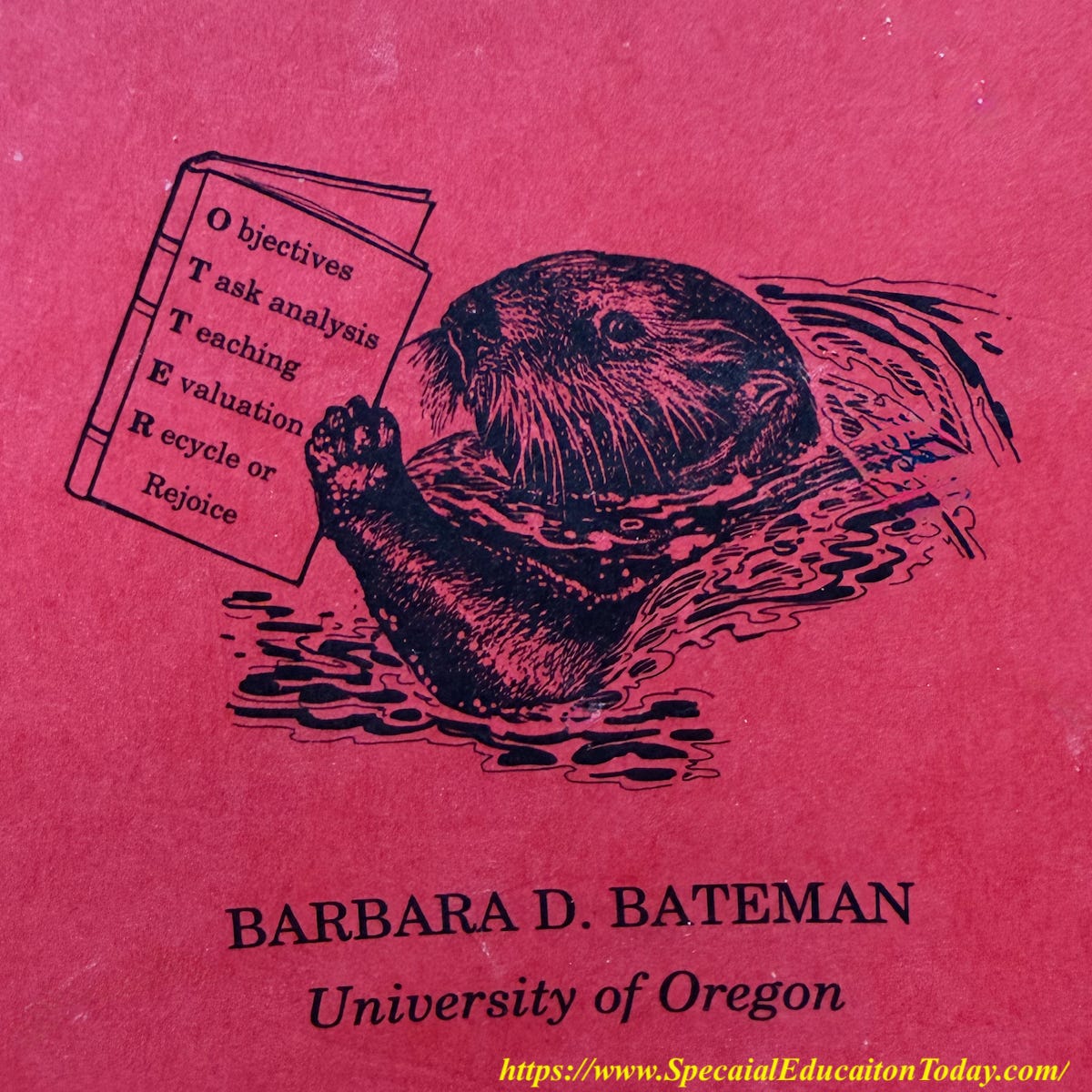
As far as I know, the original Essentials is out of print. Indeed, Bateman self-published it as a product of “Otter Ink,” a publishing company that was located at her house. One might be able to find one in the used book market, but I have not succeeded in doing so.
Attainment published a version in 2007, but I have not found it on the publisher’s Web pages. The used book seller Alibris lists the book but shows that it has zero copies for sale. Maybe one could find it at another used book company…or, maybe, in the jungle.
I think my copy of the 2007 version grew legs like a snake and walked right off my bookshelves and out of my office door. So, for the forthcoming posts, I shall be writing from the 1971 version, which I still have right here on my desk at SET Central.
One more note before I close this post: The articles covering the OTTER approach will be available to supporting subscribers. If you would like to become a paid subscriber to SET, please follow the link here.
References
Bateman, B. (1971). The elements of teaching. Otter Ink.
Bateman, B. D. (2007). Elements of Teaching: A best practices handbook for beginning teachers. Attainment.
R for reinforcement.
https://www.amazon.com/Elements-Teaching-Practices-Beginning-Teachers-ebook/dp/B00H2Y6EFW