
Special Education Today newsletter: 6(2)
What's in this summary for the week ending 12 July 2026?

Howdy, hello, and welcome to the weekly newsletter for Special Education Today. This is the second issue of the sixth year for SET. This issue has the usual sections (photo, updates, list of spedlettes, commentary), and there is plenty of content in each of them, so let us go then, you and I….1

Photo
This week, in the category of Backyard Fauna, we have a juvenile white-tailed deer. Pat caught this fawn in the backyard about 20 meters from the desk for SET Central. It is one of two that have been spotted multiple times over recent weeks, and I am not quite sure which one this is.2
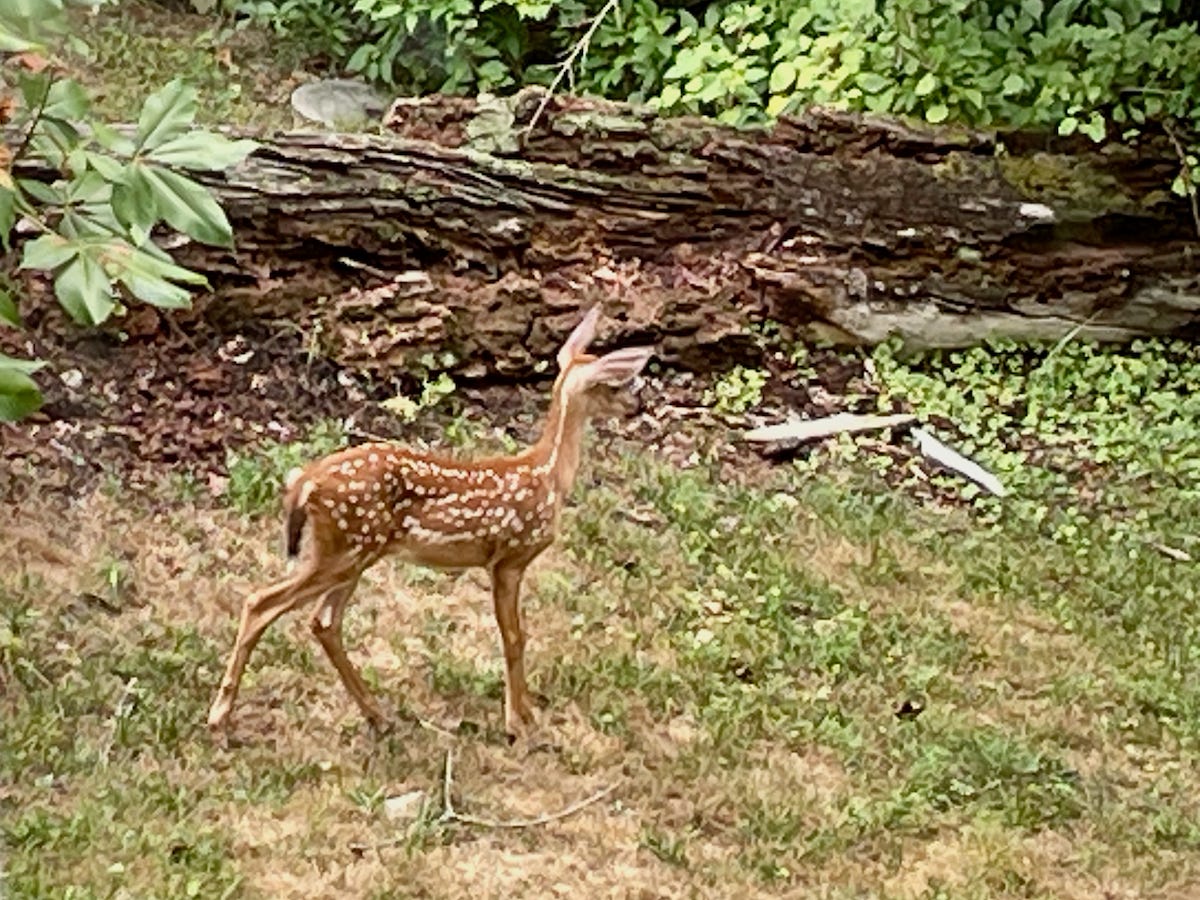
This one is clearly still sporting its camouflage dots. It is going to need to gain some weight (fat is okay!) to prepare for the coming winter.
Updates
I want to provide a tip of the cap to some folks who recently anted up for a paid subscription or renewed their existing subscriptions: Roberta B., Marilyn F., John U., Bear A., Linda M., Jenn L., & Jenn R. It is wonderful to have your support of SET, right there alongside the Patrons, Kathy M., Anita A., and Mike G. Thank you!
This issue of the SET newsletter is going to greater than 1200 subscribers, and another ~500 followers will get notice about its publication. About 100 of you Dear Readers are financial supporters.
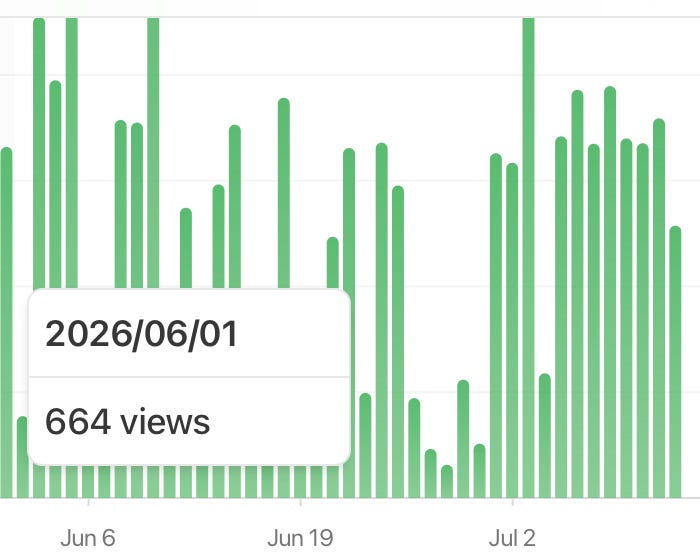
With the first week of the new volume year, SET is once again taking some traffic. Things were a little inconsistent during the two-week summer break. The following bar graph shows the page views for the month of June and the beginning of July 2026. The highest bars are at about 1000 views for those days.
I am no longer seeing quick and easy access to the distribution of subscribers by geography, so I cannot provide a list of countries around Earth that harbor subscribers. Sigh. I like thinking about and sharing with you, Dear Readers, the international extent of the audience for SET. I shall have to inquire among the overlords what has become of that feature.
I hope that we can make the audience for SET grow. Please help by informing your friends and colleagues about SET.
Spedlettes
There were eight spedlettes for this past week. Here is the list from oldest (the previous newsletter) to newest.
Special Education Today newsletter—6(1): What was happening the first week of July 2026?
National DI Conf: Isn’t this one worth attending?
Readiness tips from the American Medical Association: What does the pediatrics group of AMA recommend to parents?
Foundation for scientific thinking: Is there objective knowledge and how do we determine it?
US Education Department’s annual report about states’ implementation of IDEA: What does the report reveal about the provision of special education?
Friday catch-up notes—10 July 2026: What tidbits didn’t show up as a full post this week?
Keeping current with learning disabilities: What is the Learning Disabilities Association newsletter carrying?
Please remember that y’all can access the current posts (as well as the archives of > 1700 spedlettes) at Special Education Today. A list of the entire catalog—that’s the whole shebang—is right out there in public for the world to see. (To be clear: The content of some of the posts are only available to paid subscribers, but the full list is public.)
Comments
I have been cogitating, and (as many of you know) that’s dangerous. I’m concerned about what seems to me to be a runaway train that is hauling a load of “science” and “cognitive psychology” into not just the midst of instruction for special education—and education overall. I’m working on a paper with my long-time colleague and pal, Peggy W. that examines the foundation for and future of specially designed instruction. That’s been adding to my unease about how straight-ahead work on instruction in the decades of the 1960 and 70s (and even the 80s and 90s) got pushed aside in favor of shiny constructs from psychology and law.
In the 2020s, advocates for educational reforms who promote effective instruction seem to be especially enamored with scientific research. Phrases like “the science of X”—where X can stand for reading, arithmetic, writing, and (of course) learning—frequently appear in posts from excellent (and not-so-great) sources. Some of these sources assert that they are drawing on science as the foundation for recommendations about instruction, about teaching.
What’s hot?
Frequently, the advocates refer to research about cognitive science, especially cognitive psychology. They write often about mental processes such as attention and memory, which are mainstays pf psychological explanations of how the mind works. They discuss, for example, short- and long-term memory and the importance of rehearsal in advancing memory for concepts and operations. Let’s interleave practice opportunities so that what’s to be remembered will be more durable, will be transferred to long-term memory!
And, lest we overlook another important process, there are frequent mentions of “executive function.” Executive function refers to allocation of attention, memory, and other processes to perform tasks, including learning to read, compute, write essays, and so forth. To the extent that executive functions become automatic, the burden of exercising those functions is lessened for the learner. That is, there is a reduction in the cognitive load—and there’s another popular topic in discussions of applying cognitive science to teaching.
Whoa back!
I am a tad—well, honestly, more than a tad…substantially—concerned about the rush to find guidance about instruction in cognitive science. I want to recommend that educators tap the brakes on racing downhill to an embrace of cognitive psychology.
My hesitation is not newly discovered. Dan Willingham and I (2007) described the misalignment of neurocognitive concepts and educational practice. We noted that one of the reasons that we were able to use reading problems and reading instruction to illustrate our observations about the correspondence between neuropsychology and education was that education already had an extensively detailed account of reading and reading instruction. That is, we were simply mapping the neuropsych constructs onto well-defined instructional processes.
I think the same point that Dan and I made in 2007 is readily applicable to the contemporary rush to apply cognitive psychology to teaching. Most, or at least a lot, of the discussion of cognitive psychology one reads in 2026 is essentially the application of a cognitive vocabulary to already known instructional constructs and practices. To be sure, those constructs and practices may be employed in slipshod, ill-articulated ways, and maybe hardly employed at all. So, if listening to the cognitive psychologists will help educators to implement them better…well, yay! But let’s not have the fancy vocabulary lead us to think that we’re getting something modern and new. In the end, our task is still about getting learners to respond in specific ways under certain circumstances, and that’s what teachers do.
I have been working on articles explaining problems and prospects for instruction. I hope to begin dropping them in these pages over the next few weeks. Stay tuned! Don’t touch that channel!
Meanwhile, and actually to the point, please remember to take care of yourselves and your friends and colleagues and keep the focus on teaching our kids well.
JohnL
SET founder and editor
SET should not be confused with a product that uses essentially the same name and is published by the Council for Exceptional Children. SET predated CEC’s publication by decades; I wonder if CEC put “today” in all capitals to distinguish its product from SET. Despite my appreciation for CEC, this product is not designed to promote that organization nor should the views expressed here be considered to represent the views or policies of that organization. A membership in CEC does not get one a subscription to SET and vice versa!
Footnote
Homage to T. S. Eliot for, “The Love Song of J. Alfred Prufrock.”
There’s the UK’s highly decorated Paralympian swimmer, Sascha Kindred and his non-disabled twin, Timo. Maurice or Robin? Romulus or Remus? Barbara or Jenna? Michael and Chris? Nakula and Sahadeva? Pollux or Castor? Masashi or Seishi?