

Hey, there, and howdy! Welcome!
This is the weekly newsletter for Special Education Today for the week ending 16 March 2026. It’s volume 5, number 37, and it is the 1621st post in the history of SET.
If you’re new to SET’s newsletters, here’s what you will be able to read (hear) in this issue: (a) a photo that may or may not be relevant to special education; (b) an update about the status of SET; (c) a list of posts from the previous week (with links to them); and (d) an editorial comment or such.
Image of the week
Readers who have been reading for a while may remember that I have previously posted photos of a trail that runs adjacent to (and sometimes across) our property. It is part of the Rivanna Trail and a segment of it is just about 40 m. from SET Central. It’s a wonderful place for me to exercise (when the ticks aren’t abundant) but I’ve only rarely used it in the last year. However, I went down to it just recently. I got this photo of the creek next to it.
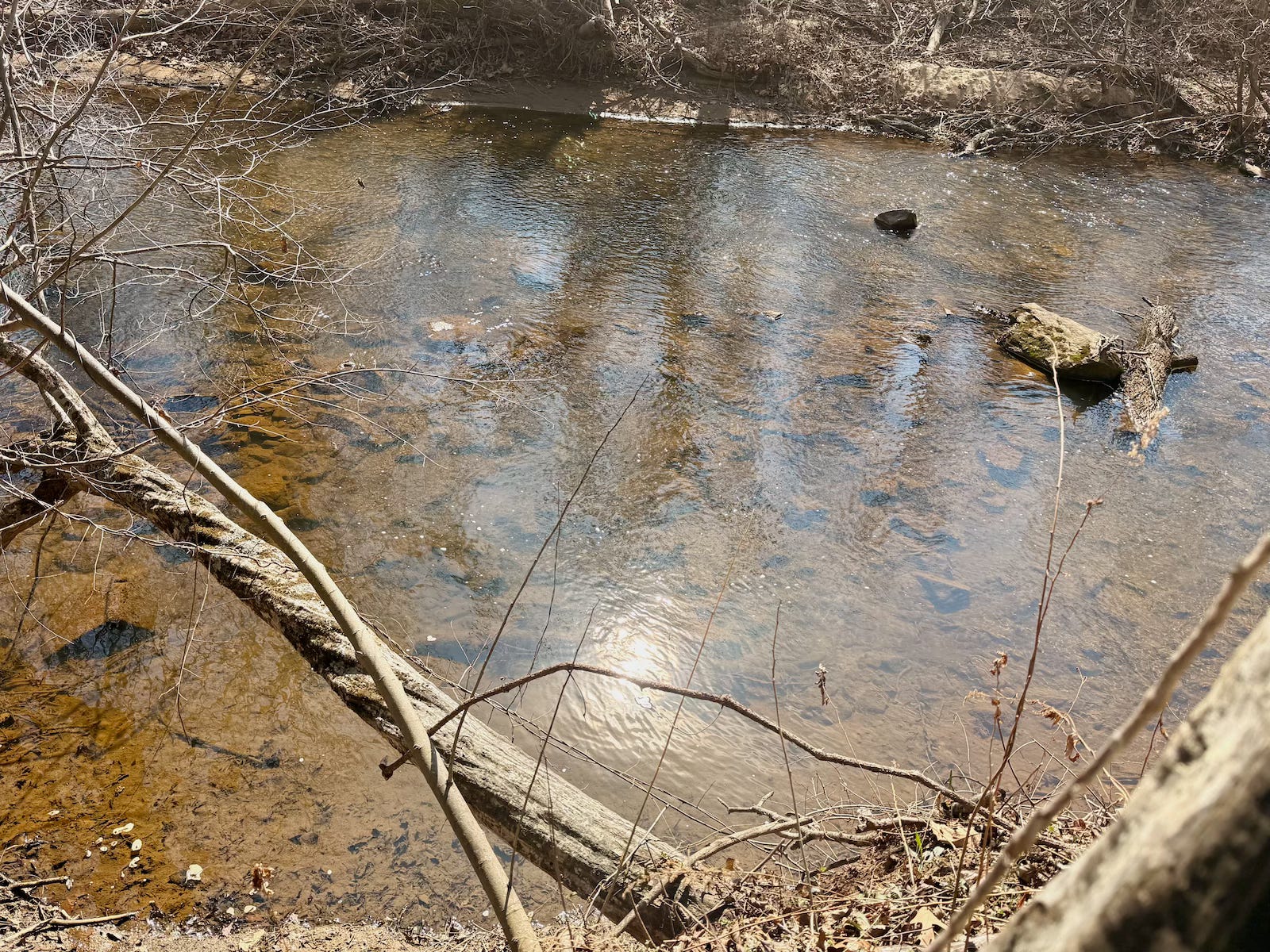
I don’t mean to contend that this is any great photo or that it shows something significant. I’m just passing it along as a way of saying that get onto the trail and managed about a quarter mile of walking along it. That creek is still there—yay—and I hope to get back to walking the trails again in 6 months. or so.
Status notes
SET keeps chugging.1 We’re well over 1100 subscribers. Now, that’s nothing like the 2, 800,000 subscribers that, say, Heather Cox Richardson has for her ‘stack, Letters from an American. Nor is the SET number anywhere near the (well-deserved) reach of Holly Korbey at The Bell Ringer. But it’s OK. Sure, I’d like our number to be greater, but—you know—SET is in a niche market. So, why worry? Let’s be happy!
Besides, there’s been a little growth. Maybe 10 or 12 people subscribe, but there’ve been some unsubs, too; the net is probably plus a couple-few a week. But, welcome to Dave P., Brady G., Ghop, Julie K., Stephanie F., Caitlin R., Gynn, Linda P., Fernwinth, Key, Efrat F., and Mike. It’s great to have y’all on the ride…please hold on tightly!
As always, I was to post a shout-out to SET’s sustaining supporters. Kathy M., Anita A., & Mike G have been contributing and continue to do so. Thanks, too, to the many readers who also support SET with subscriptions, including Ed P., Dan H., Stephanie A-O, Marina P., Monica McH., linda L., Larry M., Ed. M. Hill W., Kristin S., Maryanne L., Pam S., Pam S., Vince C., Joel I., Joel M., Alix H, Alexis, Callie O., Angelique W., Anna O., Fang X., Kidu V., Jane N., Jim F., Candace S., Jean S., Ann R., Paige P., and Tom Z. All y’all: Thank you!
I also want to express my appreciation to those who dropped comments or restocked posts this past week: Carl H., Nancy S., and Shasta M.
Spedlets
Here is a catalog of the posts from the previous week. Authors’s initials are in brackets.
For everyone
Special Education Today newsletter 5(36): What happened in SET Land the week that began 2 March 2026? [JWL]
Reading interventions in high school for ELs with disabilities: What do we know about interventions in high school?
Police kill autistic man outside his new community home: What happened with Alex LaMorie of Maryland (US) on 1 March 2026? [JWL]
Friday photos: D. Ramer and P. Weiss together at CEC conf: Where have these people been seen together before? [DB & JWL]
Friday catch-up notes—13 March 2026: What tidbits didn’t show up as a full post this week? [JWL]
Success is sweet—thanks E. Dickinson: Shouldn’t we make sure to remember our kids’ wins? [JWL]
California governor’s dyslexia in the news (again): What spins about reading-spelling problems are appearing in news media? [JWL]
For the faithful
A presidential press conference about autism, acetaminophen, leucovorin, & ... oh my: What were the effects of bogus medical advice on prescriptions for drugs? [JWL]
If you wonder whether you might have missed a mailing, whether I posted something but did’t send a mailing, what’s in the archives, or you just want to review something, you can go directly to SpecialEducationToday.com. There is a list of the recently post (in reverse chronological order) and a link at the top of the page to the “archives,” and a link after the 10th or so recent post to another page with additional previous posts.
Editorial
As she of you Dear Readers already know (or have inferred, I’m a little fretful about all the talk about science these days. It seems like one can claim the cloak of authority by simply saying “the science of” with just about any word following “of.” We (at least, I) have become accustomed to encountering that phrase in articles about reading, math, writing, learning, and even teaching.
Part of my concern about the spread of such phrases is a result of my interest in language. One college professor whom I admired greatly taught creative writing (Henri Coulette, whose focus was on poems) turned the phrase into anathema for me. I remember him musing about the generic phrase “the X of Y,” explaining that it was all too common in unsophisticated, pretentious poems. I don’t recall the exact examples he used, but they were similar to these: “The wonder of love,” “the joy of existence,” “the weight of loneliness,” “the science of reading.” Okay, I added that last one to connect back to my point; I’m pretty sure Professor Coulette didn’t use it as an example.
And the variants on the phrase are used to refer to a large—an often largely undefined—body of knowledge. The body of knowledge to which it refers in my reading in the last few years seems to be cognitive psychology and neurological function, with the two often mixed. To be sure, in the last 50 (or so) years,2 research in these areas has accelerate and expanded dramatically. Indeed, that work is so broad, with so many findings and so rapidly evolving, that I’m a bit skeptical that people who refer to “the science of thinking” are actually acquainted to all of it.
But, you know, it does sound powerful when one can say, “The science of X has shown this to be true.” Doesn’t it? BahBoom! Strike the bass drum with vigor. No need to question that point, right?
You know, there was a predecessor for “the science of.” It had a similar function. People used it when making a vague and undefined reference to trustworthy knowledge. You, Dear Readers, probably heard it repeatedly. “Research shows….” Shoot, I don’t even need a spoon. When I hear that, I can start to retch without the benefit of a metal utensil. Just gag me.
I usually have been pretty good, if I do say so myself, about suppressing the urge to regurg when I hear “the research says….” I prefer to listen, nod, and then, when I get a chance, ask a question. “To what research can you point me?” “If I understand what you’re saying, you recommend teaching in this MNOP way to improve this XYZ outcome. What studies show that’s the case?” “You know, I actually like reading studies and figuring out what was tested in them.”
In the words of Og Lindsley, “Show me the data.” I’m kinda done with the science of believe me.
And every everyone (that’s only a semi-scientific term), please remember to take care of yourselves, your family members, and friends—eat well, exercise, practice patience, drive carefully (with seatbelts affixed). And, of course, remember to teach your children well.
Giggles and grins,
JohnL
John Wills Lloyd, Ph.D., UVA Professor Emeritus
Founder & Editor, https://www.SpecialEducationToday.com/
Footnotes
I mean “chugging” as did the “Little Engine that Could,” not like the person raising a jug on his arm.
As a doctoral student, I had the delightful experience of studying with a professor, Michael Posner, who helped propel the extraordinary growth of cognition and neuroscience.