
Update on federal funding for special education
What is happening with funds for special education and research in current US legislation?

As of 21 January 2026, the US Congress is considering a budget bill that proposes levels of spending that continue allocations at the same level as in recent years. Described as a “minibus” (as opposed to an “omnibus”) spending bill, the appropriations plans include funding for special education in the Education Department, as well as some funds in other federal departments. According to a press release from the Appropriations Committee of the US House of Representatives, the proposals will continue full “funding of the government before the January 30 deadline.”
Some features of the proposals are noteworthy for what they prohibit. In particular, there is language in the proposed legislation that forbids agencies transferring funds or responsibilities to other agencies. As the proposals explained, these provisions explicitly respond to efforts by the Education Department to shift functions to other agencies during the changes in ED—dismantling the department—pursued during 2025.
I’ll take up illustrative financial features first and then return in a later section to the constraints on reallocating funds and functions.
Some financial features
In a separate document released by the committee Representative Rosa DeLauro for the Democrats (the minority or opposition party), the overall level of funding for the Department of Education is said to increase by $12.3 billion to a total of $79 billion.
K-12 Education, including Individuals with Disabilities Education Act programs – The bill includes $44.7 billion, an increase of $9.3 billion above the House Republican bill. Within this amount, the bill includes:
$18.4 billion for Title I Grants to Local Educational Agencies, an increase of $4.7 billion above the Republican House bill.
$890 million for English Language Acquisition, which was eliminated in the Republican House bill.
$2.2 billion for Title II-A (Supporting Effective Instruction State Grants), which was eliminated in the Republican House bill.
$15.5 billion for Special Education, an increase of $23 million above the 2025 level.
$1.4 billion for Student Support and Academic Enrichment State Grants, equal to the 2025 level.
$1.3 billion for Nita M. Lowey 21st Century Community Learning Centers, equal to the 2025 level.
$1.6 billion for Impact Aid, an increase of $5 million above the 2025 level.
$150 million for Full-Service Community Schools, which was eliminated in the Republican House bill.
Other documents have allocations for very specific disability related activities. For example, in “DIVISION_ - DEPARTMENTS OF LABOR, HEAL TH AND HUMAN SERVICES, AND EDUCATION, AND RELATED AGENCIES APPROPRIATIOS ACT, 2026” there are specific directions to the Centers for Disease Control under the Department of Health and Human Services to spend $19 million on birth defects, $28 million on autism, $2.5 million on Tourette syndrome, $1.9 million on ADHD, $7.5 million on spina bifida, and more. In the section on the Education Department, he document specifies an increases of $1 million for Educational Technology, Media, and Materials; requires the department to “hold a new competition for the C-2 regional [Parent Information and Training] center”; specifies funding for the American Printing House for teh Blind, the National Technical Institute for eh Deaf, Gallaudet University;
There is a section appended to the agreement that includes lines and amounts for the Office of Special Education and Rehabilitation. Here is the section referring to special education:1
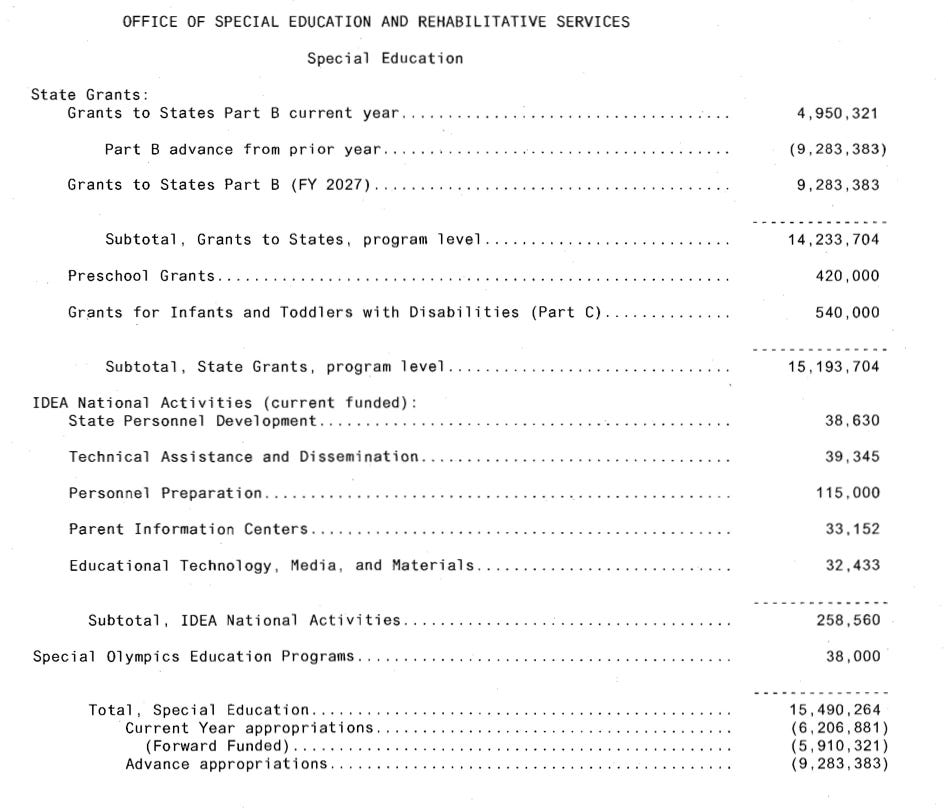
The list I have created here is not exhaustive. If you don’t see notes here about funding for something of special interest to you, don’t take it as an indication that there is no funding. I only extracted some specifics in my quick review.
Some of the allocations include language stipulating that the the cabinet level agencies must report to Congress about the execution of the features of the law. Sometimes these reports are required very quickly (e.g., within 30 days) after the law is passed. Other times the reports are frequent (e.g., every 90 days). I am accustomed to reports to congress being required annually (as with IDEA), so these provisions raised a flag for me. I hope others with greater knowledge about what’s happening will help explain them.
Express direction for execution by ED
As mentioned in the introduction of this post, there are provisions in the agreement that prohibit the Department of Education for “outsourcing” activities to other agencies. I may be mistaken, but I read this as constraining ED from having other cabinet-level agencies such as Health and Human Services or Justice perform duties related to IDEA.
Here are a couple of relevant paragraphs. This is in the section regarding of the agreement that refers to ED’s management; it is under heading “DEPARTMENTAL MANAGEMENT: PROGRAM ADMINISTRATION.”
Interagency Agreements and Program Transfers.—The agreement notes that it provides funding to the Department of Education to carry out specific programs, projects, and activities that have been authorized in law for the Department of Education to carry out. It also continues a provision that prohibits the transfer of such funding to another Federal agency unless such transfer authority is provided in an appropriations law. The agreement further notes that no authorities exist for the Department of Education to transfer its fundamental responsibilities under numerous authorizing and appropriations laws, including through procuring services from other Federal agencies, of carrying out those programs, projects, and activities to other Federal agencies.
The agreement notes concern about the Department of Education’s recent, unprecedented use of Interagency Agreements to transfer significant programmatic responsibilities, procure services, and detail staff to other Federal agencies, including to the Departments of Labor, Health and Human Services, State, and Interior. The agreement is concerned about the assignment of such programmatic responsibilities to agencies that do not have experience, expertise, or capacity to carry out these programs and activities and lack developed relationships and communications with relevant stakeholders, including States. The agreement is concerned that fragmenting responsibilities for education programs across multiple agencies will create inefficiencies, result in additional costs to the American taxpayer, and cause delays and administrative challenges in Federal funding reaching States, school districts; and schools. The agreement is also concerned this will weaken Federal support to protect the rights of students, children, youth, and families under Federal education laws.
Given these concerns, the agreement directs the Department of Education and signatory agencies to provide biweekly briefings to the Committees on implementation of any such interagency agreements. These briefings shall include information on staffing transfers, implementation costs, metrics on the delivery of services, availability of technical support for programs to grantees, the issuance of Notices Inviting Applications or other funding opportunities, plans for maintaining high standards of quality and objectivity in grant competitions through multi- reviewer peer panels, rates of accessing funds by grantees and any resulting delays through the draw down of funds, updates on monitoring for grantees’ compliance with all federal requirements, implementation of reporting requirements by grantees and Federal agencies and communications with eligible grantees, States, and other stakeholders. Such information shall include comparisons to prior years on a comparable basis.
As I read this, it sounds like it will be unlawful for ED to pursue its efforts to dismantle itself by moving some functions to other cabinet departments. Does that seem like an accurate interpretation?
Other sources
Other sources covering these appropriations proposals provide additional information.
Laura Spitalniak, 20 January 2026 for Higher Ed Dive: Congress moves to reject Trump plan to slash Education Department funding: A bipartisan 2026 spending proposal from both legislative chambers would preserve funding for a litany of student support programs
Mark Lieberman, 20 January 2026 in Education Week: Rebuking Trump, Congress Moves to Maintain Most Federal Education Funding: Funding for key programs like Title I and IDEA are on track to remain level year over year;
Jay Heckman, 20 January 2025 for Federal News Network: 3.8% pay raise for air traffic controllers, Education Dept cuts rejected: Highlights from final FY 2026 spending bills;
I understand that people at the Council for Exceptional Children are tracking the budget developments. Interested readers might want to follow “Policy Insidet”2 for news from Kuna Tavlin of CEC (itself) and “Washington Updates” from Kaitlyn Brennan of the Teacher Education Division.
Footnote
This part is an image, because the formatting in the original made copying it diabolically difficult.
“Policy Insider” appears as a part of CEC’s “Special Education TODAY.” SET should not be confused with the CEC product that uses essentially the same name. SET predated CEC’s publication by decades; I wonder if CEC put “today” in all capitals to distinguish its product from SET.
Thanks so much for the Deep Dive, John! I also think that IES is scheduled to receive at least flat funding in this bill. Did you find anything about IES in the language? Encouraging news #4specialeducation