

Here begins, yet again, the latest is of the weekly newsletter for Special Education Today (at least the “latest” until next week. This one covers the week that began 31 July 2026. Friends and others familiar with how we roll here in SET land may anticipate the usual sections: Photo, Updates, Spedlettes links, and (maybe?) Comments.
Let it rip!
Photo
If one was standing just outside SET central and looking pretty much eastwards, this photo shows what one would see. That is a part of our backyard as of September 2026.
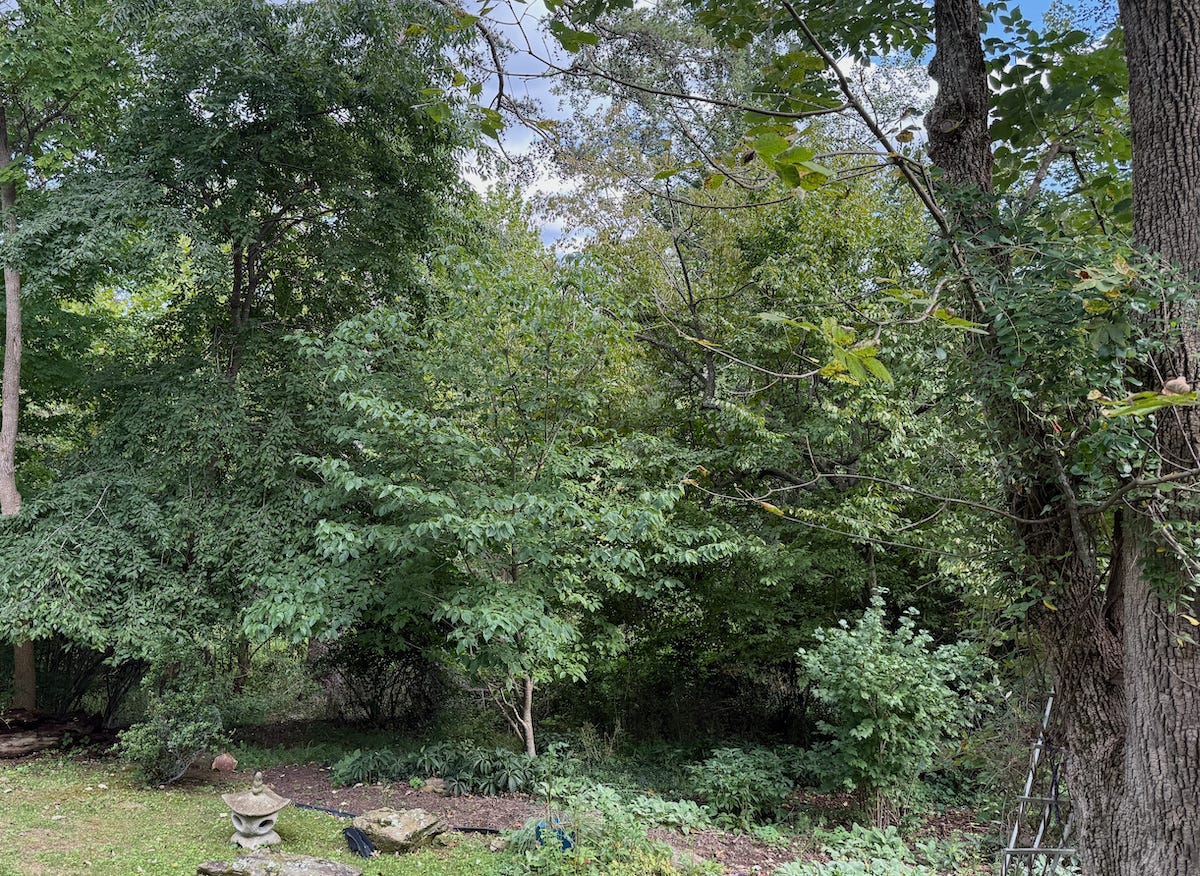
It is right dang thick. Just beyond the pagoda-like yard ornament in the lower left, there is a tunnel-like passage through to the deeper backyard, the trail, and the creek. Dear Readers may recall having seen those areas in earlier photos.
The larger tree on the right is an Ash. It has been infested with the Emerald Ash Borer, an invasive species that destroys host trees. The boring (ahem) insect has reportedly destroyed 100s of millions of Ash trees since the early 2000s. The Wikipedia entry on the Emerald Ash Borer is informative and includes a map showing how the insect has spread from Michigan to areas around the Great Lakes and down into the forests of our general area.
Pat has selected the help of two arborists in hopes of allowing this individual tree to produce seeds for future generations (where, of course, new generations of Emerald Ash Borers may propagate, too).
Updates
I have no new paying subscribers to announce this past week. Sigh. At least we have those who have been with SET for more than a week—in many cases, for years. I’m including Sally B., Jane B., Adelaide D., Ed P., Clay K., Em D. Joel M., Dan H., Christine T., Mike N., Linda L., Angelique W., Larry M., Ed M., Hill W., Michele M., Kristin S., Mary-Anne L., and both Pam S. and Pam S. There are others who support SET.
Please join them and our patron sponsor, Anita A., Kathy M., and Mike G.
The overall subscriber base for SET includes greater than 1270 people. As the following map indicates, there are subscribers from many countries. The darker the green, the more subscribers. (I’m sorry that it’s hard to see the fainter greens.)
Slightly greater than 20% of those subscribers are from the US with additional big clumps in Australia, Canada, and the UK. My fond hope is that SET will develop reach into many other parts of Earth.
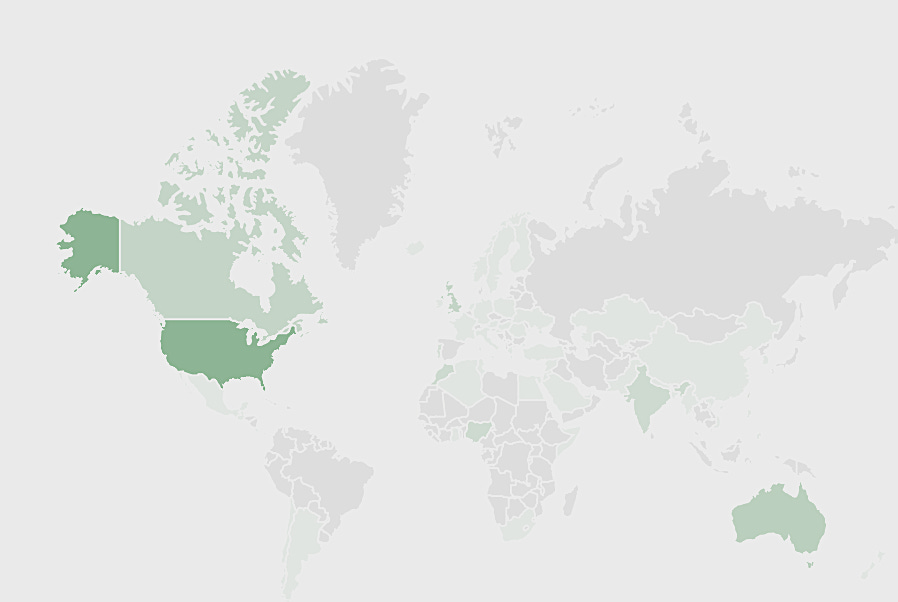
I need to refine my image editing skills to make this clearer…maybe in a future issue.
Spedlettes
We had a few posts this past week. Here’s a list.
Special Education Today newsletter 6(09): This missive is an update for the week that began
SBSK interviewed a student about to start medical school: How did this woman go from paralysis as a pre-teen to studying medicine?
Science in Autism Treatment on educators: What does the venerable organization have to say about teachers?
Growing white matter?:Why would that matter? [PAID]
Attention is hot...well, wait...uhm...what is it?: How does one know much about this widely discussed topic? [PAID]
Friday catch-up notes—4 September 2026: What are some stories that didn’t show up as full posts this week?
Extra! Extra! Disappearing NRP documents?: How’s that for a mysterious click-bait headline?
So that’s all I’ve got for this week. Here’s the obligatory reminder: Folks, regardless of subscriber status, readers can find a full catalog of posts on the Web site for Special Education Today.
Comments
Let me ask you this, Dear Readers: What is teaching?
It’s easy to find a lot of philosophical smack about teaching. Teaching is freeing learners to be themselves. Teaching is sharing. Teaching is passing joy onto students. But I’m not talking about those grand proclamations. I’m searching for operational, objective, behavioral descriptions of teaching.
We could go off in the opposite direction of the grand philosophical characterizations of teaching. We could go in the currently popular direction of talking about memory, attention, executive function, and such. We could be discussing Rosenshine’s principles or high-leverage practices. But those are too bitty and not conceptually organized…a bit ad hoc.
Instead, I’m going in the direction of behavior. I’m preparing to argue that teaching is manipulating environmental variables to cause predicted changes in learners’ behavior.
I am borrowing this characterization of teaching from Barbara Bateman’s 1972 book, The Essentials of Teaching1. It provides a simple, operational, objective means for talking about teaching.
We’ll be going there in the coming weeks.
But, before I leave this newsletter, I want to note that it is publishing on the anniversary of my late, dear sister Hannah’s birth. She was a wonderful big sister, walking me to school, introducing me to her boy friends, telling me so much of what she was learning, Here’s a photo of her on her wedding day.

Peace,
JohnL
John Wills Lloyd, Ph.D.
UVA Professor Emeritus
Founder & Editor, https://www.SpecialEducationToday.com/
SET should not be confused with a product that uses essentially the same name and is published by the Council for Exceptional Children. SET predated CEC’s publication by decades; I wonder if CEC put “today” in all capitals to distinguish its product from SET. Despite my appreciation for CEC, this product is not designed to promote that organization nor should the views expressed here be considered to represent the views or policies of that organization. A membership in CEC does not get one a subscription to SET and vice versa!
Footnotes
I’m working from a version that Bateman self-published as Otter Ink. Attainment has a newer, fancier version. You might be able to find it on the intertubes. Bateman, B. D. (2007). Elements of Teaching: A best practices handbook for beginning teachers. Attainment.