Welcome to this week’s issue of the Special Education Today newsletter. This issue covers the week that began 13 April 2026. Over the week there were some goings-on, but none of them were especially dramatic or momentous. Whatever happened, this is the place where one can find notes about those happenings.
If you are a regular reader, then you likely can predict that this issue of the newsletter includes a photo, some status notes, a list of recent posts, and a bit of editorial comment.
Photo
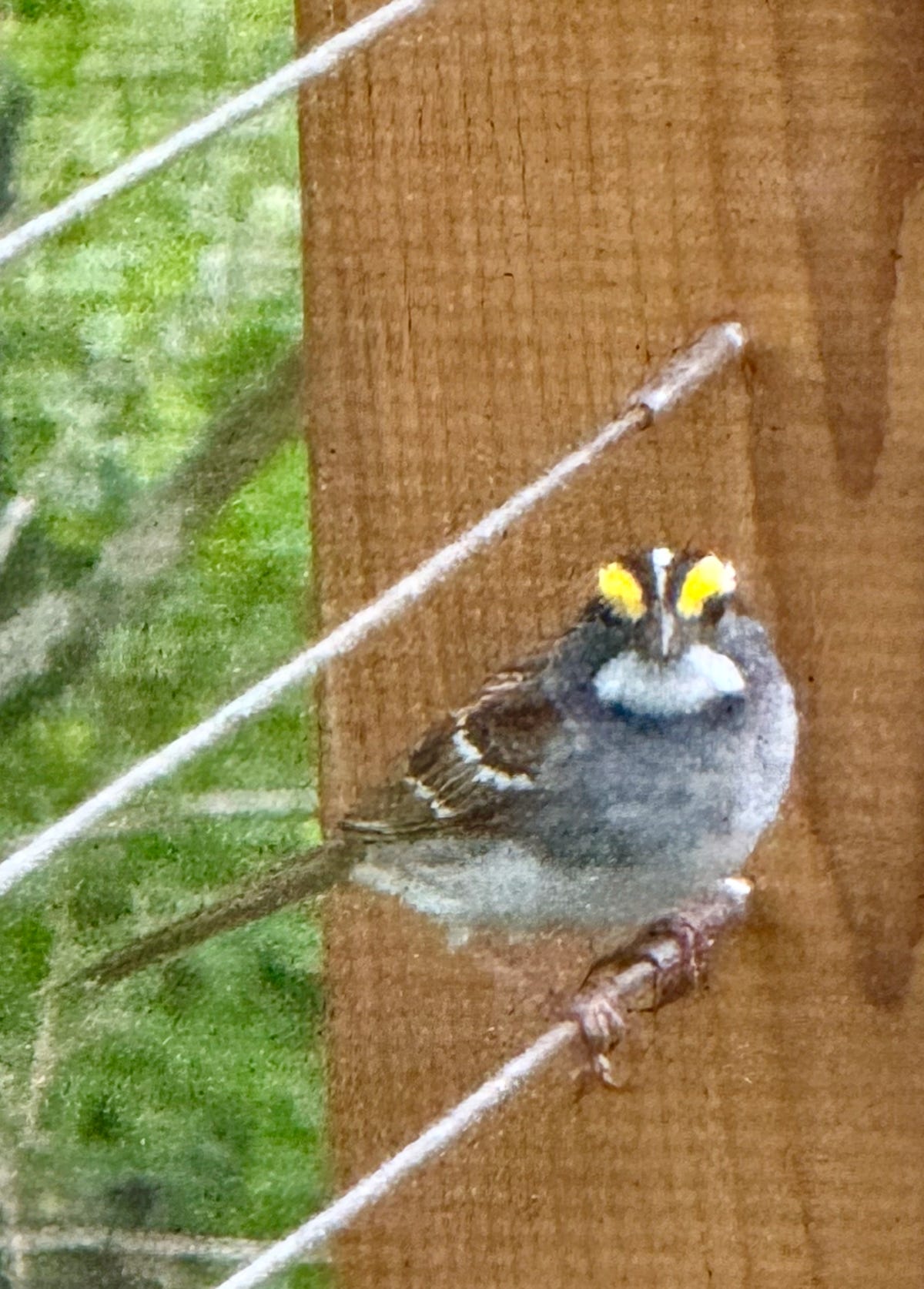
You, Dear Readers, have seen multiple mentions about birds lately on SET. Why should I quit when I’m on a roll? Here is a picture of a White-throated Sparrow I took recently looking out a window from my place at the kitchen table. You can see the window screen pattern on the background. Oh, to be skillful enough to capture images of the quality that those professionals do…sigh.
Even given the low-quality photo, it is pretty easy to see why this little visitor is called “white-throated,” isn’t it? Sometimes one sees individuals with less obvious yellow eye markings (often immature, birds, I think) and sometimes there is a small, dark spot on the chest (smaller than one would see on a Song Sparrow), but these birds’ marking are distinct.
These little beauties are residents of the eastern US in the winter and early spring. They migrate to areas all across Canada, leaving my neighborhood in mid- to late-May.
During the spring in my neighborhood, one can often hear the songs of White-throated Sparrows in trees. The page about the song on the Cornell Lab’s All About Birds (great site) gives two mnemonics for the song: “Oh-sweet-canada-canada” and “Old-Sam-Peabody-Peabody” that are pretty easy to remember.
The song sung by some White-throated Sparrows has changed since about 2000, however. According to an article by Priyanka Runwal in Audubon Magazine, “A modified dialect of male song began in a local population in western Canada and, in two decades, traveled to birds more than 1,800 miles away.”
Male White-throated Sparrows usually whistle a simple yet elegant tune: Oh sweet Canada Canada Canada. But that’s not the song biologist Ken Otter has heard the local sparrows singing since 2000. Instead of the thin whistle typically ending in three syllables, male sparrows in Prince George, British Columbia, sang songs that ended in two syllables: Oh sweet Cana Cana Cana.
Between 2000 and 2019, this rare dialect went ‘viral,’ Otter says, traveling more than 1,800 miles eastward into Canada and the United States. As it spread, the new two-syllable song replaced the widespread three-syllable song, the University of Northern British Columbia researcher and his colleagues report in a study published today in Current Biology.
Pretty fascinating, no? This is a change in behavior (I guess we’d say, “verbal” behavior?) across millions of individuals in a matter of a couple of decades. Cool?
Updates
Thanks to all you wonderful Dear Readers for your continuing readership. I am regularly encouraged when I open the administrative Web page for SET and see that 100s and 100s of y’all have taken a look at a recent post.
The subscription base is pressing up on 1200 with almost 1600 followers. Some few of you have probably read all ~1660 posts, but there are some readers who are just getting accustomed to the flow of SET; welcome to you if you’re among those folks. New subscribers include Jim C., PPB, Anne, Stephanie R., Jenn K.-H., Ms. Q., Janelle T., Karen V., and Isabelle S. Nice to have y’all along for the ride!
These new subscribers join the scores of folks who support SET with their paid subscriptions. One score of those marvelous supports include Anita A., Marina P., Stephanie A.-O., Monica M.-S., Emerson D., Jamie J., Pepper S., Mike C., Mike G., Vincent C., Callie O., Jenni R., Bear A., Bill R., Linda M., Anna O., Pam S. (yes, two of you), Jim F., Ann R., and Kathy M.
Meanwhile, let me send a shout out to a batch of subscribers from the UAE, Austria, Brazil, Switzerland, Germany, Finland, Egypt, Ireland, and France: They include Razia S., Ajit M., Timberlane M., Kazimierz W., Julie B., April R., Peter W., Peter Z., Marion F., Rebekah L., Alanna H., Angela L., and Sandi R. That as far as I gone through the countries and with figuring out names.1 And I omitted Australia, Canada, the UK, and a host of other countries (Ghana, Greece, Guam, Hungary, Hong Kong, Honduras, Coatia…); maybe I’ll write a script to extract a list of those subscribers’ names for a future issue of this newsletter. Anyway, for sure, welcome to the 200+ Dear Readers from outside the USA. I’m very glad you are here!
Also, it’s a good time to say “thanks” to the fine contributing authors of SET: Li-Yu Hung (National Taiwan Normal University), John Romig (Florida State University), Ana Paula Martins (University of Minho), Mitchell Yell (University of South Carolina), Mandy Rispoli (University of Virginia), and David Bateman (university of all over the place…I’m not sure where he is this week).
Here is a catalog of the posts for the week. All of them were on the free side, and all were by the same author (JWL), so the list is not separated into two clumps and does not have authors’ initial appended to each story. It’s order FIFO.
We hope you like this issue of Special Education Today; it’d be great to have you join the community.
Notes & comments
Some Dear Readers know that I harbor some concerns about the currently popular embrace of cognitive psychology in education. I don’t mean those concerns to be read as a dislike of our colleagues in cog psych, of course; indeed, as the saying goes, some of my friends are cognitive psychologists. I’m just fearful that we educators may lead ourselves astray if we become infatuated with learning about memory, executive function, and the like.
This is not to say that there are no good things to learn in psychology. There are concepts that I find fascinating. Most of them, however, are predicated on research that has virtually no explicit implications for instruction. (More on this topic in a forth-coming post.)
However, there is a cluster of studies about memory that have quite clear implications for teaching. In fact, these studies expressly tested teaching practices predicated on memory processes, and frequently tested those practices with kids with disabilities. Over more than 20 years Margo Mastropieri and Tom Scruggs conducted what could rightly be called a replication series of studies that examined teaching students to recall facts and factual relationships using mnemonic strategies (see Mastropieri & Scruggs, 1989, 1998; Scruggs & Mastropieri, 2000). They published a very accessible summary of how to apply mnemonic strategy instruction that is available for free from TeachingLD.org.
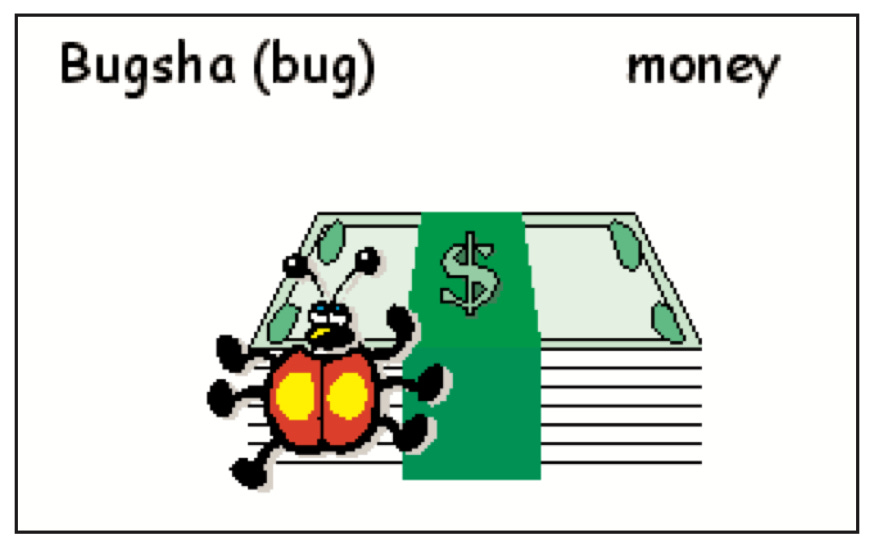
Here’s an illustration of a keyword mnemonic strategy from the TeachingLD tutorial:
One of the most powerful mnemonic strategies is the keyword method.
The keyword method works best when the information to be learned is unfamiliar to the students. For a simple example, consider teaching the slang word bugsha, meaning “money.”
Create a “keyword” for the new word, that is familiar to learners, sounds like bugsha, and is easily pictured (bug).
Create a picture that links the keyword with the definition (a bug climbing on a stack of money).
Tell students, when they are asked the meaning of “bugsha,”
Think back to the keyword (bug),
Think of the picture (with the bug in it),
Remember what else was happening in the picture (bug climbing on a stack of money), and
Tom and Margo tested the usefulness of the keyword and other mnemonic strategies in science, the social studies, and other areas of learning. They consistently found that students who learned the mnemonic strategies outperformed their peers in control conditions by huge margins (average effect size greater than 1.6).
So, next time you hear someone prattling on about memory research, ask him or her if they have any studies demonstrating the effectiveness of memory instruction with classroom subjects for kids with disabilities. Likely, the prattler will have no examples. You, Dear Reader, can them whip out your copies of the references here and say, “Do you know anything about mnemonic strategy instruction?”
And, my Dear Fellow Travelers, I hope you will not need any memory strategies to help you remember how important it is that you take care of yourselves and each other. Remember to get plenty of sleep, look both ways before crossing a street, buckle those seatbelts, drive carefully, eat healthily, and exercise regularly. That’s because we want you to be out there in the schools buzzing around like mosquitos, infection educators everywhere with the Teach Effectively Virus…and—of course—teaching your students well.
Hey, please consider upgrading to a paid subscription.
References
Mastropieri, M. A., & Scruggs, T. E. (1989). Constructing more meaningful relationships: Mnemonic instruction for special populations. Educational Psychology Review, 1(2), 83–111. https://doi.org/10.1007/BF01326638
Mastropieri, M. A., & Scruggs, T. E. (1998). Constructing more meaningful relationships in the classroom: Mnemonic research into practice. Learning Disabilities Research & Practice, 13(3), 138–145.
Scruggs, T. E., & Mastropieri, M. A. (2000). The effectiveness of mnemonic instruction for students with learning and behavior problems: An update and research synthesis. Journal of Behavioral Education, 10(2), 163–173. https://doi.org/10.1023/A:1016640214368
SET should not be confused with a product that uses the same name and is published by the Council for Exceptional Children. SET predated CEC’s publication by decades. Despite my appreciation for CEC, this product is not designed to promote that organization nor should the views expressed here be considered to represent the views or policies of that organization.
Determining names of subscribers takes me some time. Not every subscriber reveals her name; sometimes it’s just an email address, and the address is someone’s name. Also, I although I can search the Intertubes for names connected with an address, that is time-consuming and fraught with the chance of errors. So, I use what I can get from subscribers’ bio information and munge it into the convention of FirstName+InitialforLastName (to permit a modicum of privacy). If I mess up someone’s name, I he will let me know!


I liked your comments on cognitive psychology.