

Welcome to the this week’s issue of the Special Education Today newsletter. It is the 20th newsletter for the 6th volume, and it’s for the week that began 9 November 2026. As has routinely been the case with the preceding newsletters, it includes a photo, some status notes, a list of recent posts, and a bit of an editorial.
That was your advanced organizer…let’s get on with it!

Photo
Here follows another image from the SET neighborhood. As the leaves are falling (should I say “autuming?”), the construction site across the creek is becoming easier to see. In the background is Monticello to the left and Mount Alto1 to the right. Just at the top edge of the photo, above Mount Alto, one can see a crane and its ball (used to pick up and move large, heavy construction materials).
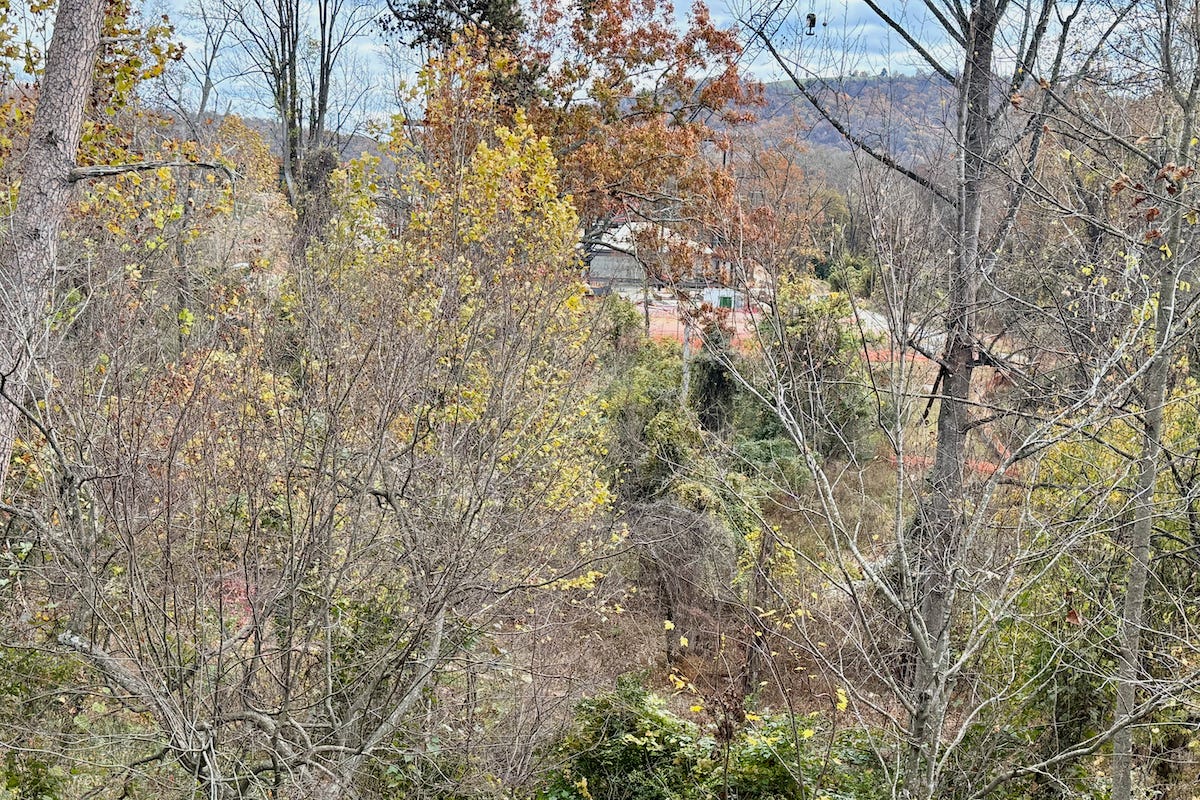
I do not know the schedule for the construction of the new building. It’s been going on since 2025 (as some Dear Readers will recall) and I have to guess will take another year. Given my recovery from hip replacement, the uneven terrain, and the extensive occupation of the flora by a certain fauna (ticks), I have not visited the trail in many months. I hope to do so in the coming weeks, and to get new photos of the area. Stay tuned!
Updates on status, activities, and such
Although there were no new supporting subscribers this past week, there were 10 new subscribers at the free level. Overall, there are > 1300 subscribers. The leaders continue to be Anita A., Mike G., and Kathy M.; if you see any of them, please express thanks to them.
Importantly, there are folks who have been supporters for many months, and I am saluting some of them. Here are shout-outs to Angelique W., Bear A., Carol W., Cindi S., Ed P., George S., Gerry W., Jackie R., Jim F., Judith H., Jean C., Judy V., June R., Kata S., Kristen A., Kristin S., KT L., Lori M., Luann J., Mary R., Meg D.,Melissa J., Monica McH.-S., Pam S., Paula C., Reid L., Rob O’N., Sal B., Stephanie A.-O., Sunil G., Trent T., and Wayne.
Special thanks to Jane B. She was the only reader who commented on a post this past week. As we say in the upstairs area above SET Central, “gold star!”
Thanks to those who dropped “likes” on posts this past week. Seeing the counts on those hearts when I scan down the list of recent posts on the screen of my browser or the Substack app brings smiles to my face. Thanks, folks! Keep ‘em coming!
I noticed recently that there is a link on the home page of the Web site that is new to me. When I went to the home page and scrolled to the bottom, I found a stack of links for “About,” “Archive,” “Recommendations,” and “Sitemap.” The last of these presents a year-by-year listing of the contents for SET, as shown in the following screen clipping. The link for each year opens a page showing the posts for that year. (I have linked this image to the “Sitemap.”)

I am unsure that this feature of the Substack Web site will be terrifically useful. However, it is a bit more efficient, I think, than having to scroll through multiple pages when one wants to review the archives (and has an idea of the year when a post appeared).
SETlettes
Here you have a catalog of the posts from the past week. Because I wrote them all, there is no need to annotate the authorship for each. One, as indicated, is available only to paying subscribers.
Special Education Today newsletter 6(19): How about some notes for the week that began 2 November 2026?
What curves tell us: Effects of teachers and & curricula: Don’t advocates of evidence-based instruction want both strong teachers and strong curricula? [Paid]
Reminder: K. Tavalin Webinar on future policies for US: Do you recall that Ms. Tavalin will hold a live discussion 12 November 2026?
Libby: Signing is OK: What about the film, “The Silent Child?”
Prevention for tomorrow?: What did we once do in hopes of securing services for our kids?
Friday catch-up notes—13 November 2026: What about stories that didn’t show up as a full post this week?
More about teachers from NPR: What does a reporter have to say about writing about special education?
As usual, I remind you, Dear Readers, that you can readily find all the recent posts on the Web site, Special Education Today. In addition, there are links to the archive, notes that we published elsewhere, to the clumps (sorta-kinda subject index), and to that new sitemap.
Special Education Today welcomes new subscribers.
Commentary
As of 12 November 2026, the US Center for Disease Control and Prevention reported that measles is coming back in the USA. As shown in the accompanying chart, the number of cases has exceeded 5000 so far in 2026. That number is more than twice the frequency of any year since 2000.2 (Please note that that figure is for confirmed cases; the number of suspected-plus-confirmed cases is greater.)

Measles (AKA “Rubeola”) is a disease that can (and does) kill people, is readily spread, and can have horrific long-term consequences (see Au et al., 2026). Measles is preventable and—although it had been largely under control in the US and many other countries around Earth—appears to be increasing, as the previous chart showed.
For those of us who are concerned about children with disabilities and special education, the increase in confirmed (suspected) cases is important, in my view. There are at least three reasons we should find those data unsettling:
Measles kills. The World Health Organization explained that “there were an estimated 95 000 measles deaths globally, mostly among unvaccinated or under vaccinated children under the age of 5 years.” To be sure, not all children who get measles will die, but I do not want to roll the dice with losing any of our kids.
Measles can cause disability. Although most children and youths who get measles recover and have no lasting problems, some will have seizures, intellectual disability, learning problems, or hearing or visual impairments (including blindness). I get that some advocates for our kids consider disability a “gift,” but I doubt that very many of us would wish to induce a disability in children.
Some of our kids may not be able to take preventative measures.
Parents may find that an immunocompromised child cannot take a measles vaccine, making those children especially (doubly?) vulnerable to measles. I have not found clear research that our kids are especially at risk for having compromised immune systems, still it seems to me3 that prudent parents would, having had a frank discussion with their children’s pediatricians and public health officials, seek to have their children vaccinated.
Our kids may not know how to or may be physically unable to protect themselves from exposure to measles. They may not know to get the heck out of Dodge City when they find themselves among a bunch of infectious children (and that’s hard for all of us, given the incubation period for measles). They may rub their eyes after touching contaminated surfaces, for example; we could—and probably should—mount an intensive, systematic, and proven-effective program to prevent eye-rubbing (or whatever). Right goal? Right objective? Right use of instructional opportunities?
More important than these reasons for fret and worry, we should probably take a serious look at what we—members of the SET community—can do.
We should work with our local contacts to ensure that reasoned policies and practices are in place, policies and practices correspond with best-evidence ways of preventing the spread of measles (and other diseases. We should ask that schools, for example, have in force and will enforce vaccination requirements. Public health agencies should publicly explain risk and report data for our neighborhoods.
We should have open, frank discussions with our neighbors about the risks, both for kids with and those without disabilities, of highly transmissible diseases. I am not suggesting confrontations, but rather calm discussions about why we do not want our kids included in “pox parties.”
I also think we should engage in wider debates there address the larger community. The influential socio-political forces promoting the resistance to vaccination should not get to manipulate governmental levers in ways that bring risk to our kids. I think we should call out the specious arguments advocates of those views present.
Okay, I have prattled on long enough (perhaps too long?) about my views on measles and such. Please tell us what you think.
Meanwhile, please understand that my editorial comments here are, essentially, a part of the usual admonitions: Take care of yourselves (wear seatbelts, drive safely, eat right, exercise) and others (get them to wear seatbelts, etc., too!) and remember to teach your children well.
✌🏼 & 💚
John Wills Lloyd, Ph.D.
UVA Professor Emeritus
Founder & Editor, https://www.SpecialEducationToday.com/

Reference
Au, S., Saini, S., Cruz, W. D., & Venketaraman, V. (2026). Measles: An updated literature review of the host response, pathogenesis, complications, prevention measures, and recent outbreaks. Current Issues in Molecular Biology, 48(2), 206.

SET should not be confused with a product that uses essentially the same name and is published by the Council for Exceptional Children. SET predated CEC’s publication by decades. Despite my appreciation for CEC, this product is not designed to promote that organization nor should the views expressed here be considered to represent the views or policies of that organization. A membership in CEC does not get one a subscription to SET and vice versa!
Footnote
“Mount Alto” was, as I understand, the name that Thomas Jefferson used to refer to that hillock. “Montecello,” meaning “little mountain,” was the one he used for the hillock on which he built the mansion we know by that name. In my life time, I have known Mount Alto by two other names. My mother called it “Patterson’s Mountain.” In the 1970s and 80s, I remember it being called “Brown’s Mountain.” Now that the Monticello foundation has acquired it, it is back to “Mount Alto” (and it is now border to the southwest by “Carter’s Mountain”).
The 5000 cases for 2026 is higher than any year since 1991, according to the CDC data (you may have to click on a button on that page to change the time period).
I am not a medical expert, so my opinion should only be taken lightly. That is, this opinion is only based on a reasoned reading of evidence.