

Howdy, and welcome to the 33th issue of the 5rd volume of the newsletter for Special Education Today. I find it amazing to realize that we are greater than 60% of the way through the fifth year of SET. That’s a lot of newsletters!
Well, this one is similar to many of those that SET published before it. It includes the usual photo, some notes about the status of SET, a list of posts that appeared during the previous week, and some comments.
Photo
Some readers will recall seeing pictures of our back yard and the trails the follow the creeks adjacent to it. Here is a different view.
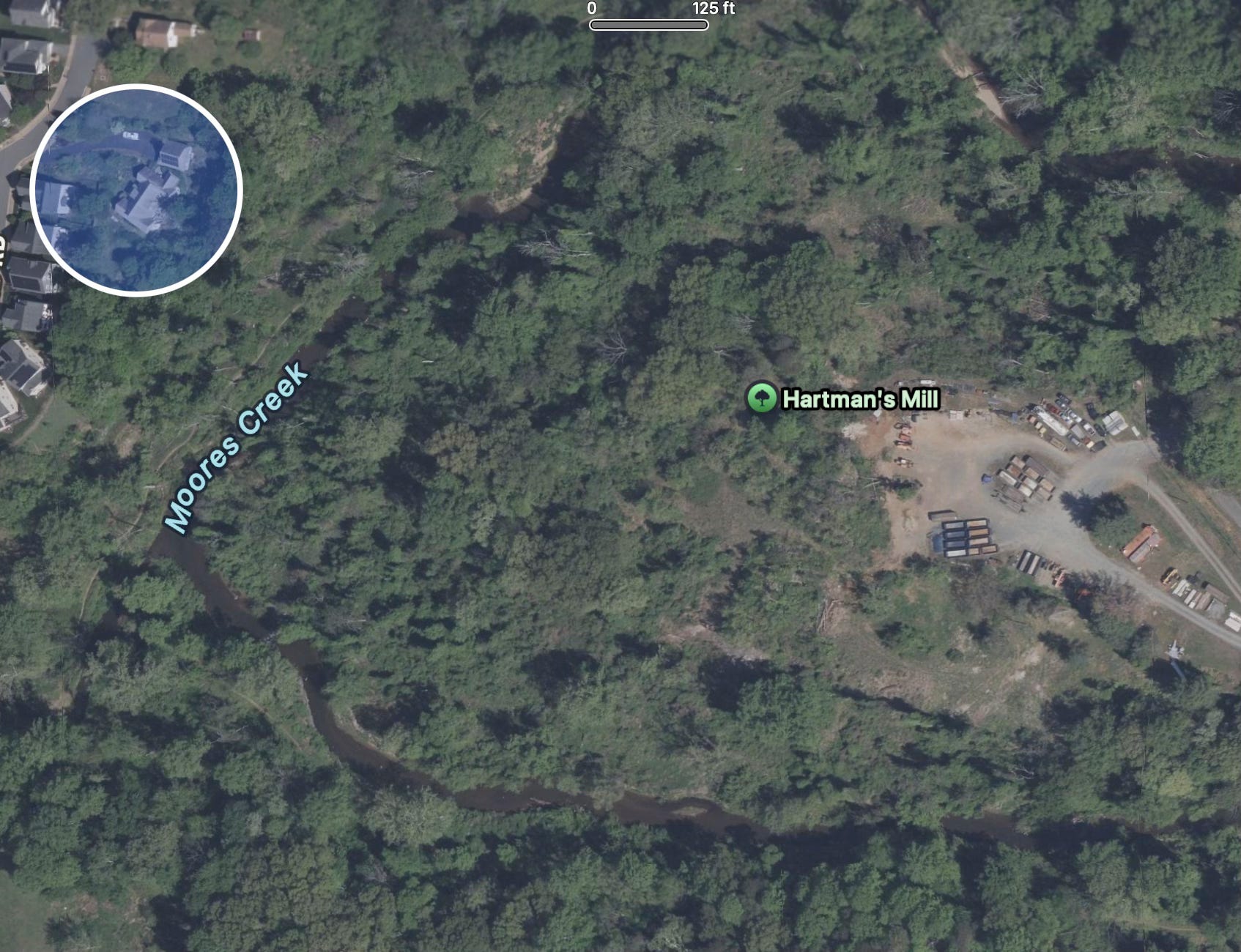
This images shows an arial view of the neighborhood. Our house is in the blue disk at the top left. As one can see, we are adjacent to Moores Creek, which looks like a dark band and makes a loop. To the east of Moores Creek is a large swath of property that is labeled “Hartman’s Mill.” There is a light industry site at Hartman’s Mill and that company is now developing the inside the loop of the creek, just a couple of hundred feet from our backyard. What has been a city sanctuary for local wildlife —birds (Great Horned Owls, Red-shouldered Hawks, Pileated Woodpeckers, migrating warblers, and many more) as well as fauna (we regularly have had raccoon, dear, skunks, and others, including an occasional bear)—is being graded by a big yellow shovel, front-end loaders, bobcats (the metal kind), and dump trucks.
I have not been along the trails for weeks (months?) recently, so I do not have personal photos to share. I suspect that the next revision of the arial view from Open Street Map for the area will show changes.
Status and such
In the introductory paragraph, I mentioned that SET has published a lot of newsletters. This one is something like the 210th or so of them and the 1588th of all time. If SET was to publish a bound, book-like collection of the newsletters and each newsletter was about three pages, then the printed book of them would form a nearly 700-page book. And that would be just the newsletters; it would not include the day-to-day content. It’s a good thing we can carry it on our phones, ‘cause that would require a dang handtruck to move.
So, thanks to Kathy, Anita, and Mike, the founding supporters who keep SET going. And thanks, too, to Bev J., Jim S., Jim P., Jane B., Nancy C.-W., Bob P., Carol W., Larry M., Pam S. (both of them), Kimy L., George S., Kristen A., Cheryl D., Cheryl Z., Jean S., Meg. D., Paige P., Bear A., Alexis F., and the scores more who are Dear Supporting Readers. It is wonderful to have you here as constituents in SETland, especially knowing that so many of you are busy making wonderful contributions to the education of our eds.
I greatly appreciate the comments that Tom Z. and Betsy T. (twice). They provided thoughtful and informative observations that I hope helped readers other than me, too. As if often the case recently, there was a shipload of “likes” dropped on various posts. They’re great to have. Thank you!
Also, welcome to Stephen W., Jodi J., L. W.-E., Kevin C., Courtney S., and Phillip M., all of whom subscribed this past week. I may have missed one or two, and there were a couple of others who apparently subscribed and then unsubscribed quite quickly…sign.
And, thanks to those readers of SET who tell friends and acquaintances about SET. Click that share button! Forward posts! Copy Web locations for SET content and send it to others who share your interest in kids with disabilities and the special education that they should receive.
Just in case it’s helpful, here’s a link to share this post!
Spedlettes for the week
Well, we posted only six notes on SET proper since the last newsletter. They were posts were posts that I hope readers found informative and maybe even inspiring. Authors’ initials are in brackets.
For the paid subscribers
Advocates express concerns about proposed revisions of IDEA: What might happen if the US law was opened for modification? [JWL]
US IES study of spending on special education: What is the US educational research agency studying about spending [JWL]
For everyone
Special Education Today newsletter 5(32): The newsletter for the week of 8 February 2026 {JWL}
When politics disrupt science, families pay the price: What ripple effects do cuts in research funding have? [MJR]
The evidence we should trust: Part A: Evidence-based means...uhm, what? [JWL]
DISES 2026 is in Peru: Wouldn’t this be a fine opportunity to visit with fellow special educators? [APLM & JWL]
Commentary
As most readers know, I hope that we can turn SET into a resource for people all around Earth who care about children and youths with disabilities and about ensuring that they receive beneficial special education. To that end, I have been searching (unsystematically, I must admit) for organizations that advocate for policies and practices that benefit our kids.
I would like to see SET develop collaborative connections with those entities. I do not envision these connections as one-way streets, but rather as actual collaborations. As Mandy Rispoli argued in her post for this past week, there’s a lot those of us in the US can learn for international collaborations. As constituents of SETLand, members from countries around Earth could learn about news, policies, and practices from reading SET and would be able to contribute news and research from their own countries.
Here’s a little starter list of international organizations providing resources and advocacy for students with disabilities and their families. I do not pretend that the organizations shown here are the best or the most influential; this is not a catalog of recommendations. Nor do I think that it is exhaustive. In fact, Dear Readers, I welcome your suggestions about agencies and groups I have overlooked—please leave a comment (the comments on this post with be open for a couple of weeks) or simply reply to the email version of this message (replies will come directly to me).
UNICEF—of course, the United Nations group is the big player in this sphere, with connections in most countries, and it is mostly about children in general, but there are foci on disabilities.
DISES—The Division for International Special Education Services, is the subgroup in the Council for Exceptional Children with the greatest emphasis on international special education; other subgroups also may have international interests, too.
World Federation of the Deaf—It’s an international association supporting people who are deaf; it includes efforts for children and youths.
Perkins School for the Blind—Its international efforts aim to help schools support kids with visual impairments in many places around Earth..
International Council for Education of People with Visual Impairments—addresses standards, teacher preparation, and similar topics.
Sense International—It seeks to enable people, including children, with DeafBlindness to be able to participate in society and earn livings.
Down Syndrome International—It focuses on resources and policy for individuals with trisomy 21, and it has home offices in the UK, but there are affiliates and representative groups at many other locations.
Ubuntu Hub—a non-profit research and educational center connected with the London School of Hygiene & Tropical Medicine that operates programs for children with developmental disabilities (and their families) in Ghana, Kenya, Rwanda, South Africa, and Uganda.
Autism Speaks—It has a broad agenda and it maintains a great list of international organizations devoted to autism.
International Society for Autism Research—It’s a research group, but it has resources that others might find of value, too.
International Academy for Research in Learning Disabilities—This is primarily a processional organization devoted to research, but it has international roots and provides guidance for educators and parents.
International Dyslexia Association—IDA is strongly oriented toward the US, bur there are outreach efforts one can find there.
So, there’s a little starter list. Please contribute others. Regardless of whether you contribute, though, I hope that you will remember the usual admonitions: Stay safe (seatbelts!), take care of your family and friends (that includes taking appropriate precautions about spreading viri), and, of course, please teach your children well.
JohnL
SET Founder and Editor guy
Charlottesville
Please remember that SET should not be confused with a product with the same name that is published by the Council for Exceptional Children. SET predated CEC’s publication by decades. Despite my appreciation for CEC, this product is not designed to promote that organization nor to speak for it. I’m not selling anything here other than the ideas you read in the posts.
The International Association of Special Education (IASE; https://www.iase.org/) should be on your list, John. Great people who do great work in a number of countries, e.g., volunteer service projects in Colombia, India, Malawi, Tanzania, Vietnam, and Uganda. They hold biennial conferences; the one for 2026 is in Bhutan (!).