

Here begins this week’s issue of the Special Education Today newsletter. This is the 1701st post for SET! Wow! Read the archives!
This issue of the newsletter has the usual contents. If you have been on the ride a few times, you’ll know what to expect in this newsletter. However, if you’re relatively inexperienced in the ways of SET, you should know that the issue includes these sections: (i) photo, (ii) administrative notes, (iii) a list of recent posts, and (iv) notes and comments.
Photos
SET readers may recall that I attended the 48th meeting of the International Academy for Research in Learning Disabilities last week. I’ll be returning to that adventure later in this newsletter (so, read on!). First, though, while I was in Durham, NH, for the meeting I got a couple of photos that I shall share here. Here is a photo of Sylvia Linan-Thompson and Annmarie Urso with me in a posed shot (thanks Bill Therrien) with the blank screen behind us.
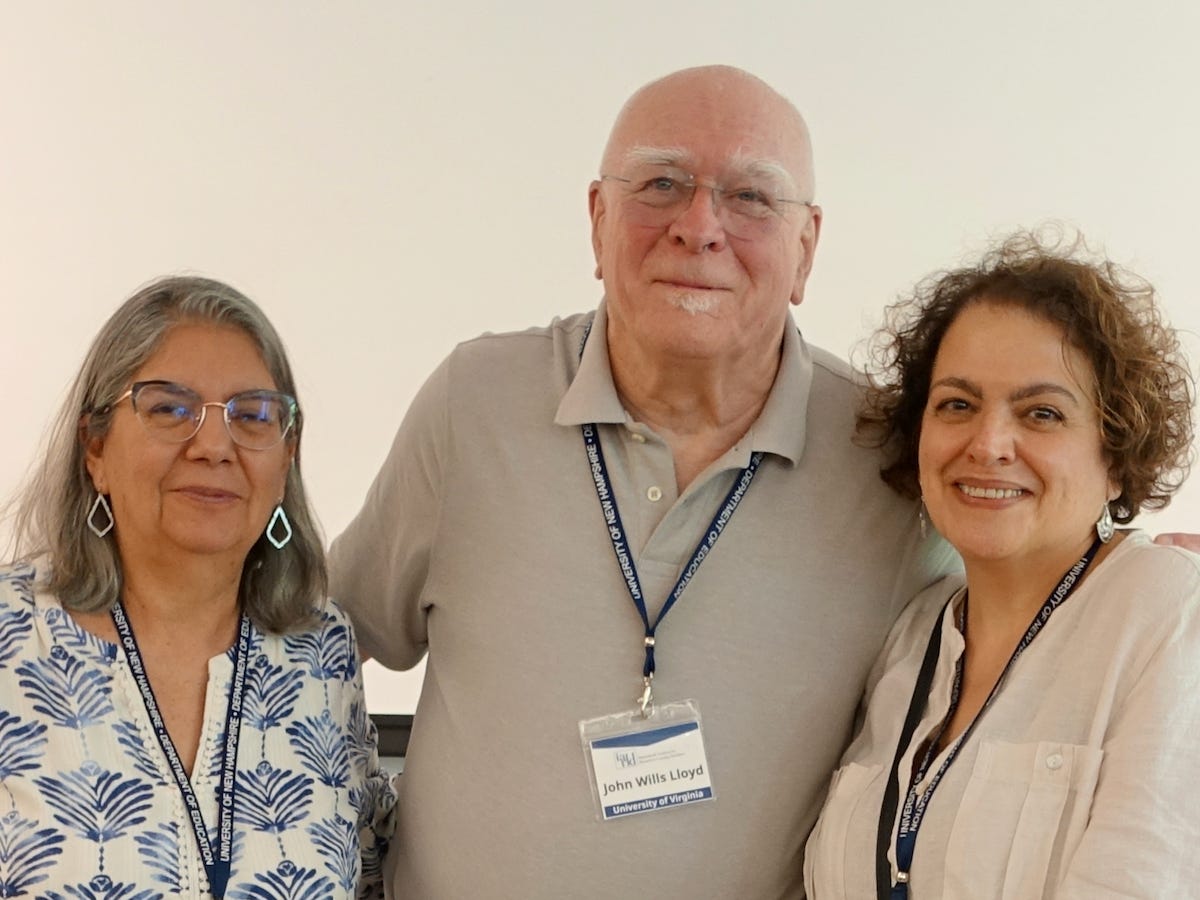
Sylvia has been doing exemplary work on adaptations of instruction for students who are learning English for many years. Readers of SET should know that, although she’s done lots of work on concerns for Spanish speakers, she’s also working on adaptations for students who speak less common languages such as Aleut, Athabaskan, Tlingit, and other Alaskan native languages.1 Annmarie, whom I first got to know a couple of decades ago (when she was a teenager) has been doing great work in preparing teachers (especially in employing well-grounded individualized education programs, as in her book with Dee Berlinghoff2) as well helping guide organizations like IARLD and the Division for Learning Disabilities of the Council for Exceptional Children.
Annmarie is a long-time subscriber to SET, and there were lots of other SET-affiliated folks at the meeting including (but not limited to) Vincent C. (wonderful host of the event), Rebecca S. (who’s been with SET since pretty-dang-close-to-the beginning!), and others—I should have had us all gather for a photo, but I failed. Sigh.
Admin updates
Thanks to those SETters who said “hi” at the IARLD meeting and to all the wonderful Dear Readers rp, everywhere for your continuing readership. I am regularly encouraged when I open the administrative Web page for SET and see that 100s and 100s of y’all have taken a look at a recent post.
A special thank you to the founding subscribers, who include Anita A., Kathy M., and Mike G. These folks subscribe at levels over and above the basic contribution and thereby help SET to be able to publish free content for subscribers all around this Earth. Sometimes, when I think about these folks’ vote of confidence in SET I get a “little emotional.” Drop a comment and thank them.
Meanwhile, let’s welcome a few folks who joined the community at the free level this past week. Here’s a welcome to Kathy D., Constance S., sea sea(?), Su E., Mary O., Tony M., Tasha, Tracy K., Olivia S,, and Amy T. There were a few ( three?) others who apparently hit the subscribe button but didn’t complete the process. It’s great to have all these known new subscribers. If the SET community could grow by 10 people a week, we could have substantially greater body politic, a force to improving recognition and service for our kids. Thanks for sharing the word about SET and please keep doing so!
Imagine if the 1200 of us on SET now were, say, 2-3000…20-30000…lots more of us. We would be able to talk with each other (celebrate, complain, collaborate…) about better lives for kids with disabilities. Let’s grow!
And thanks to those of us who are already contributing to the effort: Alexis F., Amanda H., Angelique W., Ann R., Anna O., Bear A., Bev J., Bob P., Callie O., Candace S., Carol W., Cheryl D., Cheryl Z., Christy A., Dan H., Ed P., Ed M., Em. D., George S., Jane B., Jane N., Jean S., Jenni R., Jim P., Jim F., Jim S., Judy V., Keith L., Kimy L., Kristen A., Kristin S., Larry M., Luann D., Marina P., Meg. D., Mike C., Nancy C.-W., Nancy M., Nancy S., Paige P., Pam S. (yes, there are two of you), Riley M., Stephanie A., Tom Z., & Trent T. They are already helping to push SET to broader reach.
Spedlettes
Here’s the catalog of posts on SET for the last week. Look for the initials of authors…well, I wrote all two of them this week, so no need for initials in brackets. As usual, the list starts with last week’s newsletter.
Special Education Today newsletter 5(47): This is yet another issue and it is for the week that began 18 May 2026
Memorial Day 2026: Let’s be thoughtful in our remembrances
Friday catch-up notes—29 May 2026: What are the stories that didn’t show up as a full post this week?
TECBD 2026 conference notices: What’s to be known about the 2026 meeting of Teacher Educators for Children with Behavioral Disorders?
There you have the corpus of posts for the week beginning 25 May 2026.
Notes & comments
When my friend, Vince Connelly, invited me to attend the meeting of the IARLD for this year, I was really quite flattered. But, then I had to prepare a talk…aye-yie-yie! Vince, what in the [xxxx] did you get me into?
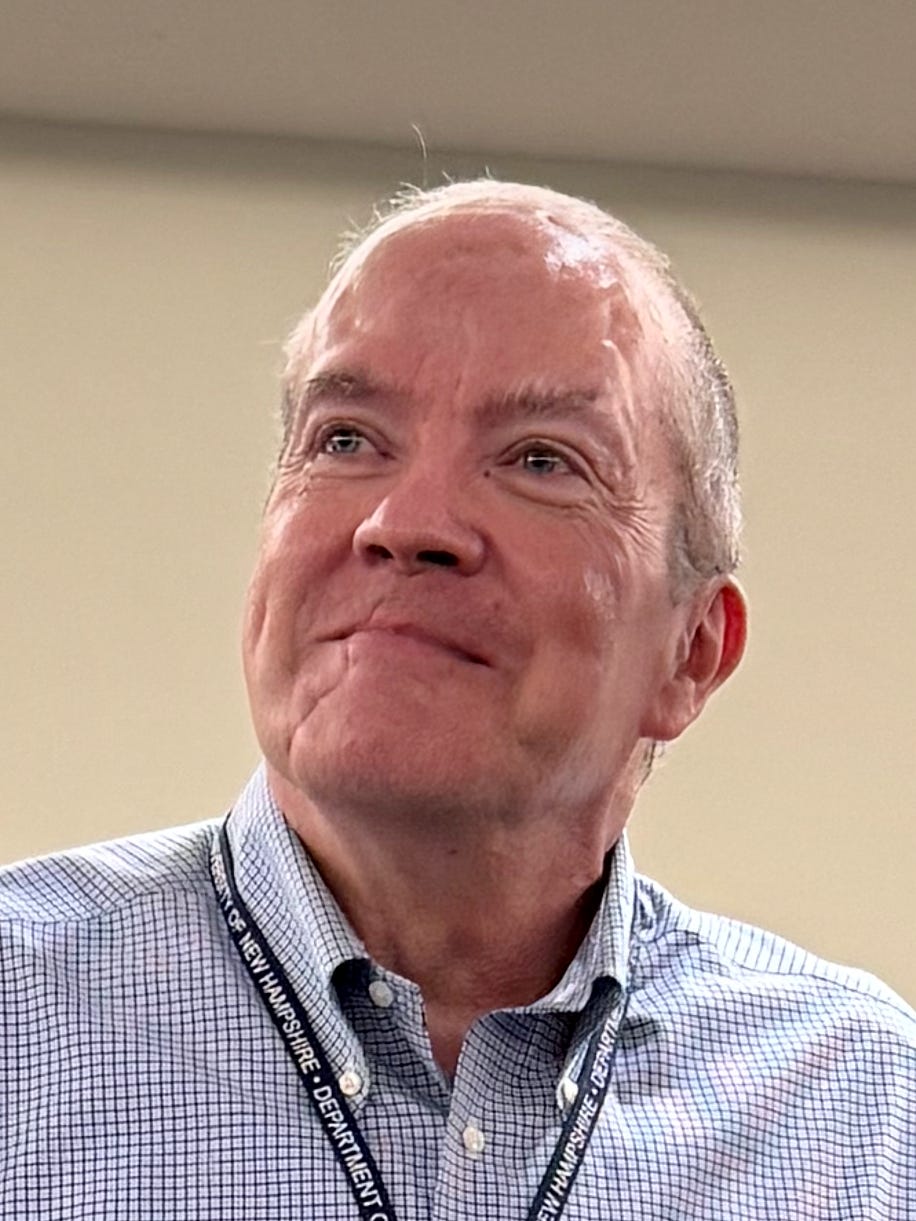
As most Dear Readers will know, I’ve been concerned about learning disabilities throughout my time as a special educator. When I got started in special education,3 I was drawn not only to those children who had severe behavior problems (“autism” was so unknown that my psych professors didn’t have any suggestions about readings or practices when I asked them about it in after-class scrums). but also to those kids who couldn’t read and write. Having been raised in a home that valued knowledge, I dove into the study of special education.
So, I thought for my talk, I would just tell the story of my journey to an on-going focus on teaching and the research that we need to move ahead in the endeavor of improving instruction for our kids.
I struggled to assemble something sensible. Here’s the outline on which I sorta settled:
How did we get LD?
We invented it
We were influenced by (for better and worse)
Medical ideas
Psychological perspectives
Educational influences
What is it about learning disabilities?
Wait?
What?
What about teaching?
Ooopsies…
Instruction?
Maybe we learned something
Maybe we missed something?
What research do we need?
Look at teaching at the micro level
Focus psycho-education here, not on pop-psych
What is our path forward
High-quality research
Focus on the actual problems of LD
So, I ran my slides and talked for about 50 minute. I hoped that showing lots of images of the folks whom the audience and I have known in my time in special education, I could connect with the listeners. I hope all of the attendees got the message that teaching, instruction, and education are really important.
Of course, you Dear Readers of SET already have that idea, right? And that idea, Dear Readers, is why it’s important to keep yourselves healthy and vigorous. Eat well (and good). Get that rest. Stay safe. And to keep up with evidence about effective practice so the you can make sure you can be there to teach your children well.
JohnL
John Wills Lloyd, Ph.D.
Founder and Editor, Special Education Today
SET should not be confused with a product that uses the same name and is published by the Council for Exceptional Children. SET predated CEC’s publication by decades. Despite my appreciation for CEC, this product is not designed to promote that organization nor should the views expressed here be considered to represent the views or policies of that organization.
Footnote
My account of the languages Sylvia is addressing may be inaccurate. She, Annmarie, and I were talking about her work one night after hours, and I didn’t take good notes. Sigh. But, she’s working on multi-tiered systems of support, as reflected in her chapter, Linan-Thompson, S., & Dorman, M. (2025). Culturally and linguistically responsive multi-tiered system of supports. In D. Vega & J. N. Wolf (eds.), Culturally and Linguistically Responsive Intervention and Assessment Practices with Emergent Bilingual Students (pp. 57-71). Springer.
Annmarie’s and Dee’s book is called “Writing a Legal, Robust and Useful IEP: The Foundation of an Effective Special Education Program.” It’s got lots of winning content. SET does not get any kickback from mentioning it here.
After my first volunteer efforts as an adolescent teaching swimming to blind and other visually impaired kids, I got more involved in special education early in my college days in 1966. For readers who don’t know the back story, Pat and I began to volunteer in classrooms for the “educationally handicapped” as undergraduates in the LA area of California.