
Article: Behavior problems increase among primary grade children
What is the venerable Hechinger Report publishing?

Writing for the Hechinger Report on 17 February 2026, Jackie Mader reported that teachers of young children say they are seeing increasing behavior problems in schools. In the first paragraphs of her article, “Biting, kicking, wandering the classroom: Teachers say there’s a rise in misbehavior even among the littlest kids: Teachers, districts and states are divided over the best ways to get students on the right track,” Ms. Mader followed common journalistic form by providing anecdotes, and then she followed with notes about research from the US Institute for Education Sciences school surveys.
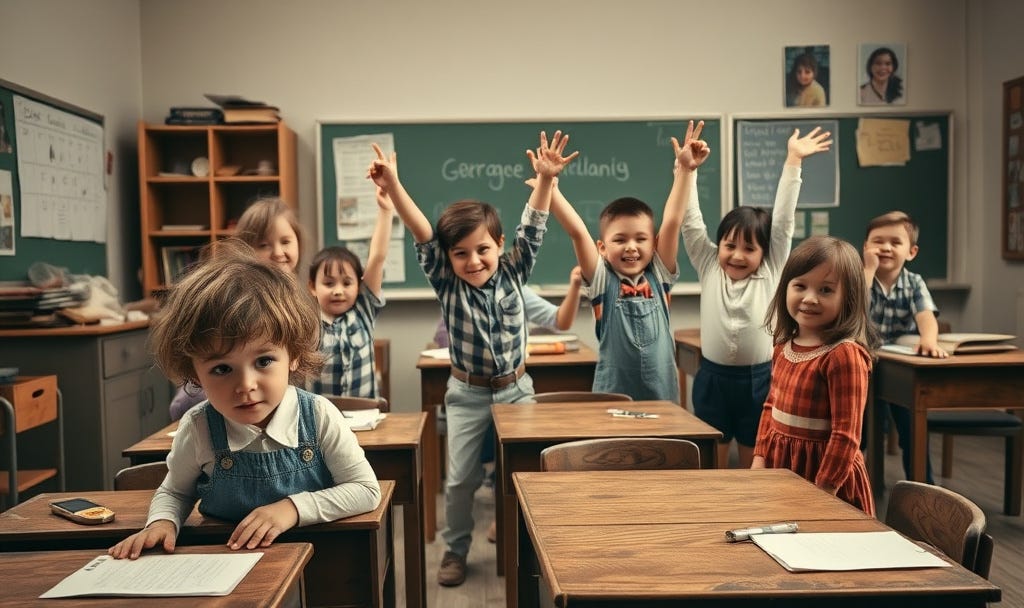
Elementary teachers nationwide say they’re seeing the same trend: worsening — and increasingly severe — behavior problems in young children. Students are more disruptive. They sometimes lash out physically at classmates and teachers. They’re more defiant. It’s pushing many teachers and schools to try new methods to bring classrooms under control, with districts and states sharply divided over the right approach.
While policymakers have been focused on stalled academic progress and math and reading interventions, far less attention has been paid to understanding why students are displaying more challenging behavior and supporting and training teachers as they try to manage it. Federal data shows educators want help: The percentage of elementary schools where educators say they need more training on classroom management increased from 51 percent in May 2022 to 65 percent last year.
Ms. Mader’s article includes discussions about children’s behavior being associated with the disruptions associated with the Covid-19 pandemic, increased emphasis on academic tasks, and inadequate teacher preparation. When she moved to discussing means of addressing these problems, there were also familiar ideas: providing stickers for completing tasks appropriately, coaching for teachers, depending less (or more) on seclusion and expulsion, providing additional counseling resources, etc.
It would be very valuable to have some objective data about the levels of disruptive data in classrooms at different grades from two or more time periods separated by, say, 5 years. Some people somewhere must have collected credible observations of frequency of inappropriate behaviors in a representative group of scores of classrooms across a broad geographic area. How about having those folks come back and repeat their observations using the same instruments, etc. Data from such a project would be wonderfully valuable. Who knows? Those data might corroborate the assertions by some folks, “Kids these days. They are so different than the ones we used to get in kindergarten.” Or, maybe such data would contradict such assertions?
In the good-news category, Ms. Mader consulted some experts whom many readers of Special Education Today will recognize. She has quotes from Brandi Simonsen of the University of Connecticut (see posts 8 March 2024 and 2 February 2022) and Wendy Reinke of the University of Missouri.
"The percentage of elementary schools where educators say they need more training on classroom management increased from 51 percent in May 2022 to 65 percent last year."
Tom is right. General ed teacher prep curricula don't include training in classroom management, despite teachers calls for this. I haven't read the Hechinger Report yet, but from your summary, it appears that educators are casting about for solutions rather than searching out what works. If medicine operated this way, we'd still be applying leaches and trephination to patients.
Yet, most general teacher training programs don’t require a full course in classroom management or behavior management. Those courses are typically limited to special education teachers. All teachers need that training. Also, let’s stop blaming the kids (with disability labels) and start focusing on parent and teacher training.