

Thank you for following Special Education Today and appreciating and advocating the improvement of special education (at least, I’m presuming you do those things). Of course, if you despise special education and just wish it would go away, I guess you are welcome to read SET, too.
This issue of the SET newsletter, which is probably the 275th (± a few), covers the week that ended 8 February 2026. Although I hope that SET generally focuses on the topics such as effective practices, current events, policies, new insights into the nature of disabilities, and such, I know that I sometimes stray into related discussions and I appreciate you, Dear Readers, sticking with me on those excursions.
Regardless of whether you’re a new readers or one who has been hanging on since the get-go, thanks for reading. What follows is the usual weekly summary with sections that are familiar to regular readers: A photo, an update about the state of SET, a listing of recent posts, and some opinions (by me).
Photo
I have posted a couple of times about the wintery weather those of us close by SET Central (and elsewhere in eastern part of North America) have experienced recently. Those posts with photos of the conditions are available for review for 25 January, 26 January, and 2 February 2026. I offer those links, because here I am writing for the issue of 9 February 2026, and there is still a lot of ice in the neighborhood, as the accompanying photo shows.
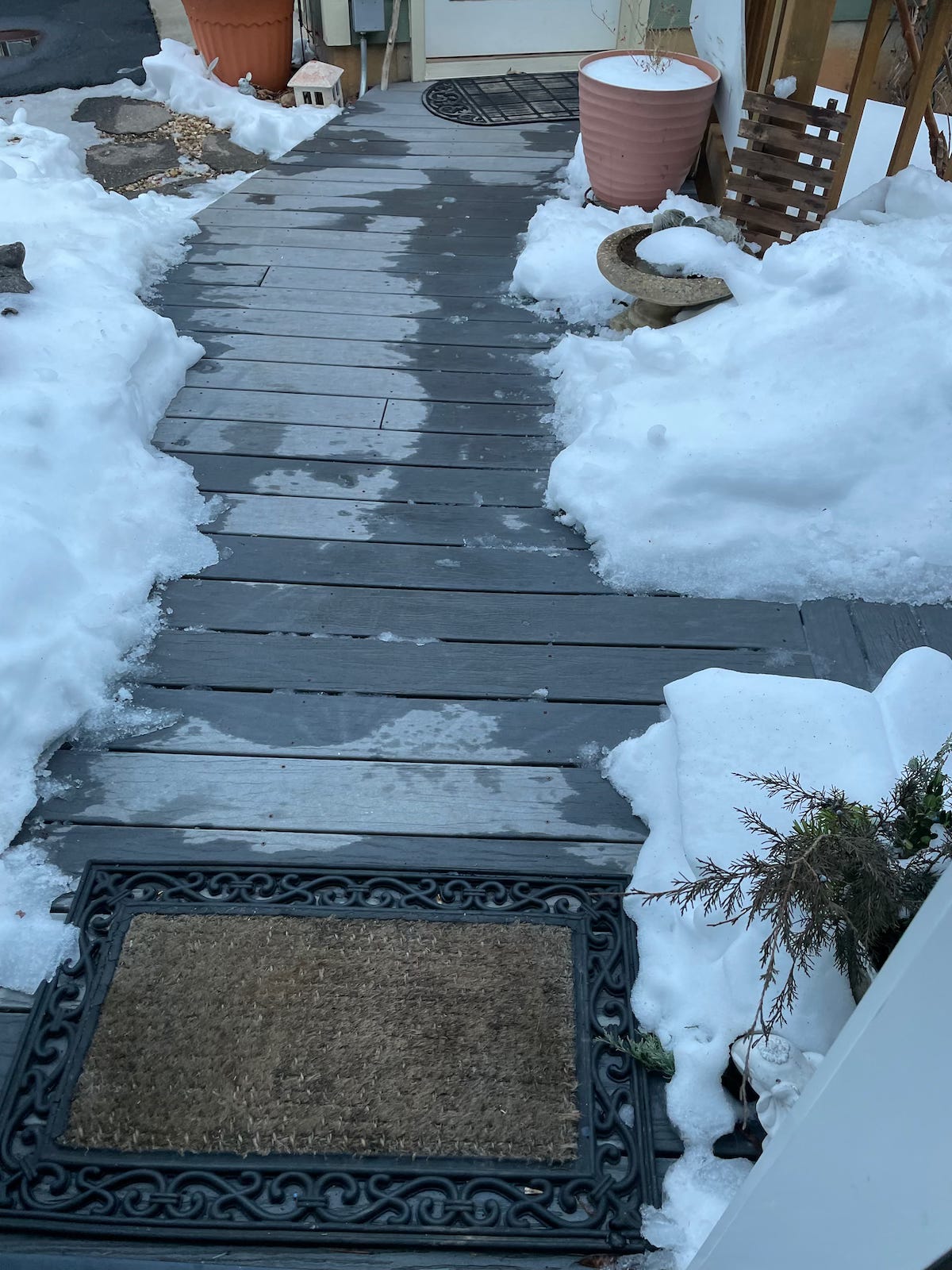
I want to acknowledge that many readers elsewhere live with ice much worse than what we have experienced here in central Virginia recently. One of our Dear Readers said of a 1-meter-tall pile of ice, “Where I grew up, we call that a ‘bunny hill.’” Surely, lots of readers endure worse weather conditions. Understood. I dwell on it here, though, because it is a bit unusual.
I also mention this topic again because, even though it is now dang near two full weeks since the ice fell and there are many sidewalks that have not been cleared. As Pat and I drove along a four lane, 40-mph road in the city Sunday with the sidewalk cleared on one side and blocked repeatedly on the other. As we drove northwards, we saw, four lanes away on the opposite side of the street, a woman in a wheelchair having to roll southwards in the street.
Status update
SET subscribership passed 1100 this week. There are several 100 additional followers (people who keep up with SET and its authors by reading our notes). About a year ago, the total followers and subscribers was about 1000, but it is currently almost 1500. SET has grown! Thank you!
Even though I’ve said this before, let me say thanks on behalf of all of us to these subscribers who go beyond the basic cost, and chip in at a sustaining level: Anita, Kathy, and Mike have been provided super support for SET for years.
Also, let me appreciate the contributions of readers who contribute. It’s wonderful to have authors such as David Bateman, John Romig, Li-Yu Hung, Mandy Rispoli, Mitchell Yell, and Ana Paula Martins. What a line up! It’s great to have you here on SET.
Thanks, too, to the supporting subscribers for SET, some of whom are Stephanie Al-O., Emerson D., Jamie J., Bob P., Monica Mc-S., Pepper S., Mike C., Gerry W/. Vince C., Bill R., Jenni R., Angelique W., Anna O., Paige P., Nancy S., Meg. D., Laura M., Mary R., Bev J., Nancy C-W., Tina C., Dan H., Maryanne L., I. G., Mike N., Rebecca S., June R., Jean C., and Ed P. You, my peeps, are winners in this race!
Commenters: Waves to Jane B. (multiple), Annmarie U., Li-Yu H., Larry M., Tim H., and Clayton K. Y’all’s comments help richen the mix here on SET. Thank you!
Also, I want to acknowledge those Dear Readers who write to me via back channels. I won’t “out” you here, but I appreciate your feedback and suggestions. Thanks!
Also, even it they don’t show up in this catalog, thanks to those readers of SET who tell friends and acquaintances about our little island of sanity (or whatever) here. These are folks who tap that share button! Forward posts! Copy Web locations for SET content and send it to others. Sharing may or may not have been a part of the curriculum during your school years, but it is a great skill to have (maybe less so when one is sharing illnesses, of course). But thanks for sharing. Here is a button to make it easy to do so.
This week’s sped lets
These are the posts for the week that began 2 February 2026. I’ve appended the initials for the authors on the end of them. There are two sections: posts for (a) paid and (b) all subscribers.
For the faithful
Family assessments for child mental health: What are clinicians contemplating in addressing mental health issues? [JWL]
Dogs with disabilities: What is it about the Puppy Bowl? [JWL]
Melvin Levine, famed pediatrician, died in 2011: What do we know about Dr. Levine’s passing and his legacy? [JWL]
For everyone
Special Education Today newsletter 5(31): The newsletter for the week ending 1 February 2024 [JWL]
Science in Autism Treatment again: Who wouldn’t want to know what’s in ASAT’s SIAT newsletter? [JWL]
US federal funding plans are set: What levels of funding for special education are in the passed and signed budget? [JWL]
Webinar on transition for students with LD: Would you like to learn about supporting students moving on from K-12? [JER & JWL]
Friday photo of G. Wallace & T. Zirpoli: Would you like to have been at their table for lunch?
Elf-esteem: What is it about these times and this topic that make an old post still seem relevant? [JWL]
Happy charter day, W&M: How about this venerable school? [JWL]
So, there is the harvest for the past week. All 10 of ‘em. If you missed any of them in the regular mailings, you can go back to read them by following these links (provided you aren’t hitting the links 10 or more days after when they were published, when almost all of them go behind the paywall). In general, readers can go back to the archives at any time but, please note, some of the nearly 1600 posts in the archives are only available to paid subscribers.
Commentary
As some Dear Readers may already know and others may soon learn, I have problems—no, not that kind of problems—with some of the contemporary political push to disavow and even demolish diversity, equity, and inclusion efforts. Some of my concerns are small (petty, even?); in US education, for example, the word “inclusion” often refers to an educational policy that would have all students receive their education in the same physical setting. But most of my objections have to do with some much more fundamental ideas.
I fear that anti-DEI efforts are essentially a rejection of difference. The view seems to be that activities that single out people who are different from the norm. I hear a rejection of difference when people say, “We are all human. We are all the same. Our differences are immaterial.” I catch strong whiffs of a rejection of equity when I that no one should have special treatment because she is different: “We should all be treated equally.” I object, but let me admit that if we lived in Garrison Keillor’s “Lake Woebegon, where all the women are strong, all the men are good looking, and all the children are above average,” And, sadly, we might wind up living in a dystopian US such as Kurt Vonnegut, Jr., described in “Harrison Bergeron,” where the Diana Moon Glampers (the “Handicapper General”) forces people wear masks and shave their eyebrows so that they will not look attractive; carry weighted bags so that they will not be too agile or fast; keep noise generating speakers in their ears to keep them from thinking well; etc.
And one more thing: In my view, difference is not inherently bad. One doesn’t even need to understand the intricacies of the Laplace-Gauss distribution to see that there are lots of variations in humans. Try this thought experiment: Think of one human, a person with (for simplicity) 50-11 characteristics. Got it? Now think of another human who has 50-11 characteristics. Are they the same people? Why, of course, they are both human. Do they differ on any of those 50-11 characteristics?
Now, think about one or a couple of those 50-11 characteristics representing aspects of disability. Does that difference make one individual good and one bad? Disability is not a stigmata. There should be no disgrace in disability. This is not to say that disabilities may not have bad consequences, but in or of themselves they are not ignominious. They just are. Disability is actually normal, in the sense that it simply represents variation in the human form and behavior.
In special education, that some people differ on those 50-11 characteristics in ways that we call intellectual disability, visual impairment, cerebral palsy, behavior disorders, autism, etc. And we can operate on the assumption that we educators should do things (i.e., teach) in order to mitigate the deleterious effects of those characteristic differences. It does not mean that we are out to “fix” the person, but rather to teach children how to read, how to navigate hazardous physical environments safely, hot to interact with others in mutually beneficial ways, how to use adaptive devices to complete activities of daily living…how to accomplish things that that individual’s unique complement of the 50-11 characteristics make difficult so that he can live a relatively normal life.
And, because you, Dear Readers, are doing a lot of good things for people with disabilities, I encourage you to take good care of yourself so that you can continue to do those good things…especially that you can teach your children well.
JohnL
SET Editor guy
Charlottesville
Please remember that SET should not be confused with a product with essentially the same name that is published by the Council for Exceptional Children. SET predated CEC’s publication by decades. Despite my appreciation for CEC, this product is not designed to promote that organization. I’m not selling anything here other than the ideas that you read in the posts.