

Hello, Dear Readers and thank you for opening this issue of the newsletter for Special Education Today. This is the 1812th post on SET and something like the 260th issue of the newsletter. AI was used in generating this newsletter, but only in very specific way…as those who read the newsletter will discover.1
As usual, regular readers may anticipate the contents of this newsletter. For those news to the newsletter, the sections that follow are photo, admin update, spedlettes, and commentary.
Grab your beverage of choice and settle back for the read. Read on!
Photo
Outside the building where I go to see the orthopedist who has done both of my hip replacements and to receive physical therapy, there is a stand of Asclepias or “milkweed” as it is often called (in the US, at least). I see it several times in passing and have regularly stopped to inspect the plants for the caterpillar of the Monarch Butterfly, because those animals occupy a special (very high) place in my pantheon of animals.
On 8 September as I walked by the patch of milkweed on my way to a PT session, I was delighted to see some leaf damage. Closer inspection showed that the cause of that damage was, indeed, a caterpillar on its way to becoming a Monarch Butterfly. I got this photo.
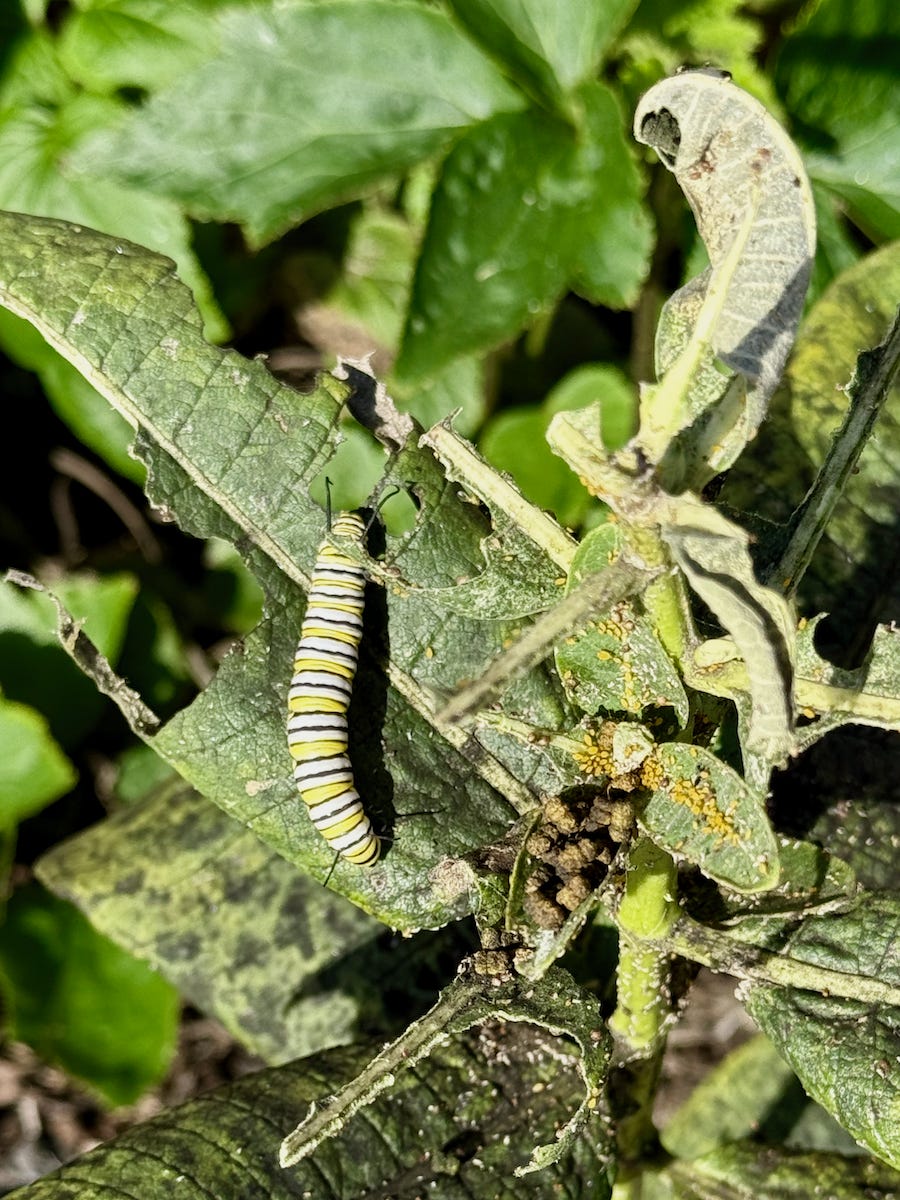
This caterpillar appeared to be pretty far along in its growth cycle. (Those Dear Readers who have seen the caterpillars in their infant form will understand.) I suspected that this one would soon form a chrysalis and begin the transformation into the butterfly.
There was another caterpillar on a nearby plant. I looked for them on a visit 10 September 2026, but didn’t find either, and I did not find any chrysalises dangling from plants or structures in the area. I’ll be looking again when I go to PT on 14 September 2026.
Updates
Although a few new subscribers joined the list (in a month of two there will be 1300 of us), I have only one new supporting subscriber to welcome this: Joel I. Welcome!
Joel joined the stalwarts—Nour A., Dimitris A., Sunil G., Trent T., Jackie R., Stephanie O., Monica McH., Gerry W., Bill R., Bear A., Angelique W., Nancy S., Jean S., Nancy M., Paige P., Ton Z., Kristen A., George S., Kimmy L., Paula C., Ed M., Micki D., Jen W., Bev J., Michael K., Roberta B., Annmarie U., Linda L., Tina C., Jim P., and dozens of others—who help keep SET afloat.
Flash of the electrons (Hat Tip?) to Adelaide D., Dan H., Jane B., Paul C., Nancy S., and Mike N. for dropping comments this past week. There were a couple of times when comments on comments appeared—almost like a discussion! As those who have been reading newsletters for the past 5 years will know, I have often noted that I hope conversations with arise in these pages.
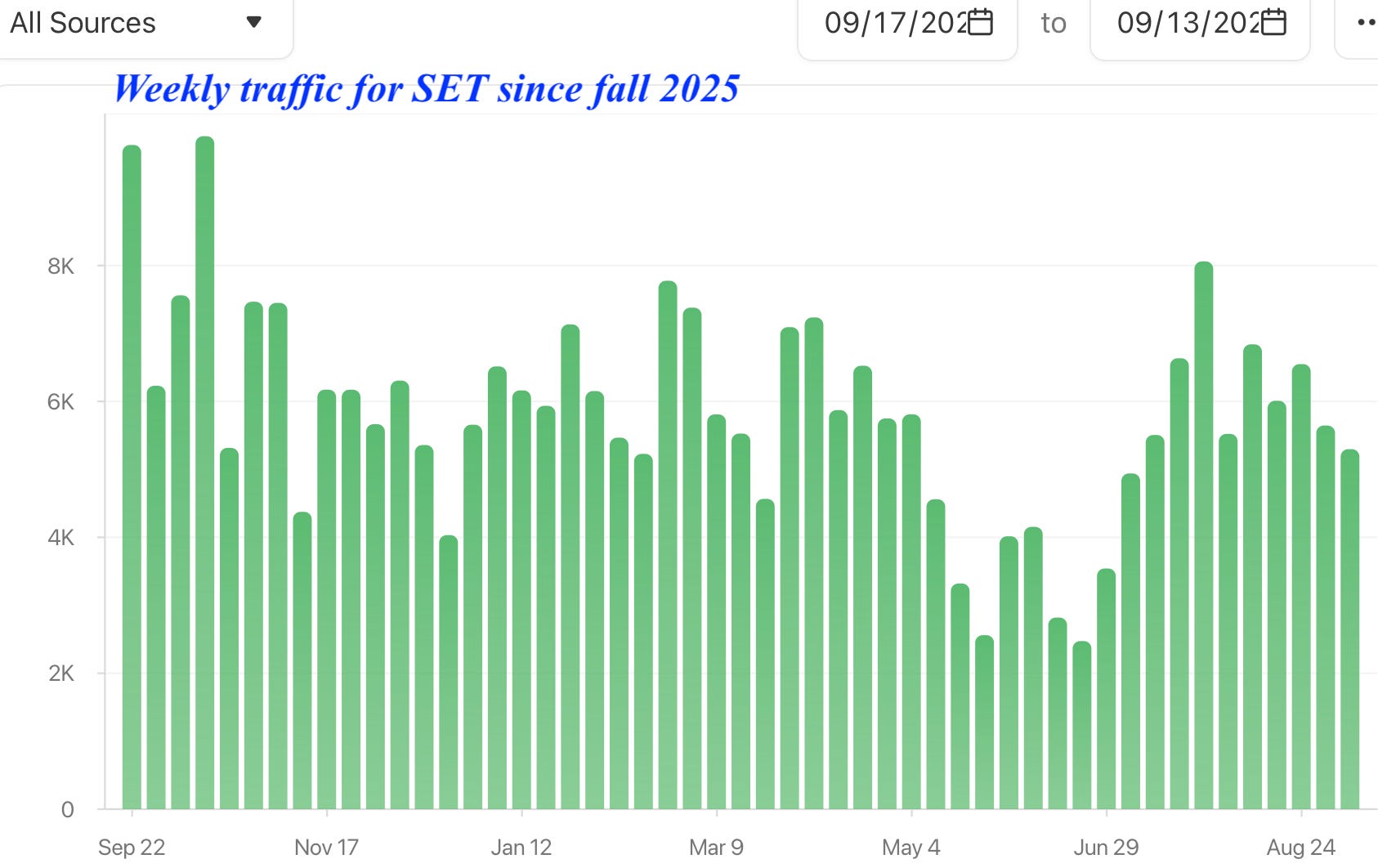
SET seems to be sustaining its readership. The accompanying graph shows how many “reads” SET has had each week since September of 2025. This is almost certainly because you, Dear Readers (well about about a third of you total subscribers) routinely open the spedlettes that are published to your email address or to your Substack app. Thanks!
Spedlettes
SET published eight articles about news, research, and such this past week. Here is a catalog of them.
Special Education Today newsletter 6(10):Are you ready for the compilation of content from the week beginning 31 August 2026?
US invaders welcomed by Icelandic researchers: Should you believe that clickbait headline? No...or only somewhat?
“Being Heumann” will premiere and go into theaters: What celebrations could one enjoy at the openings of this film?
Kelly Rogers resigned US special education leadership position: What is to come of the Deputy Assistant Secretariat?
Two rare syndromes share similar genetic disruptions: How about a little basic info about Okur-Chung and Poirier-Bienvenu neurodevelopmental syndromes?
Friday catch-up notes—11 September 2026: How about these stories that have not appeared as full posts this week?
News report: Irish parents felt “abandoned”: What are the concerns about education of students with disabilities in Cork?
Noise interferes with learning for kids with ASD!: Do the results from a study of a computer game provide guidance for teaching?
All eight posts were on the free side this week. They will be going behind the paywall as they age, though. So, read them now. Better yet: Upgrade your subscription so that you can read all the posts that are in the archive.
Comments
I have been thinking about the news this past week, contemplating change in the US Department of Education (Kelly Rogers resigned US special education leadership position) and the comment by Dan H. about how that news caused him to feel sad. I concur.
Having been an outside observer of the Office of Special Education and Rehabilitative Services for decades, I want to make clear that I consider that office an important and valued organization in the constellation of agencies and organizations that support special education and our students. It’s not just one of the important agencies and organizations, it is in the contest for the goat, the most important org in the US.
That Ms. Rogers left the position even before her appointment became official—the assistant secretary position requires US Senate confirmation—causes me to fret about the capacity of OSERS to continue its history of serving students, teachers, administrators, parents, and the many others who are the core of special education.
Here is a look back at people who have been confirmed to the assistant secretary position. Read each name carefully, because many of them are likely familiar (and because at least three of them are subscribers to SET):
Edwin W. Martin, Jr., 1980-81
Jean S. Tufts, 1981–1983
Madeleine C. Will, 1983–1989
Robert R. Davila, 1989-1993
Judith E. Heumann, 1993-2001
Robert H. Pasternack, 2001-2004
John H. Hager, 2004-2007
Tracy R. Justesen, 2007-2009
Alexa E. Posny, 2009-2012
Michael K. Yudin, 2015–2016
Glenna Wright-Gallo, 2023-2025
If you examine the dates, you will notice that there are gaps in that record. OSERS has sometimes been leaderless (for many reasons). This is a list of the confirmed assistant secretaries. There are other individuals—including Katy Neas, Sue Swenson, Johnny W. Collett, Kimberly Richie, Mark A. Schultz, Erin McHue, and others (most recently, Ms. Rogers)—who served as acting assistant secretary. (I can’t say that this list is exhaustive. If you know of people who should be included or other mistakes in the list, please correct it.)
As I have written previously on SET (and sorry I won’t take the time to link to it for you), one may have disagreed with the policies promulgated by one or more of these people, but one damn well must acknowledge that they were doing as well as they could under the circumstances. One must acknowledge the long hours and brutal meetings that they endured (the job isn’t a bowl of cherries!), They deserve thanks.
Still, the current situation brings forward substantial concerns for me about the future for OSERS. Here are a few points from my thoughts. Please amplify, correct, or supplement them with your own by dropping comments on this post.
OSERS is in the news these days for many reasons, not the least of which is that under the Trump administration’s recommendations, Education Secretary Linda McMahon has created agreements with other departments of the US executive branch to have functions of OSERS managed by people outside the education world. Indeed, news reports cited the pending move of some OSERS functions to Health and Human Services as a possible contributor to her resignation. Could Secretary McMahon’s actions to dis-establish the Department of Education lead to the actual demise of OSERS?
Let us just suppose that a new and strong majority of legislators concludes that it must make special education and rehabilitative services more firmly ensconced in law than it is now. Suppose that the US House of Representatives and the Senate write legislation (not an amendment to the US Constitution, of course2) that more firmly establishes offices such as OSERS
Will the rewrite disconnect rehabilitation and habilitation? Will OSERS become twins: OSE and ORS?
Will the process of rewriting laws open the doors to a rancorous debate about the nature and purpose of special education. Will there be 40-11 disabilities groups knocking on the negotiating table to demand they be represented in the law? Will scores (100s?) of private companies elbow their way onto the list of approved service providers? Etc.
Supposing that OSERS is returned to something like the status and capabilities that it has been under the administrations since our dear friend, Ed Martin, who in the world is going to be there to do the work? Have we destroyed the capacity for the US government to be a meaningful contributor to special education and the assistance for citizens with disabilities?
Friends, with these questions (comments?), I am not hoping to convey hysteria and doomsday thinking. However, it is time for us in the US to talk. We need safe and civil conversations about the future of special education and services for individuals with disabilities.
Please help us all to engage in those conversations. What do you think should be the future for OSERS?
Meanwhile, and in the hope of promoting those conversations, please remember how important it is for us—all of us—to take care of ourselves, to eat right, exercise, get lots of sleep, watch out for our friends and neighbors (not overbearingly, of course), and teach our students well.
JohnL
John Wills Lloyd, Ph.D.
UVA Professor Emeritus
Founder & Editor, https://www.SpecialEducationToday.com/

SET should not be confused with a product that uses essentially the same name and is published by the Council for Exceptional Children. SET predated CEC’s publication by decades; I wonder if CEC put “today” in all capitals to distinguish its product from SET. Despite my appreciation for CEC, this product is not designed to promote that organization nor should the views expressed here be considered to represent the views or policies of that organization. A membership in CEC does not get one a subscription to SET nor vice versa!
Footnote
I get teased (good naturally) about whether I use AI. AI is such a hot topic. For those who don’t follow closely (and why would you be reading the footnotes?), I routinely explain when I have used AI for this newsletter and other posts.
Actually, I can imagine a Constitutional Amendment. It might read something like this: “Congress shall make no law abridging or restricting the rights of individual citizens with disabilities, nor shall the executive promulgate policies or practices that restrict the freedoms of individual citizens with disabilities, not shall the judiciary mess with our kids.”