

Well, howdy, and welcome to another issue of the newsletter for Special Education Today. This issue—which is the 44th of the fifth year—is for the week that began 27 April 2026. Ain’t we had some fun?
Also, here’s to a happy few days for the week leading up to Mothers’ Day 2026. In years gone by, I have encouraged readers to read Heather Cox Richardson’s discussion of the history of Mothers’ Day (yes, plural possessive is correct). I’ll return to it later in this newsletter. In fact, after you review the regular secants—this week’s photo, status update, and list of spedlettes—you’ll find more about Mothers’ Day in the commentary.
Photo
This week’s photo is another one of those that shows a bit of the local surroundings. It’s a view of a new planting in the part of the yard, which part we laughingly call, “the south 40.”
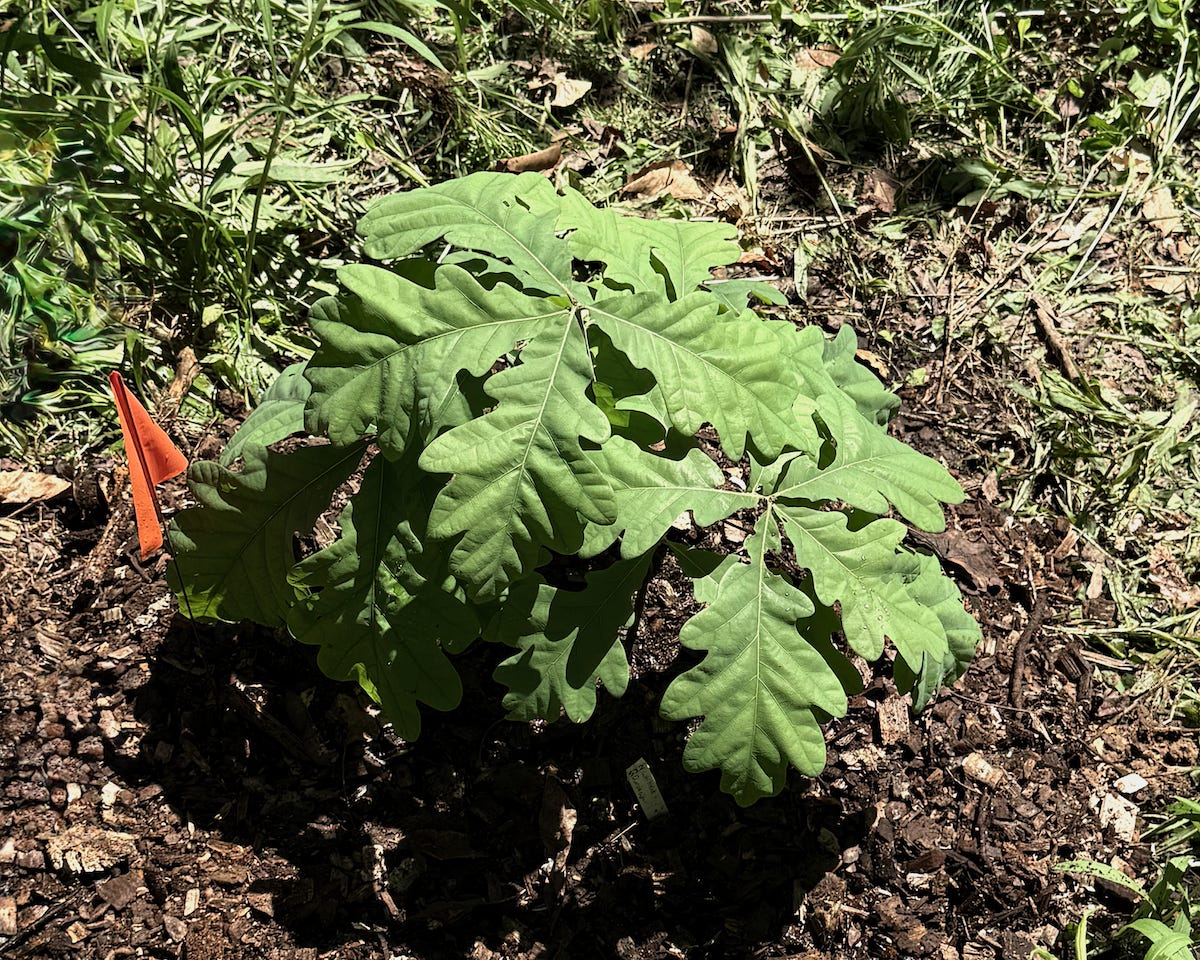
The reference to the “south 40” is a household joke about a part of our lot that is essentially left alone. 15 years ago our friend Ben created some swales there to help control the water run-off, and we planted a couple of plum trees and some berry vines, but one of the plums is the only survivor. In celebration of the 57th anniversary of our wedding, Pat and I gave each other an oak tree to plant.
It’s for the future. In coming years, I hope to provide additional photos of it as it grows. Ten years from now, should I live so long, it’ll probably be taller than I am; of course, it’s has the advantage not only of growing but also of me shrinking, so maybe 10 years is allowing too few growth periods.
It’s SET (teehee) in a pretty open area and, when it matures it should dominate that approximately 40-x-40 area of the yard. For securing the tiny oak and planting it properly, we are endebted to another friend, Phil, and an organization from the Beautyville area, the Charlottesville Area Tree Stewards.
Status update
Substack tells me that SET is edging up to 1200 subscribers, an increase of about 250 from 2025 at this time. About 8% of those folks provide monthly or annual donations to the cause s (i.e., “pay”). I thank them for helping to cover the costs associated with keeping SET going (licenses, fees, taxes, and such).
Part of the reason the community has grown is that SET pals interacted with the magazine over the past year. Y’all share posts, talk about SET with others, dropped comments, and more. I want to acknowledge some of the perpetrators of those actions.
Flashes of the electrons to Jennifer H., Clay K., Betsy T., Susan O., Joel M., Nancy S., and Dan H., who all provided comments last week. Thank you each for the contibutions. I appreciate the effort to engage in dialogue with me and with the larger community.
Appreciation to those who restacked posts and notes, including Kelly C.
Thanks to a few dozen of y’all for dropping “likes” on posts recently. It’s wonderful that you found some of the content worthy of “liking,” and I appreciate the feedback.
And a special flash to Betsy T., who shared repeatedly last week.
And serious shout-outs to Joel M., Ed P., Stephanie A.-O., Mack B., Dan H. (of course), and all the rest of you who sent me back-channel notes recently. I hope I responded to everyone’s messages, but if I failed to do so, here’s the missing message of appreciation.
Thanks to y’all who have followed @speciadedtoday. Most of you may know of by aversion to Twitter (more recently known as “X”), Facebook, and other so-called “social media.” I used to push messages to them, but I’ve let that slip in the last year or so. Still, if you’re on one of those platforms, please do not hesitate to talk about SET there. (I’d prefer that you say nice things, but any publicity is good publicity, I guess….)
Spedlettes (AKA “table of contents”)
If your only connection with SET is reading this newsletter, you are missing the “breaking news” (teehee) that appears on the Web site throughout the week. This newsletter appears once a week. I post messages to the Web site [https://www.specialeducationtoday.com] multiple times during the week. Sometimes, I push one of those posts out via the email list, but you can see them all if you regularly visit the site.
I was a little slack this past week. Sigh. But, the table of posts for the past week follows:
Special Education Today newsletter 5(43): This is only another update and it covers the week that began 20 April 2026
PBS News Hour reported on splitting ASD by severity: What did the eminent journalist Judy Woodruff explain about the question of sub-categories of autism?
Over diagnosis of autism: What problems might come from the rise in diagnosis of ASD?
E. Hanford interviewed D. Owen: What did the author of the New Yorker story on dyslexia tell Ms. Hanford?
Large-scale community treatment for mental health: Would a public campaign of brochures, games, radio shows, and more reduce stigma?
Friday catch-up notes—1 May 2026: What did we notice but didn’t write about this week?
Promoting spelling interventions for autism: A parent’s pushback: What does a well-informed parent have to say about promoting facilitated communication?
Be sure to check the SET Web site to keep current. You’ll find an HTML-formated version of this newsletter (much prettier than this funky version that comes in the e-mail) as well as any newer posts (and a link to archived posts, with some available to free subscribers and all available to supporting subscribers).
Commentary
I alluded to “Mothers’ Day” at the top of this newsletter. Here’s part of the reason, drawn from a post of 9 May 2020 by noted historian, Heather Cox Richardson:
If you google the history of Mother’s Day, the internet will tell you that Mother’s Day began in 1908 when Anna Jarvis decided to honor her mother. But “Mothers’ Day”—with the apostrophe not in the singular spot, but in the plural—actually started in the 1870s, when the sheer enormity of the death caused by the Civil War and the Franco-Prussian War convinced American women that women must take control of politics from the men who had permitted such carnage. Mothers’ Day was not designed to encourage people to be nice to their mothers. It was part of women’s effort to gain power to change modern society.
So, I want to deliver a shout out to all those mothers who, over the years, have sought to make changes to lead to a better world in which families can raise children and in which children can grow and learn in prosperous and peaceful environments.
And, I want also to provide a special shout out to the mothers of children with disabilities. Although there surely are some father-only families where children with disabilities grow and succeed, it most frequently the case that when we say, “children with disabilities and their families,” there’s a mother involved. Mothers of children with disabilities carry enormous burdens, often thanklessly.
Goodness knows, there are plenty of mothers among the readers of SET, including some who contribute to the commonweal through their own blogs. Some of those contributions are A Great Leap, Another Normal, Finding Cooper’s Voice, Lenore Eklund, Life Alongside Autism, Medical Motherhood, The Educated Parent, and other mothers' stacks. They provide a lot of insight into disability and special education, so I recommend them to readers of SET. And, let’s not forget the parent resources from Emily Oster and her team at Parent Data.
A few years ago, I published a post about one of my experiences as a teaching assistant. I remembered how Teddee Blumberg had the children in our make mothers’ day gifts for their own mothers. Here’s an excerpt from that post:
When I was a teaching assistant with Teddee Blumberg, I helped children to make gifts for their mothers. It was a sage and savvy activity. One year we had them make papier-mâché flowers; it was a multi-day project that required lots of fine motor activities—cutting the petals from newsprint; layering a few starch-soaked petals and then letting them dry overnight so that the flowers grew thicker every day; painting the three dimensional products; gluing a polished stone in the center once the flower had dried; affixing a pin assembly to a heavier weight piece of cardstock to serve as a stable backing and as a way to affix the product to clothing; and assembling the personally created flowers with the pin assembly. All the time we worked with the kids on making the parts of the Mother’s Day Pins (15-20 min a day), we promoted language development: We kept up a stream of questions for them about what they were doing and why they were doing it.
I hope those of you who are teachers can help your students to remember mothers for mothers’ day. And, of course, I hope that those readers who are mothers have a wonderful, joyous time with your children this coming mothers’ day.
I end here with familiar recommendations mothers and others: Wear your seatbelts (and encourage other passengers in your vehicle wear them, too). Wash your hands frequently. Prefer gathering in safe spaces. Get vaccinated and help others to do so. And, of course, teach your children well.
JohnL
SET Editor guy
Charlottesville
SET should not be confused with a product with nearly the same name that is published by the Council for Exceptional Children. SET predated CEC’s publication by decades. Despite my appreciation for CEC, this product is not affiliated with that organization.