
Readiness tips from the American Medical Association
What does the pediatrics group of AMA recommend to parents?

Writing in JAMA Pediatrics under the headline, “What Parents Need to Know About Kindergarten Readiness,” Clare C. Cross, Katherine A. Poehling, and Lindsay A. Thompson (2016) provided recommendations for parents about understanding kindergarten readiness. They emphasized the importance of aspects of development beyond knowing the alphabet and numerals. Here’s a paragraph from their introduction:
Kindergarten readiness is when a child begins school prepared and ready to learn. It involves much more than knowing letters or numbers. Kindergarten readiness includes basic social skills, like taking turns and sitting still to hear a story. It also includes a child’s ability to manage their emotions and understand early learning concepts like letters, numbers, and shapes. Expectations for kindergarten readiness can vary. Your child may complete an assessment before or at the start of kindergarten to help teachers understand their development across different areas. These assessments help guide instruction to the strengths and opportunities for growth for the children in that class.
The article included a graphic emphasizing key points.
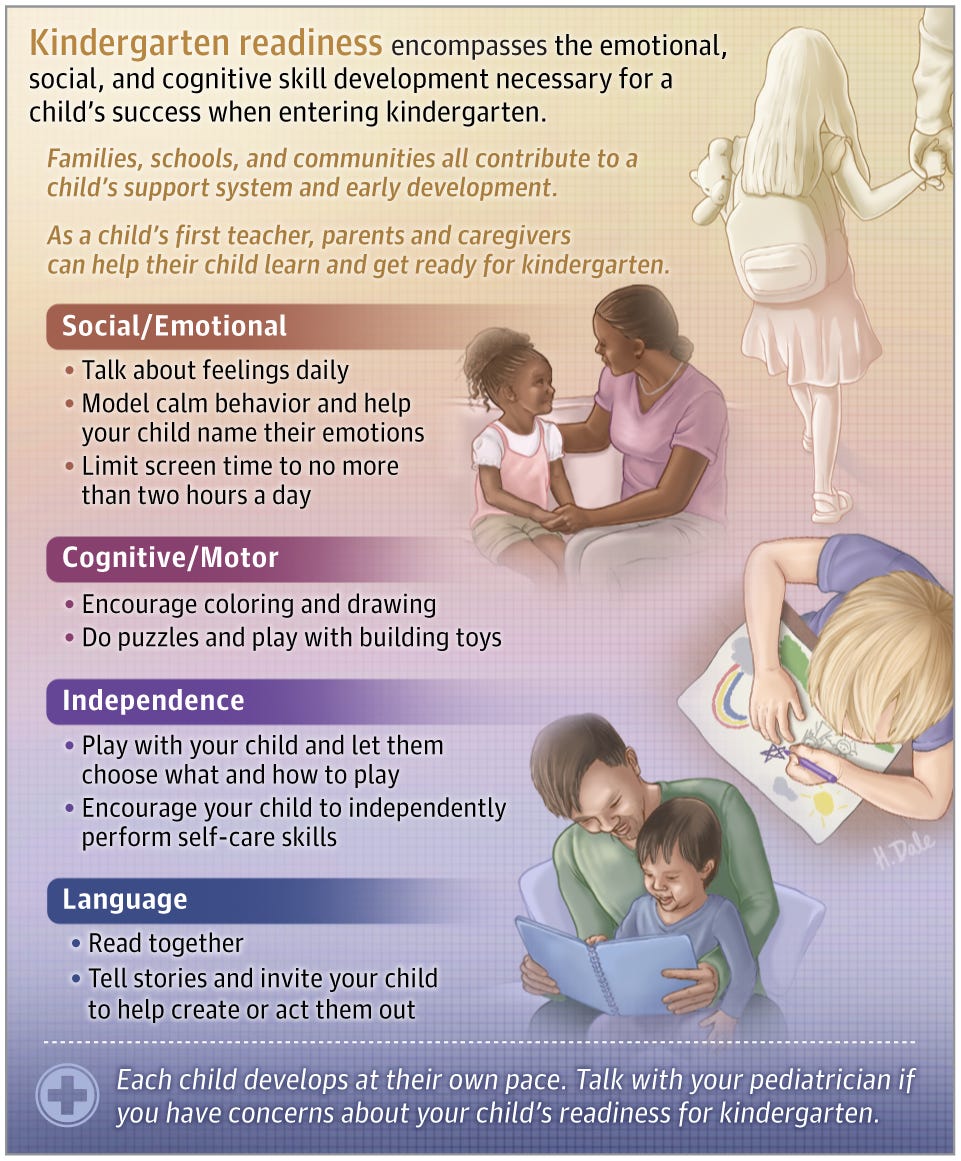
Professor Crosh and her colleagues are correct in emphasizing “readiness” beyond the traditional “ABCs.” Other broad aspects of development—social-emotional competence—merit consideration.
Additionally, as Dear Readers of Special Education Today might anticipate, I wish the authors had told their audience (which I suspect is pediatricians, not actually parents; I doubt many people other than MDs read JAMA Pediatrics) a couple other important ideas:
“Readiness” for children with disabilities may be a bit different.
Pediatricians should support parents of students with disabilities in working with their local education contacts for their children’s education plans for kindergarten (in the US this is the Individualized Family Service Plan).
Pediatricians should support evidence-based efforts to ensure that kindergartens are ready for kids, including our kids. Locating “readiness” as a property of children is bassackwards. Kids are going to come to kindergarten with greater and less competence in virtually every dimension that Crosh et al. (2026) discussed, and schools need to be prepared to adapted to that broad range of abilities—and disabilities.
Reference
Crosh, C. C., Poehling, K. A., & Thompson, L. A. (2026). What parents need to know about kindergarten readiness. JAMA Pediatrics. Published Online: June 29, 2026. https://doi.org/10.1001/jamapediatrics.2026.2467