

Paige C. Pullen, in conjunction with the Evidence Advocacy Center, published a book entitled The Canon of Literacy: A Three Sciences Framework in July 2026. It is a book about literacy that does not advance one or another of the popular perspectives on reading. Instead, it is a book that integrates evidence and reason from multiple perspectives, creating a unified whole from literatures of teaching, learning, and development. It is a book that I hope has salutary effects on the practice, study, and discussion of reading and language arts.
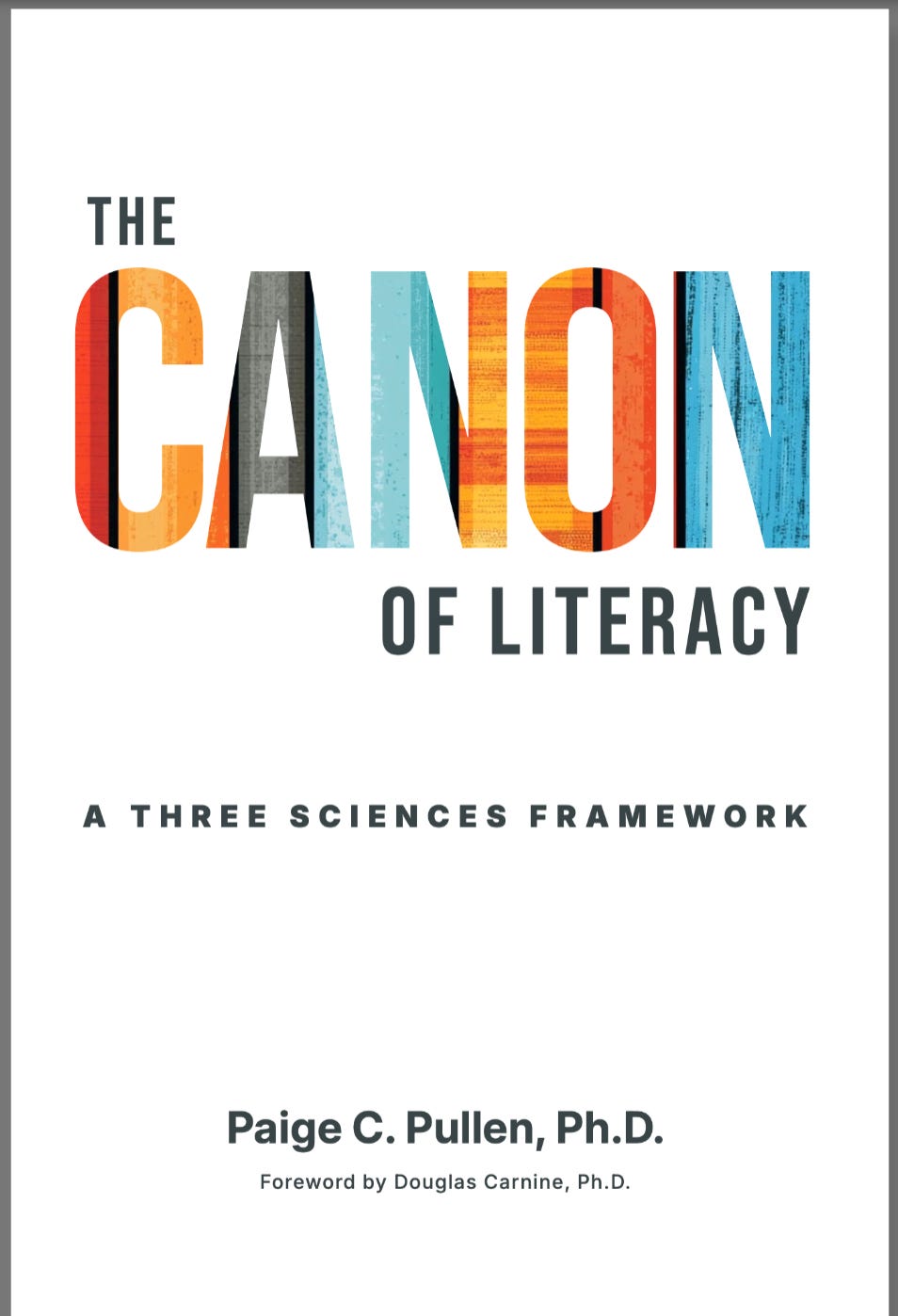
For all that has been written about literacy, there are few books that have had lasting influence on the study and practice of instruction in reading. Two of those—Jeanne S. Chall’s (1967) Learning to Read: The Great Debate and Marilyn Jager Adams’s (1990) Beginning to Read: Thinking and Learning about Print— have become rightfully honored as books that anyone who professes to know about literacy should have on her bookshelf. Both of those drew heavily on empirical research and both focused primarily on early literacy—decoding. Paige’s Canon will deserve that same honor because it cleaves closely with evidence and scientific understanding—and it offers the bonus of covering literacy more broadly, delving into comprehension, connections with written expression, and more.
This is not a dense, academic tome. Paige knows and explains complex concepts in prose that is accessible to normal human beings. It is only 260 pages.
Paige sent me a note the night of 17 July 2026 with the subject line, “The Canon is out!” She did not have to tell me more. I understood right away. She had provided me with a manuscript version a few months earlier. Now I am eager to get a copy of the finished product.
Check out the EAC’s announcement of The Canon. I understand that other organizations (e.g., Deans for Impact) will be promoting the book.
As a publication of the Evidence Advocacy Center, it is probably no surprise that there are familiar names associated with The Canon. Doug Carnine wrote the foreword and Linda Diamond contributed to the content. The EAC is making The Canon available via Amazon: https://www.amazon.com/Canon-Literacy-Three-Sciences-Framework/dp/B0H8FJCZK6/.1
If you haven’t already figured it out, let me state it bluntly: People should get this book, read it, and integrate it into their study, practice, and talk about literacy.
Footnote
I receive no compensation from Amazon or the EAC for publishing this link nor for purchases of the book.
You are welcome, Paige. It's a wonderful achievement, and I hope your goals will reached rapidly!
Thanks for coming by SET and dropping a comment!
Thank you for your kind words, John! My goal is that it will be relevant to all educators and ultimately lead to improved outcomes for students!