

In the late 1970s and early 1980s, along with at least a dozen other colleagues, Dan Hallahan and I collaborated on studies of self-monitoring or -recording. We conducted single-subject studies (“single-case” is the more popular term these days) in actual classrooms, testing how self-recording affected students’ attention to task and academic productivity.
There were some theoretical angles to these studies, but each one documented a readily implemented classroom practice. Said, another way: These were not lab studies requiring spin and interpretation to determine their implications for teaching. They were educational practices employed by real live teachers in public schools.
As is the wont of researchers, we published largely inaccessible academic reports about the research, and we also talked about our findings at conferences. After the first half-dozen or so studies, we found ourselves repeatedly explaining to teachers and other practitioners in conference audiences how to implement the procedures. Realizing that practitioners weren’t interested in wading through dry reports of studies littered with citations and obscure language, in the fall of 1981 we decided to create a how-to document. So, along with Laura Stoller (a post-doc at the time), we wrote Improving Attention With Self-Monitoring: A Manual for Teachers (Hallahan et al., 1982).
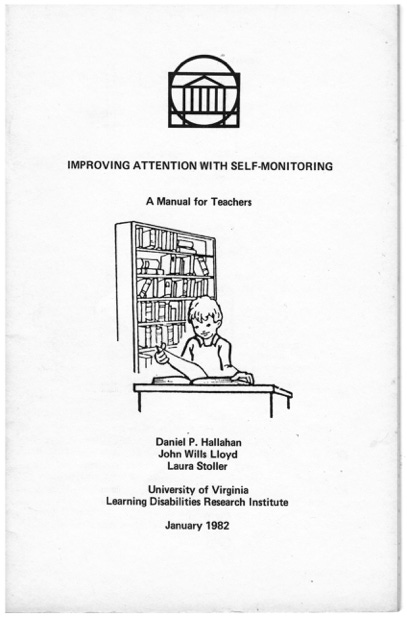
As a part of our dissemination efforts, we gave them away to pretty much anyone who asked for a copy. Initially we printed a few 100, but we quickly needed a few 100 more…and more and more. This was in the days before e-mail, so Sharon Hall was sending printed copies to people via snail mail. Because he was the project director (therefore, he had to monitor the costs), Dan likely has a better idea than I do of how many we printed and sent to those who requested copies. I’d guess it was maybe a couple 1000.
When we ran out of funding, we couldn’t print additional copies. So we photocopied the manual and sent those copies to folks. I don’t get requests for it these days. However, in a way, it lives. The process has been used with students across ages, disability categories, educational situations, and lots more. Self-recoding is in the repertoire of lots of teachers. People are still studying the process (see, e.g., Scheibel et al., 2024; Sulu et al., 2022) and recommending its use (Ryan & Mooney, 2024).
Perhaps I ought to return to the topic of self-monitoring and self-recording in a later post.1 Research shows, for example, that it not only “works,” but that there are better and worse ways to do it. If people use the worse ways, they may come away saying, “Oh, yeah. I tried that. It didn’t work.”
By the way, if you want to snag. your very own copy of the original manual, there’s a link in the Hallahan et al. (1982) reference that will take you to a site where it is available for free…just look through the titles at Special Education Resources Dissemination and download the appropriate PDF.
References
Hallahan, D. P., Lloyd, J. W., & Stoller, L. (1982). Improving attention with self-monitoring: A manual for teachers. University of Virginia Learning Disabilities Research Institute. Available from https://doi.org/10.17605/OSF.IO/U9JA5
Ryan, J. B., & Mooney, P. (2024). The special educator’s guide to behavior management. Routledge.
Scheibel, G., Zaeske, L. M., Malone, E. J., & Zimmerman, K. N. (2024). A meta-analysis of self-management interventions for students with ASD. Research in Autism Spectrum Disorders, 110, 102294. https://doi.org/10.1016/j.rasd.2023.102294
Sulu, M. D., Martella, R. C., Grimmet, K., Borosh, A. M., & Erden, E. (2022). Investigating the effects of self-monitoring interventions with students with disabilities on the maintenance and generalization of on-task behavior: A systematic literature review. Review Journal of Autism and Developmental Disorders, 10, 458–476 (2023). https://doi.org/10.1007/s40489-022-00304-y
Footnote
We have another, more-recent study that we should publish. I’ll post about it when it’s available.