
Measuring self-injury using wearable devices
Can advances in technology help address self-injurious behaviors?

Imagine that one could use a simple wearable device to assess the occurrence of a problem behavior such as self-injury. Instead of having to conduct labor-intensive and fallible live observations of the behavior, one could have an accelerometer or a gyroscope detect sudden body movements that were part of child banging her head or hitting himself. Getting good data on such behavior should be helpful in conducting functional analyses and the subsequent development of behavior plans. And, according to a review by Patrick Romani and colleagues (2026), many research teams are working on using wearable technology for measuring behavior among neurodivergent individuals.
But, are such data trustworthy? How do the data compare to data collected using more traditional methods? Leslie Neely, Katherine Holloway, Samantha Miller, Karen Cantero, Adel Alaeddini, and Sakiko Oyama (2025) examined the data used in conducting FAs with three children with autism who hit themselves. They compared observational data that they collected using (three methods: (a) “clinical grade” assessment (live, direct observation), (b) “research grade” assessment (frame-by-frame analysis of video recordings), and (c) accelerometers. The accompanying figure from the report by Neely et al. shows the different conditions.
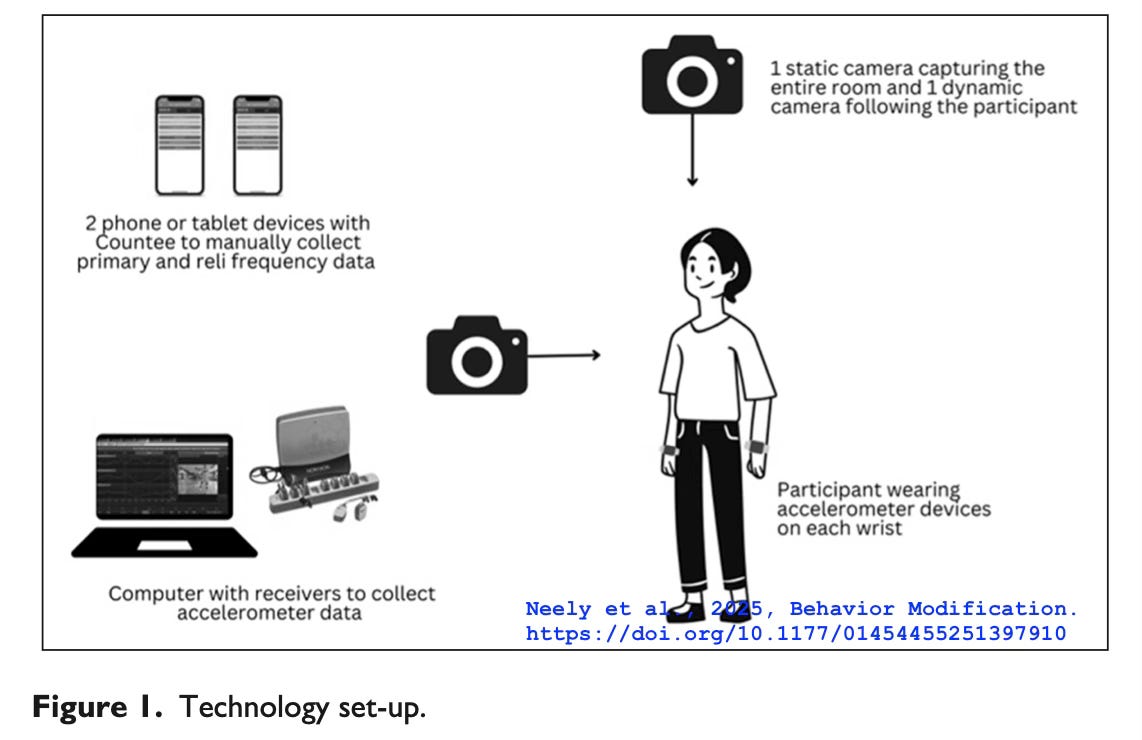
The researchers found that the wearable accelerometer data corresponded with the data from the clinical and research grade assessments. They reported that the sensitivity (accurately capturing true occurrences of the behavior) and specificity (accurately capturing true non-occurrences of the behavior) were high. And they also reported that identification of the controlling factors in FA’s using the data from the different sources matched closely.
Neely et al. concluded that their study
study highlights the promise of wearable technology, specifically accelerometers, in supplementing and potentially automating the measurement of self-hitting behavior during functional analyses. The high reliability of the accelerometer data with the research-grade data set underscores the potential utility in FAs. Despite some errors, the accelerometer data also facilitated accurate function identification for the participants. These findings support the integration of wearable technologies with traditional behavior analytic methods to enhance the precision and generalizability of measurement.
They also followed the rules for full-employment of researcher. calling for additional research. Those interested in directions for further research could combine the recommendations of Neely et al. (2025) and Romani et al. (2026).
References
Neely, L., Holloway, K., Miller, S., Cantero, K., Alaeddini, A., & Oyama, S. (2025). Wearable Technology to Measure the Occurrence of Self-Injury During a Functional Analysis. Behavior Modification, 01454455251397910. https://doi.org/10.1177/01454455251397910
Romani, P. W., D’Mello, S. K., Moulder, R. M., & Berkowitz, L. N. (2026). Using wearable technology to predict the occurrence of severe behavior problems among neurodiverse individuals: A systematic review. Perspectives on Behavior Science, 1-23. https://doi.org/10.1007/s40614-026-00497-1