

Publishing in the journal Single Case in the Social Sciences, Noan Bräuer of the University of Cologne Department of Special Education and Rehabilitation, reported a study about the effects of a reinforcement procedure on the writing of students with reading and writing difficulties. Professor Bräuer tested whether giving students a combination of explicit timing, immediate feedback, and positive reinforcement affected how many words they wrote in regular essays. To my reading of the study, “A Motivational Writing Intervention: Exploratory Observations on Elementary Students’ Text Length,” he found some modest evidence of benefits. Although they are not stunning, these results are worth considering because of both the history and familiarity of the intervention.
Here is the abstract of Professor Bräuer’s report:
This single-case study, employing an ABA design, examined the effect of combined motivational methods on the length of stories written by six elementary school students with reading and writing difficulties. The intervention comprised explicit timing, immediate feedback, and positive reinforcement. Although these methods have shown promising results in other academic domains, evidence for their effectiveness in German-language writing tasks and for specific ages and grade levels remains limited. This gap motivated the present small preliminary study. Three girls and three boys in third and fourth grade participated. The study used a preplanned number of baseline and intervention sessions, resulting in 10 planned data collection sessions for each child. The dependent variable was the total number of words written in response to a randomly selected story prompt. Results indicate changes in the total number of words written that coincided with phase transitions, with mostly higher values during the intervention phase and visual phase-separability across participants. These observations are interpreted in light of the study’s exploratory design and lead to recommendations for further research to evaluate the robustness and generalizability of any potential intervention effect.
The following screen grab is an image of some of the results from the report from Professor Bräuer. It shows the results of the intervention on three of the individual students. The “A1” and “A2” parts of the data are essentially the “baseline” conditions. During the “B” measurements, the explicit reinforcement procedures were in effect.
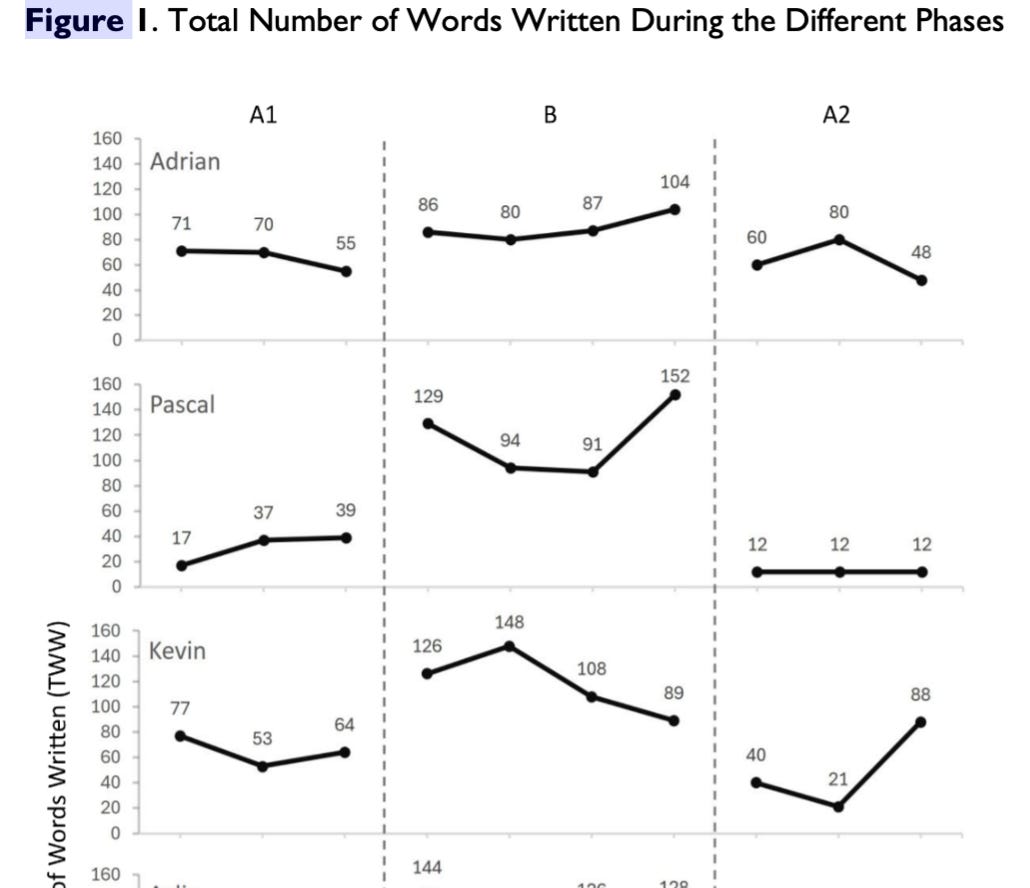
I see these changes as modest. The differences between the A, B, and A phases for Pascal look good. The results for Kevin are sorta-kinda-modest; I can see an up and down pattern that might just be the variation (rise and fall) shown over a longer time period. The data for Adrian are also (and perhaps more so) like they may reflect “normal” up and down over time.1 I encourage readers to go to the original article and review the data themselves.2
Professor Bräuer appropriately hedges on the findings of his study. Note the phrasing of “mostly higher values during the intervention phase.” Elsewhere in the manuscript there are additional caveats.
As is my wont, I am a bit reluctant to go up the scale or hierarchy of ideas from the actual measurement procedures and the manipulation of the variables to higher-order concepts like “motivation.” I know that those higher-order concepts are very important in the hot-pop world of cognitive psychology, but I encourage us to stick with the operational and objective facts. In this case, the teachers performed some fairly specific acts and the level of students’ writing changed (or didn’t). The spin masters will talk about the meaning of those specific actions and kick the discussion into a much bigger arena (“see, reinforcement [works | doesn’t work] , so there!”).
Got it? “Modest differences in writing behavior are caused by motivation.” Let that conclusion filter through our preconceptions, our individual prejudices. Does it confirm anyone’s bias?
I understand that conducting and reporting these sorts of studies requires lots of work. I don’t want to demean the effort that went into this one. As usual, however, I encourage us to consider it as just one study in a broad distribution of many studies. Just as we shouldn’t make too much of any one data point in the data path of a single-subject study, we shouldn’t assign too much importance to any one study.
Professor Bräuer’s study is a valuable contribution to the literature about teaching writing. It helps us understand more about the relationships between teachers’ actions and students’ outcomes. It surely is not the definitive demonstration that teachers should adopt specific practices, nor is it a clear revelation of what not to do.
The study is simply an analysis of what happened under these conditions at this time with these student sand teacher. That is, in and of itself, valuable.
Footnotes
Perhaps this analysis is too dense. Maybe I should create a series of posts about analysis of single-subject research. I have the notes some where on some hard drive….
And, let me take this opportunity to applaud Single Case in the Social Sciences for publishing an open-access journal. Whereas many journals in education, psychology, and similar fields are published by commercial businesses that must make profit and, therefore, use paywalls (hello, SET!), there are a few journals that are making their articles accessible to anyone. SCSS deserves credit for providing access to its articles/