
Course on analyzing education goals
What can teachers, clinicians, and others learn from a free mini behavior analysis program?

Professor Catherine L. Williams, a behavior analyst in the Psychology Department at the University of North Carolina Wilmington, is offering am online course to help educators and clinicians behavior analytic skills in analyze educational goals that leads directly to means of measuring behaviors and designing instruction to teach them. The content of the course looks like it should be of clear value to readers of Special Education Today. Here is a flyer Professor Williams distributed:
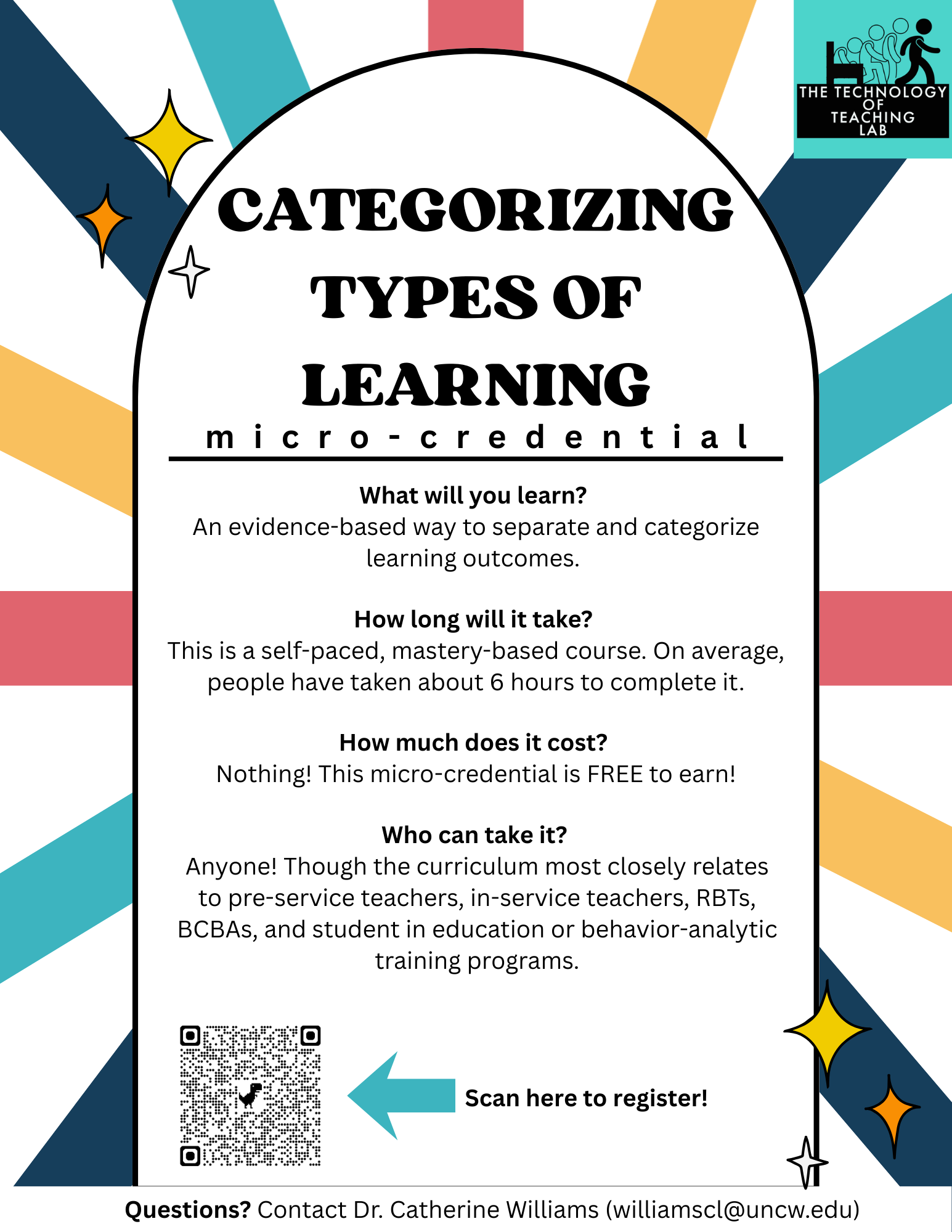
If one follows the QR code on the flyer, one can find the catalog description of the course. Here’s how it reads:
Categorizing Types of Learning to Facilitate the Design of Instruction
Teachers (and other skill builders) often receive instruction on how to identify education goals, but less instruction on how to program instruction to accomplish those goals. This may lead teachers to use inferior strategies for instruction that do not reliably produce the learning outcomes they desire, resulting in stressful trial and error filling the limited time they have for lesson planning or the continued use of less effective lessons. The first step to supporting teachers to use effective instruction for their students is teaching them to deconstruct and categorize their education goals in a way that will directly tell them how to measure and teach them. Ultimately, this categorization system improves upon other more commonly used approaches for learning taxonomies (e.g., Bloom’s Taxonomy). The approach taught through this micro-credential is uniquely useful because each category directly relates to specific instructional strategies. The purpose of this microcredential is to prepare teachers to use this categorization system to inform the instructional design of their courses.
I encourage SET readers to review the offering. Note that it is brief, offered on-line and asynchronously, and free. That sounds pretty attractive, no?
I have not yet had an opportunity to review the course itself. However, it not only sounds intriguing but other evidence leads me to believe that Professor Williams is working from very strong evidence in designing this course. She has published multiple studies in leading behavior analysis journals (Williams & Roop, 2025; Williams & St. Peter, 2020; Williams et al., 2024) that examine aspects of instructional design that I consider quite important such as not-examples.1
I also note that the course is offered through UNCW’s Osher Lifelong Learning Institute. There are OLLI programs at many institutions around the US. I am planning to offer a one-session class in the fall of 2026 through the University of Virginia’s OLLI.
References
Williams, C. L., & Roop, J. C. (2025). Instruction consisting of a rule and set of examples and nonexamples reliably teaches concepts. Journal of the Experimental Analysis of Behavior, 124(3), e70061.
Williams, C. L., & St. Peter, C. C. (2020). Resurgence of previously taught academic responses. Journal of the Experimental Analysis of Behavior, 113(1), 232-250.
Williams, C. L., St. Peter, C. C., & Murphy, M. J. (2024). Bridging the gap: Evaluating a fusion of procedures for conceptual learning. Experimental Analysis of Human Behavior: Bulletin, 35(Special Issue).
For background, see the SET post, “The power of examples.”