

Some readers will know that there is extensive marketing of cannabidiol or CBD as a therapeutic for many different problems afflicting we humans. Some recommendations include treatment of anxiety. According to an article on MedicineNet by two MDs, Jasmine Shaikh and Pallavi Suyog Uttekar, for example, CBD has many potential uses.
In “What Does CBD Do to You?.” they wrote
Cannabidiol (CBD) acts on the brain’s serotonin receptors and releases feel-good chemicals, helping elevate mood. However, research is underway to investigate how CBD does this, as the exact mechanism of action is not conclusive.
Because of its serotonin-boosting effect, CBD may be able to help people with psychological issues, including:
Chronic anxiety disorder
Post-traumatic stress disorder (PTSD)
Panic disorder
Depression
Insomnia
Drs. Shaikh and Uttekar are careful to say that there is need for more evidence. “Despite the many claims regarding the health benefits of CBD oil, not every claim has sufficient evidence to back it up.” Not all people who recommend CBD are so circumspect—just check the intertubes for illustrations.
Background studies
Fortunately, there have been studies. Indeed, there are enough studies that researchers have conducted meta-analyses (although their integrative reviews are predicated on a limited literature of fewer than a couple of dozen reports).
Carly Coelho and her colleagues (2024), in “The Impact of Cannabidiol Treatment on Anxiety Disorders: A Systematic Review of Randomized Controlled Clinical Trials.” concluded that “the data suggest that CBD may reduce anxiety with minimal adverse effects when compared to a placebo.”
Kevin Han and his colleagues (see “Therapeutic Potential of Cannabidiol (CBD) in Anxiety Disorders: A Systematic Review and Meta-analysis”) reported that their findings “suggest that CBD may be particularly effective in reducing subjective anxiety symptoms associated with SAD.”
Although there are strengths in these literature reviews,1 it is important to note that (a) their conclusions are not terribly strong about the clinical benefits of CBD and (b) their limited samples of studies did not allow them to assess effects on children youths. They were dang near required to use weasel words (“may” or “suggest”) in their reports. Because they cannot quite make definitive statements, they have to hedge a bit. And they do not provide guidance about our kids.
A focused study
Daryl Efron and his team (2026) from The Royal Children’s Hospital in Victoria (AU) reported the results of a study that is more specific to the interests of readers of Special Education Today. Following along on an earlier study (Efron et al., 2021), in the present study they conducted a well-designed evaluation of the benefits of CBD for children and youths (6-18 years) who had a diagnosis of intellectual disability.
They randomly assigned 131 participating individuals (mean age ~11 years; about 75% males; 84% with a diagnosis of autism) to either active or placebo conditions and did not disclose which children were getting placebo or CBD to kids, their parents or caregivers, or the researchers until after the evaluation was completed. The had the CBD (or placebo) administered according to a specified schedule for dosage that was predicated on participants’ characteristics (e.g., weight) and prior research.
To assess whether there were benefits, Efron et al. (2026) asked parents to complete rating scales, the Aberrant Behavior Checklist. The ABC was developed by Michael Aman and Nirbhay Singh2 in 1986 as a means of assessing treatment outcomes; it has strong psychometric properties and has been used widely by researchers. It is, however, a checklist completed by others, so it is at least one step removed from actual behavior; it is interpretation—it tells us what someone says about actual behavior.
Using the ABC, the researchers collected parents’ reports about children’s irritability at multiple times throughout the study (pre, post, follow). After the first 8-week implementation of the therapy, the researchers found a drop in the irritability scores for the children. However, they found no difference between the average scores of the children who received CBD and those who received the placebo. The follow-up did not show benefits, either. I created a graph (thank you, ChatGPT) using the data that Efron et al. (2026) reported. Here is that graph. It shows the pre and post scores for the CBD group (blue) and the placebo group (yellow) as normal curves.
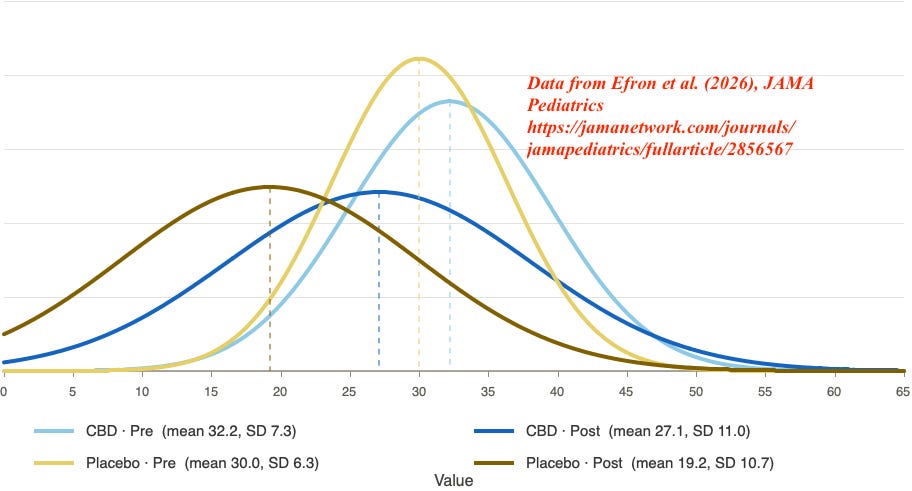
Looking at this study, my take away is pretty simple. “When you see someone hawking CBD for reducing anxiety and behavior problems for kids with ID, ask them about the proof that it ‘works.’” It looks like the benefits are in the eyes of the beholders. Everyone got lower anxiety scores just from pre- to post-assessment. Maybe just knowing your child is getting this therapy causes parents to see improvements?
That’s great, if the improvements are grounded. To determine whether the results were grounded will require additional research. We need objective data about changes in child behavior. Until then, based on this study, we can only say that CBD was no more beneficial than placebo.
References
Aman, M. G., & Singh, N. N. (1986). Aberrant Behavior Checklist manual. Slosson.
Coelho, C. D. F., Vieira, R. P., Araújo-Junior, O. S., Lopes-Martins, P. S. L., Dos Santos, L. G., Dias, L. D., de Sá Filho, A. S. Leonard, P. S., Dutra e Silva, S., & Lopes-Martins, R. A. B. (2024). The impact of cannabidiol treatment on anxiety disorders: A systematic review of randomized controlled clinical trials. Life, 14(11), 1373. https://pubmed.ncbi.nlm.nih.gov/39598172 https://doi.org/10.3390/life14111373
Efron, D., Freeman, J. L., Cranswick, N., Payne, J. M., Mulraney, M., Prakash, C., Lee, K. J., Taylor, K., & Williams, K. (2021). A pilot randomised placebo‐controlled trial of cannabidiol to reduce severe behavioural problems in children and adolescents with intellectual disability. British Journal of Clinical Pharmacology, 87(2), 436-446. https://doi.org/10.1111/bcp.14399
Efron, D., Taylor, K., Freeman, J. L., Cranswick, N. E., Elliott, E. J., Payne, J. M., Lee, K. J., Moore, C. L., Rice, L. J., Davidson, A. J., Prakash, C., Mihalopoulos, C., Chatterton, M. L., Trollor, J. N. Dossetor, D. R., Mulraney, M., Einfeld, S. L., & Williams, K. J. (2026). Cannabidiol for severe behavioral problems in youths with intellectual disability A randomized clinical trial. JAMA Pediatrics. https://jamanetwork.com/journals/jamapediatrics/fullarticle/2856567
Han, K., Wang, J. Y., Wang, P. Y., & Peng, Y. C. H. (2024). Therapeutic potential of cannabidiol (CBD) in anxiety disorders: A systematic review and meta-analysis. Psychiatry Research, 339, 116049. https://www.sciencedirect.com/science/article/pii/S0165178124003342

Footnotes
I taught a course on integrative literature reviews for advanced graduate students for probably something like 15-20 years. (When talking among themselves, the students sometimes called it “the meta class.”) Thus, I claim the authority to make evaluations about the quality of such studies.
I have collaborated with Nirbhay Singh on multiple products since the 1980s. I mention this connection in the spirit of openness. I did not have any more than a casual connection with the development of the ABC. I make no money from its use nor from mentioning it here. If you would like a list of Nirb’s and my collaborations, send me a note and I’ll send you references.